Practice
How We Work
Confidentiality
Client work is private. The practice does not disclose client names, display client logos, or publish case studies drawn from engagements. Information learned during an engagement is used for that engagement and stays within it. This applies to documents and conversations, as well as the context behind management decisions. Outside these disciplines, client information is disclosed only with the client’s authorisation, through tools and providers agreed in the engagement documents, or where the law requires it.
The practice does not publish client stories or turn client work into marketing. Research published by the practice is kept separate from client work and is built from public sources, not from client material.
Independence and conflicts
The practice is independent of transaction outcomes. It does not accept success fees or other compensation tied to whether a financing, listing, acquisition, approval, or market entry succeeds. It neither pays nor receives referral fees, and all work is delivered under its own name. Whoever pays for the work, the conclusions are reached on the evidence and are not adjusted to suit the paying party.
Potential conflicts are considered before work is accepted. The proposed client, material counterparties, transaction context, and relevant audiences are checked against current and recent engagements. Where the work comes through one of the company’s advisers, that relationship is included in the check. If an overlap could impair independent judgment or create a reasonable confidentiality concern, the issue is addressed before substantive materials are shared. The engagement may be declined or narrowed where necessary.
Information handling
Transaction materials are not treated as ordinary business correspondence. Within the practice, access to client materials is limited to the practitioner responsible for the engagement. Working copies are kept in designated locations rather than moved across accounts or services for convenience.
Specific handling requirements, including transfer methods and any client-side controls, are agreed for each engagement.
How client materials are protected
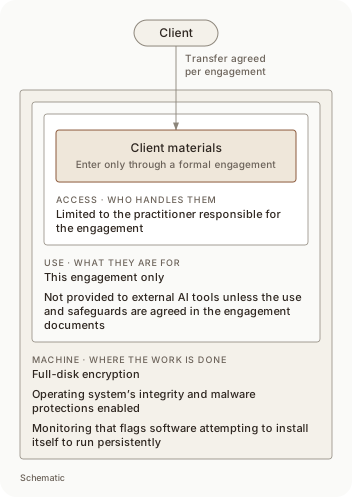
Non-public materials enter the practice only through a formal engagement; the Cross-Border Perception Memo is built from public sources and accepts no internal materials.
Access to client materials is limited to the practitioner responsible for the engagement. The materials are used only for that engagement. They are not reused in another client’s work, published as research, or turned into marketing, and they are not provided to external AI tools unless the proposed use and safeguards have been agreed in the engagement documents.
Client work is done on a machine with full-disk encryption and the operating system’s integrity and malware protections enabled. The machine also has monitoring that flags software attempting to install itself to run persistently.
Transfer methods and any additional client-side controls are agreed for each engagement.
Public-source research
Published research and market observation are based on the public record, including filings, official statements, and reported coverage. Those sources are used to examine what information was available, which descriptions circulated, and how an issue was framed.
Public evidence has limits. It may show how a company or transaction could reasonably be understood from the outside. It cannot establish what an investor, regulator, partner, or journalist privately believes. Published work distinguishes documented evidence from analytical interpretation and does not claim access to private audience views.
Client-provided materials
Materials supplied by a client are used only for the engagement for which they were provided. They are not reused in another client’s work, added to public research, published, or turned into marketing. The same boundary applies to information obtained in meetings and to context that may not appear in a formal document.
Client materials help the practitioner understand the specific company and decision at hand. They do not become a library of examples for future engagements.
AI-assisted research and human judgment
Everything the practice sends or publishes is signed by the practitioner, who reads every word before it goes out and remains responsible for all of it, including the correction of any errors.
The practitioner sets the standards each piece of work must meet. AI tools retrieve and organize public sources, compare claims across documents, draft text and challenge the analysis. The practitioner then accepts, revises or rejects that work against those standards. Nothing is stated as fact because a model said it: claims from the public record are checked against their sources, and every conclusion can be traced to its evidence.
Client materials are not provided to external AI tools unless the proposed use and safeguards have been agreed in the engagement documents. Without that agreement, client content remains outside those tools. The specific tools and safeguards for an engagement are recorded in the engagement documents.
For a fuller account of how this division works, see Judgment Is Not Ratification.
Professional-role boundaries
The practice provides strategic advisory in Cross-Border Identity Architecture. It does not provide legal advice, deal structuring, valuation, audit, brokerage, or regulated investment services. It does not execute media relations or investor outreach.
Lawyers remain responsible for legal advice and filings, banks and financial advisers for transaction and valuation work, and investor relations and communications advisers for channel strategy and execution. The practice contributes the identity framework their work can build on; their judgment and their duties stay their own.
Working with legal, banking, and communications advisers
Before transaction documents and external communications take final shape, the practice gives management and existing advisers a shared identity framework. Each workstream can use that framework in its own work while applying its own professional judgment, without adopting the same language or approach.
The practitioner explains the framework and works with management and adviser teams to see where their materials diverge from it. Discussion may be coordinated on the narrative layer, within the practice’s agreed scope. This does not mean managing or approving the work of other advisers, and it does not alter their professional responsibilities. Each adviser remains accountable for its own advice and execution. The client retains decision authority.
Records
Engagement records are kept while they are needed for the work or while agreed recordkeeping requirements apply. When neither applies, the records are disposed of rather than retained by default.
Specific commitments belong in the engagement documents, where they can reflect the sensitivity and practical needs of the matter.
Contracts govern
This page describes how the practice ordinarily works. The binding terms of an engagement, including confidentiality, information handling, use of tools, record retention, and scope, are those set out in the documents both parties sign or, for the standalone memo, the short agreement both parties confirm. If such an engagement document differs from this page, that document controls.