What Public Information Can and Cannot Establish About Narrative Risk
Public sources establish what was said and in what order. They rarely establish what an audience believed or what caused an outcome. This page marks the limit.
Method note. This page defines the evidence discipline that governs every public analysis published on this site. The method is described at Narrative Power Analysis (NPA): What It Is and What It Is For; the Studies apply the discipline case by case. Its limits are stated here once, in full.
In March 2023, the Delaware Superior Court considered two different bodies of evidence in a defamation case involving Dominion Voting Systems and Fox. One was public: months of national broadcasts in which election-fraud claims were aired, repeated, and defended. The other emerged during litigation discovery: private messages in which some of the same people described those claims with open disbelief.
The court resolved several elements on summary judgment. It held that the challenged statements were false and that Fox News Network had published them. It did not decide whether the people responsible had acted with actual malice. That question concerned individual states of mind, which could be proved through direct or circumstantial evidence. Discovery yielded evidence bearing on the question, but material factual disputes left it for a jury (Dominion v. Fox, Delaware Superior Court summary-judgment opinion, Part V.A-D, pp. 37-64).
The distance between public evidence and the claims it can support is the subject here.
The public analyses published on this site work from the public record. They examine what a company and the institutions around it have stated, the categories third parties use to describe the company, and what observable actions accompany those statements. They do not interview a company’s regulators, poll its investors, or observe its internal deliberations. This leaves a narrower question: which claims can such evidence carry?
Four different questions
Claims about narrative risk fall into four questions. The public record can answer some far more directly than others. The four stand in order: each is carried less directly by the public record than the one before it.
The record. The first question concerns the record itself: what was stated, filed, published, repeated, corrected, or visibly done. Public information answers it directly. A filing can be quoted; a press conference has a date. A third party’s description of a company either exists in print or it does not. Claims at this layer are checkable by anyone using the same sources, and we write them so that checking is easy.
Support. Next comes what the record supports: whether an adverse reading of the company is easy to assemble from what is publicly available. Here the method moves beyond observation into bounded inference. That is its proper scope. Narrative risk, as we use the term, exists when a company’s public trail makes an adverse reading easy to assemble, well supported, and portable from one institution to the next. That condition can be demonstrated from sources. Whether any audience has adopted the reading is a separate matter.
Uptake. Whether a particular investor, regulator, bank, or journalist has adopted the adverse reading is the third question, and public information answers it only when the audience has spoken or acted in public. A published analyst note, a hearing transcript, a vote, or a formal objection can serve as reception evidence. Silence is not. Hall’s encoding/decoding model makes the narrower point: a text can make one reading easier without determining how any particular reader will understand it (see Stuart Hall, “Encoding/Decoding”).
Effect. Hardest of the four is causation: whether the adverse reading produced a delay, a discount, a refusal, or a failed deal. Outcome and interpretation are separate observations, and decision-makers rarely publish their actual reasons. Sequence can be established. Causation cannot be inferred from sequence alone.
Most overclaims in this field are category errors between these layers: treating a reading supported by the record as evidence of audience belief, or a documented belief as proof of causation. The rule here is to make clear, sentence by sentence, which layer a claim occupies.
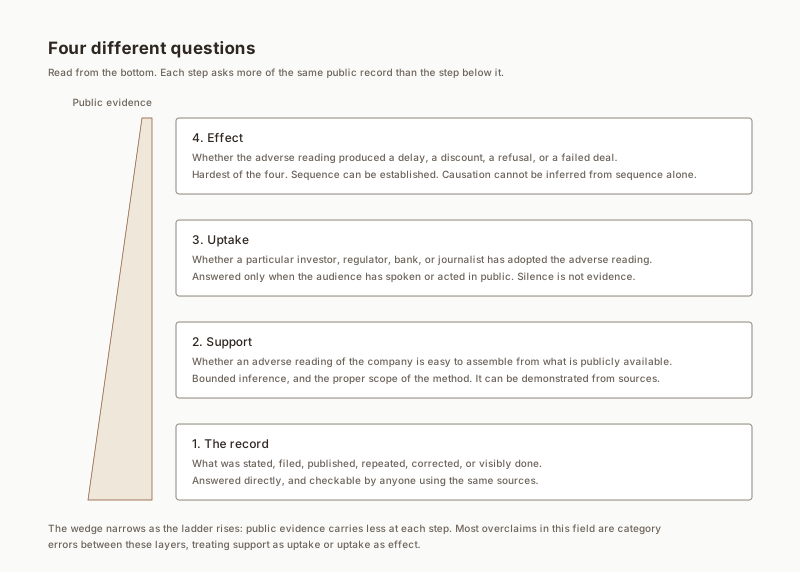
What the public record can establish, and what it cannot
Public information can establish that a statement was made: its wording, date, speaker, and channel. The statement alone cannot establish what the speaker privately believed. Other public evidence may bear on state of mind, but that inference requires more than the statement itself.
The same goes for categories: the record shows that third parties have described a company in particular terms, how often, and in which venues. Whether any specific reader has adopted those categories as a working view of the company is beyond it.
It can show that a company’s accounts of itself differ across markets, languages, or periods, and it rarely shows why: strategy, drift, and translation loss leave the same visible seam, and telling them apart requires other evidence.
It can establish that an adverse reading has concrete support in the record and that the company has placed little visible rebuttal into the channels where the reading travels. That the reading drove a particular decision is a further claim, and the record alone does not carry it.
And it can fix the order in which visible events occurred. Order alone never establishes that the earlier event caused the later one.
Courts make a similar distinction. A judge may take judicial notice of the fact that a press report or complaint exists and says what it says, without accepting its contents as true (Staehr v. Hartford, Part II.A). We apply the same rule to the public record. A document’s existence, wording, and provenance are facts. Its claims remain somebody’s claims until independently established.
Three channels, three kinds of evidence
Cross-border work adds another distinction. The public record surrounding a scrutinized company travels through three channels. Formal review criteria sit in statutes and regulations, in the definitions and tests that reviewing bodies apply. Policy labels appear in executive documents and strategy papers, where they signal direction and identify categories of investors or sectors of concern. Political and media rhetoric travels through hearings, campaigns, and coverage, using the language of pressure and mobilization. These channels shape one another over time. Each supports a different kind of claim; importing the vocabulary of one into another produces predictable errors.
Two case histories documented by the Congressional Research Service show why the distinction matters. In 2006, the Committee on Foreign Investment in the United States completed its initial review of DP World’s acquisition of terminal operations at several U.S. ports and concluded that the transaction did not threaten to impair national security. Members of Congress then introduced more than two dozen bills related to the transaction. A House committee also approved an appropriations amendment that would effectively have nullified that result. The next day, DP World announced that it would sell the U.S. operations to an American owner (CRS RL33388, pp. CRS-13-14). A forecast confined to the formal channel could have mistaken formal clearance for political viability.
One year earlier, CNOOC withdrew its bid for Unocal before any formal determination was reached. It said the U.S. political environment made its chance of success difficult to assess and created an unacceptable risk. The CRS report says that opposition from certain members of Congress “arguably played a key role” in the withdrawal (CRS RL33093, pp. CRS-15-16). A summary that says the deal was formally blocked overstates the record. Nothing was legally blocked.
Each channel must be read on its own terms. Statutes define review criteria; they do not settle political viability. Rhetoric reveals salience and pressure without creating a legal position. Policy labels show direction, not the outcome of a particular case. A company facing all three needs to know which channel is moving and what that movement can establish.
The wording carries the evidence
A reader should be able to tell from the grammar of any sentence we publish how strong its evidentiary basis is. This requires more than style. We write factual claims so readers can trace them to the supporting record, and we match the wording to the evidence. “The filing states…” reports the record. “The record supports a reading that…” marks a bounded inference, alongside what would count against it. “We expect…” signals a forecast, with a horizon and conditions that would change our view.
Intelligence analysis confronted its own version of this problem decades ago. Readers assign different probabilities to the same word. The strength of a judgment and the strength of its evidence are separate questions. Modern analytic standards treat them that way (Sherman Kent, “Words of Estimative Probability”; ICD 203, Analytic Standards, Section D). We do not adopt an agency scale or publish one of our own. The underlying rule is enough: an assessment may be probable on a thin base or uncertain on a rich one. The sentence should say which.
The rule begins before drafting. Research material remains material: a quotation is stored with its source and evidentiary status, not promoted into a finding. Conclusions are drafted only after the record has been assembled and the strongest contrary evidence has had its chance. The quiet failure mode of public-source work is not fabrication. It is material hardening into narrative before it has been tested, so that conclusions are later remembered rather than derived. The evidence boundary stays in place until the analysis has earned the right to cross it.
What this discipline claims, and what it does not
This scope statement appears here so that other pages can point to it. The public research on this site demonstrates analytical capability; it does not document client outcomes. Published analyses show how the method reads a public record and how far its conclusions reach. They do not present, imply, or stand in for work performed for a client. A citation to a Study does not imply that its subject is or was a client. When a Study concerns a named company, its claims are built from the public record under the limits stated here. The company appears because its public record was analytically instructive.
This page is written to the same standard. Readers should be able to see what comes directly from the record, what is inferred, and where the evidence stops. Each Study should meet the same test.
Explore Narrative Power Analysis:
- Understand the method: What It Is and What It Is For
- Evaluate fit: What an NPA Engagement Examines and Produces
- See it applied: The Identity Dimension of Blocked Cross-Border M&A
Further reading
- Sherman Kent, “Words of Estimative Probability” (1964), on why probability words need defined meanings.
- Office of the Director of National Intelligence, Intelligence Community Directive 203: Analytic Standards.
- Stuart Hall, “Encoding/Decoding” (1980), on why a message can prefer a reading without determining its reception.
- Klaus Krippendorff, Content Analysis: An Introduction to Its Methodology, 4th ed. (SAGE, 2018), on inference from texts to the contexts of their use.
- Martin W. Bauer, “Classical Content Analysis: A Review,” in Martin W. Bauer and George Gaskell, eds., Qualitative Researching with Text, Image and Sound: A Practical Handbook for Social Research (SAGE, 2000), pp. 131-151.