What an NPA Engagement Examines and Produces
The material an engagement works from, how it is examined and confirmed, the kind of judgment it returns, and what stays with the advisers a company already has.
An NPA engagement examines one question: how a cross-border company’s identity is reconstructed by the institutions whose judgments matter, and whether the company’s own account of itself remains persuasive when set beside the record those institutions can independently assemble. It is an analytical exercise, not a communications process, and it does not revisit work already owned by the company’s bankers or lawyers. Where this layer sits beside those adjacent disciplines is a separate subject, explored in Narrative architecture, messaging, PR and IR.
This page covers the analytical substance of that work: what goes in, what gets examined, what comes back, and what a company’s existing advisers can do with the output. Engagement structure, participation, timing, and fees are set out separately, on the services page.
What goes in
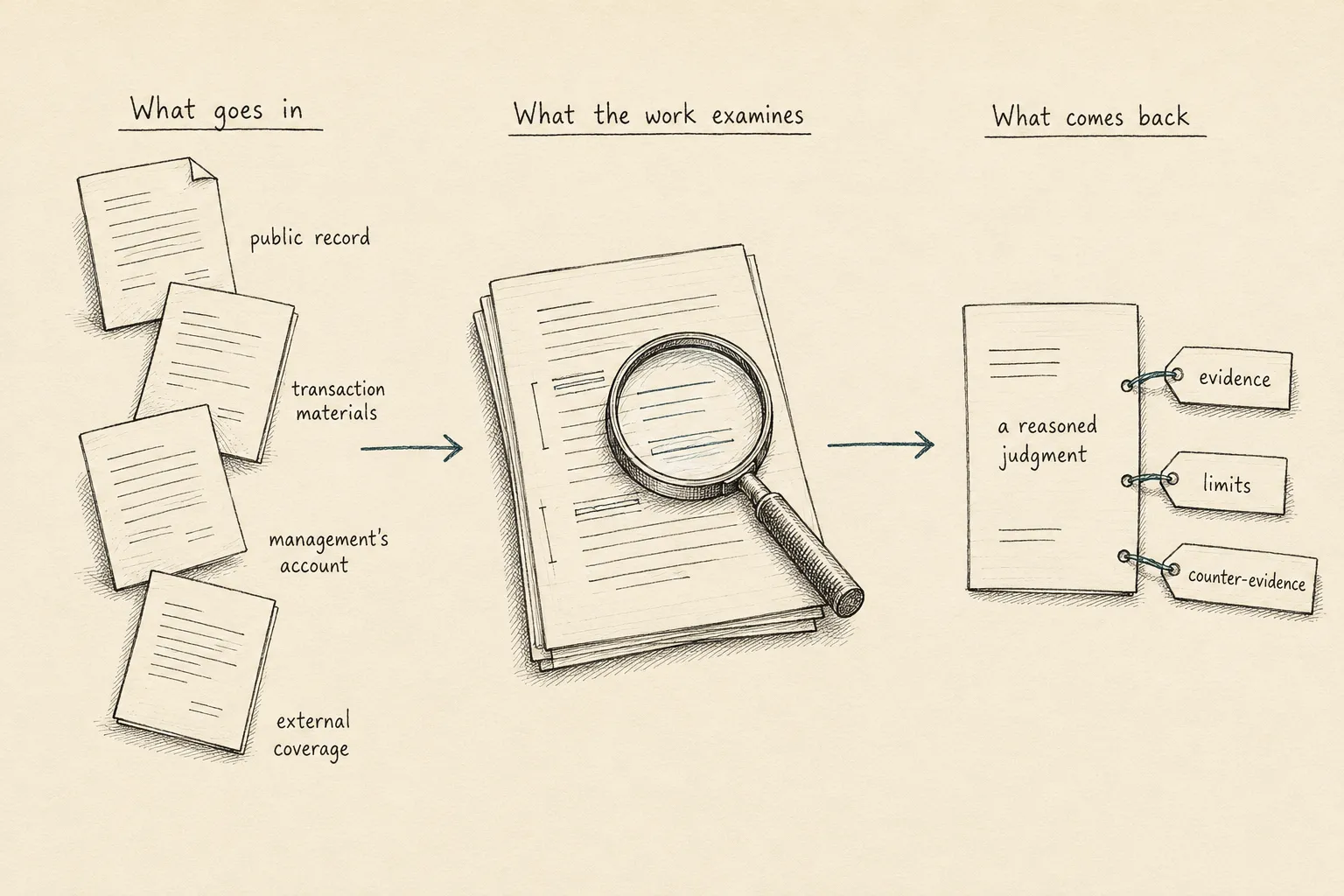
From material that already exists, the engagement draws on four kinds: the company’s public record, in every jurisdiction where it is read; the materials prepared for a transaction or for investors; management’s own account of the company, as management tells it; and the external material through which each audience encounters the company, from filings and coverage to the stray registry entry a diligence analyst actually finds.
None of this is taken at face value, and none of it is merged. Early in the work, we rebuild the raw material into a structured evidence base: every claim tied to its source, assertions kept apart from verified fact, gaps recorded rather than papered over. Why that rebuilding changes the quality of everything downstream is covered in A structured evidence base vs. ad hoc research. The consequence that matters here is that every later conclusion can be traced back to evidence anyone at the table can inspect.
What the work examines
The work moves in stages, and each stage exists to protect the next from inheriting errors. Assembling the material and rebuilding it into evidence come first. Then, before anything is allowed to rest on them, the few facts that would change the entire reading if wrong, the ownership chain behind a single significant shareholder among them, are confirmed with the company. This confirmation concerns facts that bear on how the company’s identity is judged; legal, financial, and audit verification stay where they already live.
Analysis starts from evidence that is already complete. By the time a judgment is being formed, the question is no longer what else might be found; it is what the assembled record actually supports. Gathering more material can postpone a judgment. It cannot substitute for one.
Before formal analysis begins, the frame goes into writing: the decision question the analysis must inform, the alternative explanations that could account for the same record, the evidence that would count against the eventual reading, and the boundaries of what the analysis is entitled to claim. The analysis then has to answer to that frame. A conclusion that cannot say what it examined, what it ruled on, and what would have counted against it is not delivered.
The heavy analytical execution in this work is carried by AI systems; we built the practice on that capacity and do not obscure it. What those systems do not carry is the definition of the problem, the verdict on whether an analysis holds, and the decision about what is finally stated. Those sit with a named lead consultant, who signs the result and answers for it.
What comes back
The engagement returns a judgment, not a stack of documents. The documents exist, but they are carriers for something more specific: a reasoned answer to the decision question the work was framed against, stating which readings of the company the current record supports, which it complicates, and which questions remain open, with the supporting evidence and the stated limits attached.
Concretely, a returned judgment reads less like a slogan and more like a finding: within the materials reviewed as of a stated date, a given audience can classify the company more readily under one description than under the one management intends; that reading is supported by identified elements of the record, complicated by others, and the record simply has nothing to say about the rest. Every clause in a sentence like that can be inspected, challenged, or narrowed, which is what makes it usable.
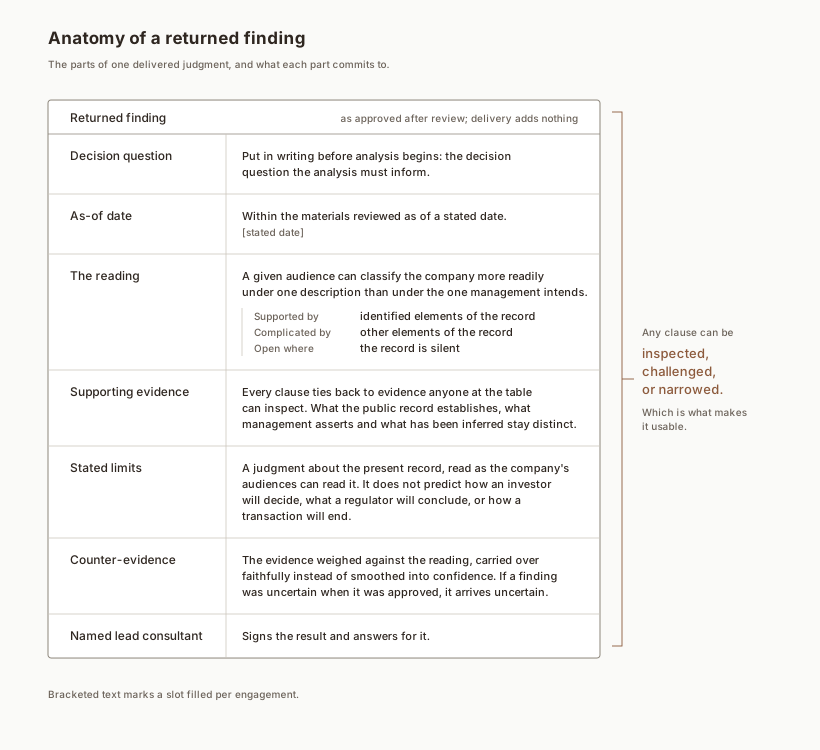
Delivery adds nothing at the last minute. What reaches the client is what survived review: the approved judgment, its evidence, its limits, and the counter-evidence that was weighed, carried over faithfully instead of smoothed into confidence. If a finding was uncertain when it was approved, it arrives uncertain. And it arrives signed: the lead consultant who approved it answers for it.
The judgment also carries limits in time and kind. It is a judgment about the present record, read as the company’s audiences can read it, as of a stated date. It does not predict how an investor will decide, what a regulator will conclude, or how a transaction will end. Anyone who says a piece of analysis can secure those outcomes is describing a different trade.
What other advisers can do with it
The output is built to be taken apart. Each conclusion is tied to its sources, and the analysis keeps three things distinct throughout: what the public record establishes, what management asserts, and what has been inferred. An adviser can lift a single finding, inspect the basis for it, apply the standards of their own profession, and set the rest aside. Counsel can pull one observation and examine its source basis without adopting any conclusion around it. Where the company’s intended account is not yet supported by the record, a banker can take those specific points and test them by their own methods.
Counsel keeps legal analysis and advice. Financial professionals keep valuation, financing, transaction structure, accounting treatment, and audit. Investor communication and media execution stay with the IR and communications teams, who use the findings inside their own work as they see fit.
The same boundaries say when not to start. If the unresolved question is legal permissibility, disclosure, or approval, counsel leads. If it is valuation, financing structure, or accounting, the financial advisers lead. And where the company already holds a settled account of itself that the record supports, and the need is to produce materials and run communications from it, IR and communications are the right owners.
Sometimes the finding is that the problem is not an identity problem at all. Weak economics, a missing license, a governance defect: these read badly because they are bad, and no account of the company should be built to obscure them. When the record is being read accurately, the work says so and points at the real owner of the problem. That sentence is cheap to write and expensive to mean, and it is the one we are most committed to.
Where to go next
- Understand the method. How this work differs from the jobs the company’s existing advisers already do: Narrative architecture, messaging, PR and IR.
- See it applied. Public research applying this method is published in the research library, including why a cross-border valuation discount can persist after the numbers improve and how regulatory friction begins before formal review. No client work appears on this site, in any form.
- Engagement structure, participation, timing, and fees: set out on the services page.