How It Asked to Be Believed
Any cross-border claim to handle institutional money has to say why it should be believed. When J.P. Morgan introduced this business in 2019, the answer was a coin. When DBS and Kinexys linked their deposit networks on November 16, 2026, it was a list of names: two banks, a first client and a settlement company.
First on the strength of its technology. Later, on banks and licenses.
On November 16, DBS and Kinexys by J.P. Morgan announced they had linked their blockchain-based deposit networks, allowing institutional clients to move US dollars between Singapore and the United States around the clock.
Reading the release raised a simple question, the same one that sits behind any cross-border claim to handle institutional money: on what grounds is it asking to be believed?
The answer turned out to be a list of names. That prompted a look back at how J.P. Morgan had introduced the very same business when it first appeared in 2019. Seven years ago, the basis for belief was of a different kind altogether.
2019: a coin
The business itself is simple. A company’s dollars sit at a bank, and the bank records them on a blockchain ledger that it runs, so that they can move at hours when ordinary payment systems are shut.
J.P. Morgan’s version came into public view on February 14, 2019, under the name JPM Coin. The Block’s headline that day read “JPMorgan launches its own cryptocurrency; the first for a major U.S. bank.” Twelve days later the bank’s own investor day slides were more careful. “JPM Coin is a prototype,” they said, and the prototype had “tested successfully.” In 2019 the technology was the news, and it traveled further than the product had yet gone.
In October 2020 Finextra reported that “a large technology firm” had become the first client to use the coin commercially, and that the bank had formed “a new unit, called Onyx.” The client went unnamed and the unit got a name. In April 2021 DBS, J.P. Morgan and Temasek announced a company called Partior under a title that promised a “platform to transform interbank value movements in a new digital era.” In both cases, the thing put forward was the thing being built. Volume came afterward: at its 2023 investor day the bank said JPM Coin “in 2022 was moving $1 billion a day across our Payments and our Markets franchise.”
In between
Three dates separate that introduction from the present one. In March 2023 the American bank Silvergate announced it had “made a decision to discontinue its Silvergate Exchange Network,” and Reuters reported that Coinbase had stopped supporting Signet, the platform Signature Bank had introduced on January 1, 2019 for “payments in U.S. dollars, 24/7/365.” On November 6, 2024 J.P. Morgan renamed its own product “Kinexys Digital Payments (formerly JPM Coin System),” and the coin left the name. On July 18, 2025 the Office of the Comptroller of the Currency issued a statement on the enactment of the GENIUS Act, a law that in its words “expands the authority of the OCC to include nonbank payment stablecoin issuers.” Across those three dates the thing built counted for less, and the institution behind it and the permission above it counted for more (Figure 1).
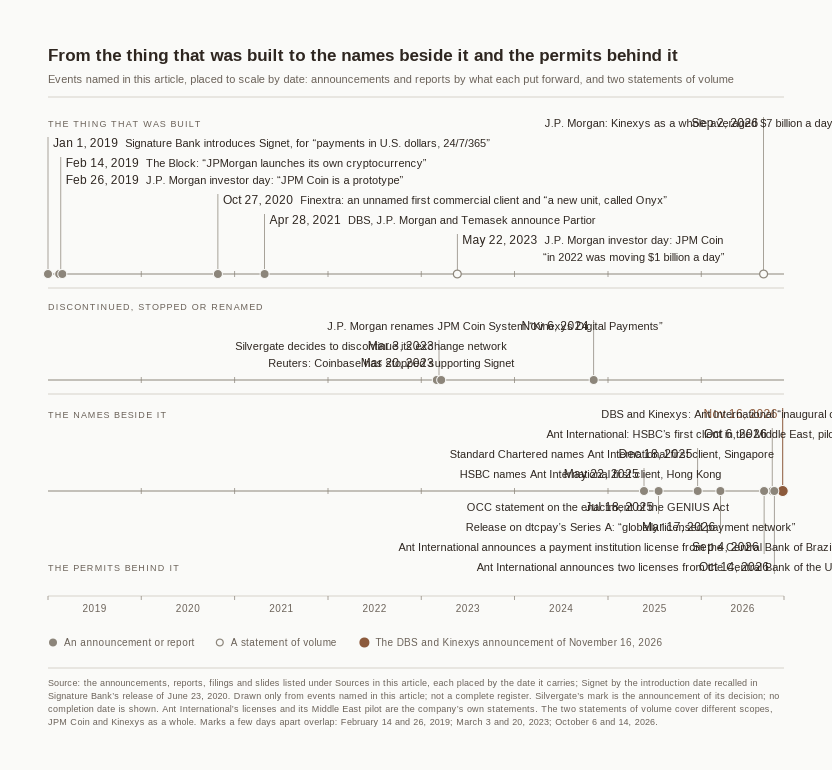
Figure 1. Of the announcements and reports shown here, those of 2019 to 2021 put forward the thing that was built, and those of 2025 and 2026 the names beside it and the permits behind it. J.P. Morgan’s two statements of volume, in 2023 and 2026, are the hollow marks. Drawn only from events named in this article; not a complete register.
2026: a list of names
The title of the November 16 announcement calls the service an “industry-first 24/7 interoperability solution for cross border tokenised deposit transfers.” The networks being joined are DBS Token Services and the Kinexys Blockchain Deposit Account network, and the service is “commercially ready.” The “inaugural client” is Ant International, which uses it to manage liquidity between its own entities in Singapore and the United States. “Settlement orchestration” falls to Partior, the company DBS and J.P. Morgan announced with Temasek in 2021.
Two documents on the Monetary Authority of Singapore’s website carry dates from the same week. Its guide on the tokenisation of bank deposits, dated November 18, says a tokenized deposit keeps its “account-based nature.” The BLOOM Field Guide, dated November 19, draws its case studies from “inputs contributed by BLOOM industry participants” and gives a section to this arrangement. In that section, the guide states that there is “no native transfer of tokens.” Each bank issues its own deposits in its own environment. When a payment crosses, a liability of the paying bank is converted into a liability of the receiving bank, and Partior coordinates the messages and the settlement between the two, alongside what the guide calls “underlying correspondent banking arrangements.” No coin makes the crossing (Figure 2).
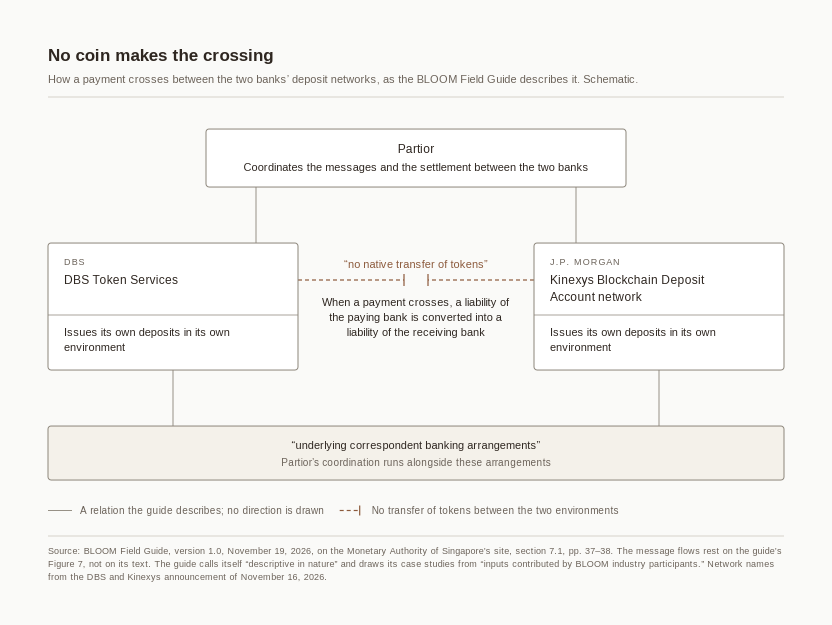
Figure 2. No coin makes the crossing: each bank issues its own deposits in its own environment, and Partior coordinates the messages and the settlement between the two. Schematic, after the BLOOM Field Guide, section 7.1.
In 2019 the reader was asked to believe in a coin. In 2026 the reader is asked to believe in an account at a bank, of a kind the regulator’s guide describes, settled the way banks settle with each other.
The companies around the product introduce themselves by their banks and their licenses. Ant International has been named the first client four times in eighteen months: by HSBC for its tokenized deposit service in Hong Kong in May 2025, by Standard Chartered for its Singapore service that December, in its own announcement of a pilot with HSBC in the Middle East in October 2026, and now here. In September and October 2026 it also announced a payment institution license from the Central Bank of Brazil and two licenses from the Central Bank of the UAE. A smaller company makes the same move. dtcpay, which the Monetary Authority of Singapore lists as a major payment institution, said its payment service would “only support stablecoins” from January 2025, and in March 2026 the release announcing its Series A described it as building a “globally licensed payment network.”
The November 16 announcement does not say how many transactions have crossed the new connection, though J.P. Morgan said in September 2026 that Kinexys as a whole averaged $7 billion a day. As of November 21, five days after the announcement, the news pages of DBS, J.P. Morgan, Partior and Ant International showed no second named client and no third bank. For now, what speaks for this corridor is who is standing in it.
The same question, asked elsewhere
Anything that wants to be trusted across a border has to put something forward, whether or not its announcement says what. It shows in what comes first: the thing that was built, or the names beside it and the permits behind it.
Sometimes a company says it outright. Onafriq is an African payments company that has been bringing stablecoins into the way it settles. In an article on its own site in October 2026 its group chief product officer, Rajat Mishra, said that “moving money on-chain is not the same thing as solving a cross-border payment,” and went on to name local liquidity, regulatory permissions, banking relationships and last-mile connectivity.
Read at face value, the November 16 announcement is a technology milestone: two institutional ledgers finally connected. Read for its grounds of belief, it is a roster of endorsements, a statement of who is willing to stand behind whom.
Credibility follows the room, not the product. When an audience is inclined to believe, what you have built is introduction enough. When it is not, the technology recedes; someone has to vouch for you, and permission must be assembled one jurisdiction at a time. The recurring mistake in cross-border positioning is leading with whatever worked in the last cycle, and realizing it only when the opening pitch is about the ledger and the first question back is about the license.
Anyone who has flown the same international route for years has seen this at passport control. Some years, the officer barely glances at your passport and waves you through. Other years, they ask who invited you and flip through the pages looking for a visa. The traveler and the route are unchanged; the terms of admission are not. An invitation letter means someone on the other side will answer for you. A visa means the state has let you in. Here, the bank is the letter, and the license is the visa.
That leaves a larger question. As the macro narrative turns from an upswing to a downturn, how must a company’s own narrative shift with it, before the questions at the border change?
Sources
Prepared from publicly available information as of November 21, 2026.
- DBS and Kinexys by J.P. Morgan, announcement of the interoperability service, November 16, 2026. The news pages of DBS, J.P. Morgan Payments, Partior and Ant International were read on November 21, 2026 for any second client or third bank.
- The Block, report on JPM Coin, February 14, 2019, updated July 17, 2019.
- JPMorgan Chase, 2019 Investor Day, Corporate & Investment Bank slides, February 26, 2019, pp. 24 and 25.
- Finextra, report on JPM Coin’s first commercial use and the Onyx unit, October 27, 2020.
- DBS, J.P. Morgan and Temasek, announcement of Partior, April 28, 2021, on Temasek’s site.
- JPMorgan Chase, 2023 Investor Day transcript, May 22, 2023, pp. 35 and 37.
- Silvergate Capital, Form 8-K, March 8, 2023, Item 8.01, recording the announcement of March 3.
- Reuters report on Coinbase and Signet, March 20, 2023, republished by Investing.com.
- Signature Bank, press release on Signet, June 23, 2020, carried by Nasdaq, for the date Signet was introduced.
- J.P. Morgan, Introducing Kinexys, November 6, 2024.
- Office of the Comptroller of the Currency, news release 2025-73, July 18, 2025.
- Monetary Authority of Singapore, Guide on the Tokenisation of Bank Deposits, November 18, 2026, section 1.5 and sections 2.2 to 2.4.
- BLOOM Field Guide, version 1.0, November 19, 2026, on the Monetary Authority of Singapore’s site, pp. 37 to 38. On p. 2 the guide calls itself “descriptive in nature.”
- HSBC, launch of the Tokenised Deposit Service in Hong Kong, May 22, 2025.
- Standard Chartered, launch of tokenized deposits in Singapore, December 18, 2025.
- Ant International, announcement with HSBC on the Middle East, October 6, 2026; announcement of its Brazilian license, September 4, 2026; announcement of its UAE licenses, October 14, 2026. The licenses are the company’s own statements.
- Monetary Authority of Singapore, Financial Institutions Directory, entry for Digital Treasures Center Pte. Ltd., last updated August 25, 2026, read November 21, 2026.
- dtcpay, LinkedIn post on supporting only stablecoins, read November 21, 2026.
- Vertex Ventures, announcement of dtcpay’s Series A, March 17, 2026.
- J.P. Morgan, announcement with KB Kookmin Bank, September 2, 2026, for the Kinexys-wide figure.
- Onafriq, interview with its group chief product officer, October 26, 2026.