Situations
Before a cross-border financing
Cross-Border Identity Architecture is independent pre-transaction advisory. Before a cross-border financing, it is used to establish how investors and the other audiences with power over the round are likely to read the company, and where that reading departs from the company’s own account: the gaps that surface later as valuation questions and diligence findings.
What is being decided
A cross-border raise puts the company in front of investors who will place it against what they have already seen. That placement sets the comparables, the questions and the discount long before anyone argues over a term sheet. Management usually experiences it as a valuation gap, or as an equity story that does not land, and treats it as a materials problem. Often it is a reading problem: the investor has already decided what kind of company this is, and the deck is being read inside that decision.
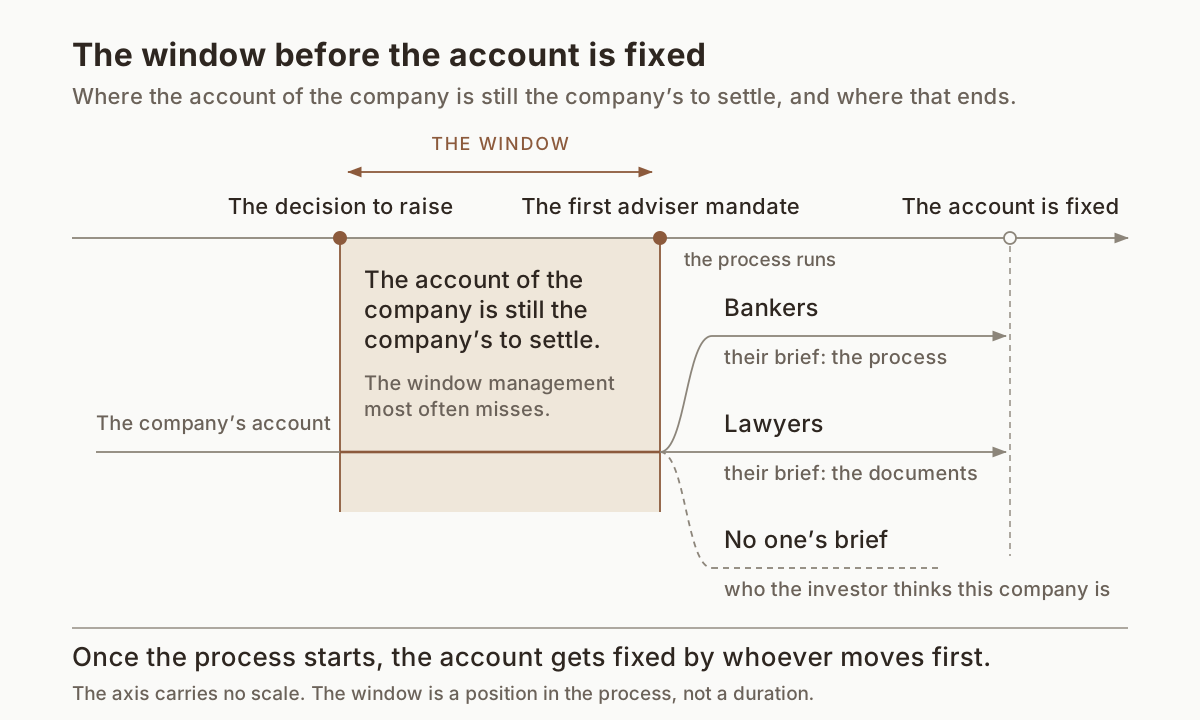
The reading forms early. The window management most often misses lies between the decision to raise and the first adviser mandate, when the account of the company is still the company’s to settle. Once the process starts, each adviser writes to its own brief, and the account gets fixed by whoever moves first.
When this work is relevant
Three conditions usually hold together.
- The moment. The raise is decided but the materials are not final: a first international round, the run-up to listing preparation, or a financing after a change of ownership.
- The fit. More than one audience matters to the outcome, they bring different assumptions, and no adviser holds the whole question of how the company is read. The bankers own the process and the lawyers own the documents; who the investor thinks this company is belongs to no one.
- A real decision. Something is about to be decided that the judgement can change: materials before revision, a positioning choice before the roadshow, a board discussion with the advisers in the room.
The moment alone is not a reason to engage. Where the problem sits in the materials themselves, a page that says the wrong thing or a claim the evidence does not carry, the Cross-Border Perception Memo is enough, and the practice will say so. Where no decision is ahead, there is nothing for the judgement to change, and no engagement is needed.
What this is, and what it is not
Companies often arrive at this work from investor perception work or financing readiness reviews. The practice reaches a judgement on how the company will be read from the public record and the company’s own account; it does not run an interview-based perception study or a readiness audit. The practice is not tied to any home market. Engagements are defined by the company, the decision at hand and the audiences with power over it, subject to conflicts and fit.
Where to go next
- One priority audience and one defined question, before the financing takes shape: the Diagnostic Sprint, typically 4 to 8 weeks.
- Several audiences evaluating the company at once, inside a window the market already knows about: Transaction Narrative Architecture, typically 2 to 4 months.
- An outside view of the public-facing materials, within a fixed scope: the Cross-Border Perception Memo.
- No decision ahead: the research is public, and the conversation can wait until there is one.
The work sits upstream of legal, financial, transaction, IR and communications advice; it does not replace them.
Related reading
Why a Cross-Border Valuation Discount Can Persist After the Numbers Improve
Liquidity, disclosure, and governance explain most valuation gaps. This looks at what remains after all three are addressed and the discount still does not move.
Why Cross-Border IPOs Stumble: The Problem of Market Placement
Some cross-border listings price poorly not because the equity story is weak, but because the receiving market has no settled category in which to place the issuer.