About · Illustrative case
Corbel Grid Systems: the choice behind a revenue line
Illustrative case. Corbel Grid Systems is a constructed company in a constructed listing scenario, the same company as in the specimens on the service pages. It is not a client engagement.
By the time Corbel Grid Systems entered the public window for an overseas listing, the board had a decision that could no longer be left to different documents. On 9 April it was due to approve the prospectus draft for submission to the listing regulator on 14 April; analyst meetings for the roadshow would begin in May. Yet the company’s materials did not quite agree on what kind of company the market was being asked to value. Was Corbel an equipment maker with durable service income, or a software company moving towards a platform model?
Corbel was already listed on its home exchange. It made fault-detection equipment for electricity substations and sold diagnostic software, with group revenue of $110.0M in the previous year. The listing timetable brought securities counsel, bankers, auditors, investor relations and communications specialists to the same set of documents. Each had a defined task. The choice of which account of the business should travel across those tasks still belonged to management and the board.
From a distance, the discrepancy looked like a matter of wording. The Investor Overview and the 2025 Annual Review both described a single revenue line as “recurring software and service revenue”. Case studies elsewhere on the website described five-year installation and field-maintenance contracts. The published financial statements carried the total as one line; the accounting notes in the prospectus draft recognised part of it as service contracts. The draft business overview called Corbel a “subscription platform”. The draft roadshow slides called the line “platform ARR”. Earlier press releases spoke of a “software-led transformation”.
None of these documents changed the reported total. They were written for different readers: the financial statements in accounting categories, the case studies around work done for customers, the business overview around the offering, and the earlier releases around a strategic announcement. On their own, the descriptions were intelligible. The problem appeared when they were put next to one another. No adviser had been engaged to read the whole set as one account of the company.
An institutional investor starting with the public material could readily recognise an industrial business with continuing work after installation. But the available figure did not distinguish contracts attached to equipment from software sold in its own right. The draft slides, if left unchanged, would turn that unresolved distinction into a much stronger software claim.
The regulator had asked how “recurring platform” revenue was defined. It would be reading a business overview built around subscriptions alongside accounting notes describing service contracts. A journalist looking back at the transformation headline would have another perfectly reasonable question: how did that earlier description fit the business now set out in the prospectus? Each reader could support a different interpretation with Corbel’s own words.
Some of this was easy to correct. Investor relations could align the labels on the website and in the annual materials. But better editing would not answer the question underneath them. Before the prospectus and slides could tell a consistent story, the board needed to decide whether it was presenting an equipment business or seeking to be read and valued as a software business. That was a business judgement, not a copy edit.
In the illustrative Transaction Narrative Architecture engagement, the Multi-Audience Narrative Matrix set the source documents beside the interpretations they made possible for investors, the regulator and financial media. Where an audience’s likely conclusion depended on a distinction missing from the materials, the matrix exposed the gap. It showed management which decision the documents were already asking it to make.
The answer was already in contracts Corbel had signed. The $41.8M (38%) that had gathered so many names was not a single software business at all. It was two different commercial relationships, with different reasons for continuing and different things the company could reasonably claim about them.
Of it, $29.2M came from five-year calibration and firmware contracts signed with equipment installations across 142 sites. Utility customers bought that work with the hardware, from the same capital budget. Renewal at term was 94% and gross margin 61%. Both figures came from billing records and management accounts, not audited segment data. These were the contracts recognised as services in the draft accounting notes. The operating figures were useful evidence about the durability of Corbel’s installed-base business, but not of an independent software platform.
The other $12.6M came from diagnostic software licensed separately to other substation operators. It had reached 31 customers over 30 months of commercial operation. No contract had yet reached its 36-month renewal point. There was evidence of initial adoption, but no completed renewal cycle on which to base a retention claim. Neither part of the revenue line would be described as ARR.
Here was the distinction the documents had left unstated. Corbel did not have to deny the software it had built, or let the software claim redefine its whole business. It could say, plainly, that it was an equipment company whose installed base carried contracted calibration and firmware revenue, alongside an early standalone software licensing business. One relationship followed an equipment installation; the other did not. Both were real. They simply supported different claims, and investors needed to be able to tell them apart.
The Management and Board Narrative Alignment Memorandum took that reading into the board meeting. It presented the account the existing evidence could support, the language that needed to change, and the consequences for the prospectus, the roadshow and public communications. The board and chief executive approved the equipment-led account, with the two revenue categories kept distinct. The former platform and transformation labels would no longer carry the company’s current description.
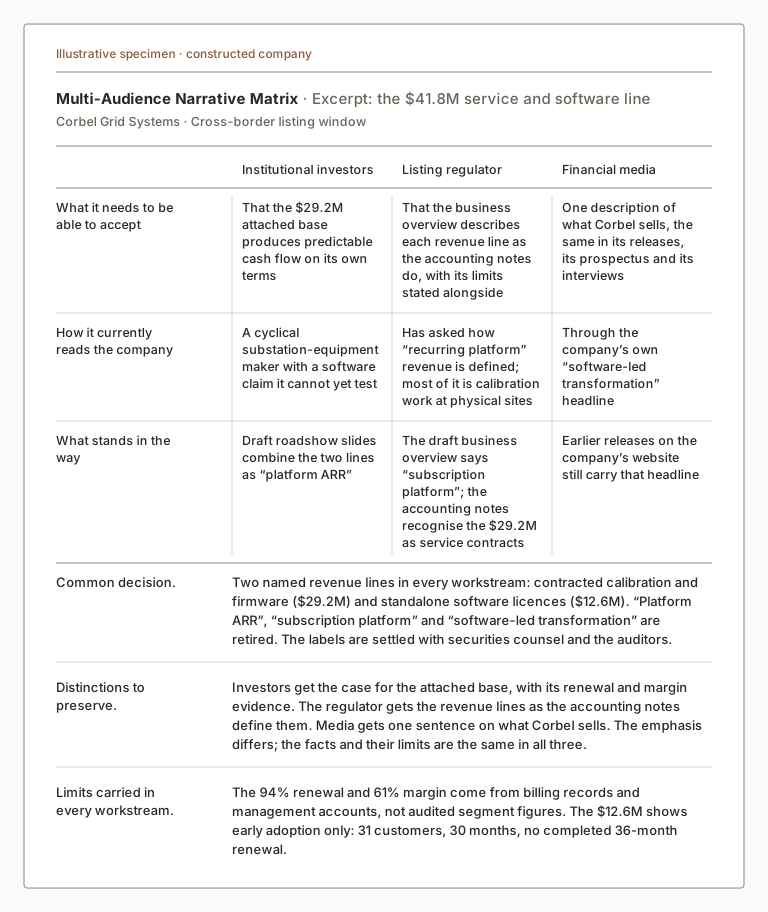
That choice did not mean making the figures available in every conversation at once. The chief financial officer would settle the categories with securities counsel and the auditors. The split would appear first in the prospectus and would not be used in investor meetings before publication.
To help each workstream use the decision, the Advisor Narrative Interface gave the teams a brief shared reference. An excerpt would read:
- Shared account: Equipment and the installed base lead the description; separately licensed software is an early business line, not a general platform revenue claim.
- Counsel: the business overview and the reply to the regulator, read against the accounting notes.
- Bankers and investor relations: the roadshow materials, built on the distinction between attached contracts and independent licences, with the operating evidence kept next to its source.
- Communications: the investor pages, releases and interview language, measured against the board’s chosen description.
Each team keeps responsibility for the wording and advice in its own workstream.
The meeting ended with work for every team. Counsel had an approved account from which to draft the business overview and regulator reply. Bankers and investor relations could prepare the analyst materials without asking one revenue label to represent two contracts. Communications could decide how to handle the earlier releases and bring the website into line. The teams still had different readers and different documents. They now had the same company to describe.