Situations
Before a cross-border listing
Cross-Border Identity Architecture is independent pre-transaction advisory. Before a cross-border listing, it is used to establish how the receiving market, its regulators and its investors are likely to place the company, and where that placement departs from the company’s own account: the gaps that surface later as valuation questions, diligence findings and approval delays.
What is being decided
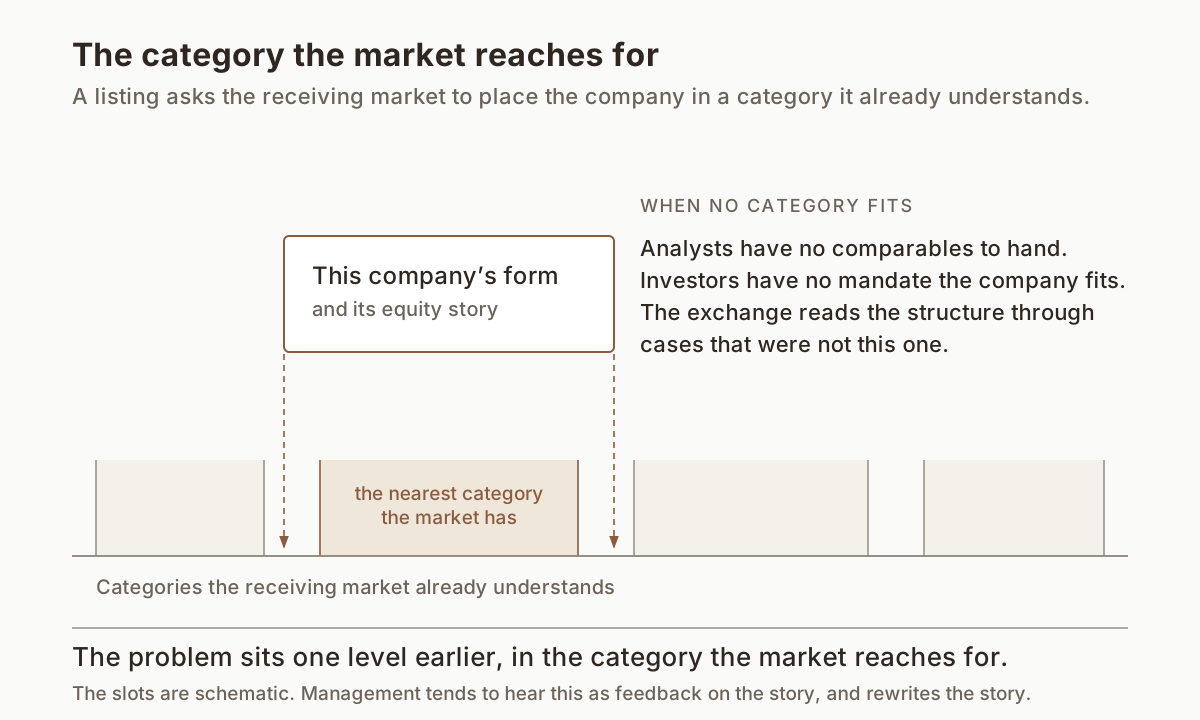
A listing away from home asks a market to place the company in a category it already understands. Where that category exists, the equity story does its work. Where it does not, the story can be strong and still price poorly: analysts have no comparables to hand, investors have no mandate the company fits, and the exchange reads the structure through cases that were not this one. The story is then read against the nearest category the market has. Management tends to hear this as feedback on the story and rewrites the story. The problem sits one level earlier, in the category the market reaches for.
A listing also brings several readers at once. The regulator, the exchange, the cornerstone investors and the financial press form their views separately and on different timetables, and one reading can move the others. By the time the prospectus is being drafted, the company is already being scored.
When this work is relevant
Three conditions usually hold together.
- The moment. Listing preparation has begun but the account of the company is not settled; or the market has been chosen and nobody has yet asked how that market will place the company.
- The fit. Several audiences with different institutional memories are evaluating the company, and no adviser holds the whole reading. Counsel owns disclosure, the banks own the equity story, IR owns the roadshow; who the market thinks the company is belongs to no one.
- A real decision. Something is about to be decided that the judgement can change: the account of the company before drafting starts, a positioning choice before analyst education, a board decision on which market and on what terms.
The moment alone is not a reason to engage. Where the problem sits in the materials themselves, the Cross-Border Perception Memo is enough, and the practice will say so. Where no decision is ahead, no engagement is needed.
What this is, and what it is not
Companies often arrive at this work from IPO readiness assessments or investor perception studies. The practice establishes, from the public record and the company’s own account, how the market is likely to place the company; it does not audit listing readiness or interview investors. The practice is not tied to any home market. Engagements are defined by the company, the decision at hand and the audiences with power over it, subject to conflicts and fit.
Where to go next
- Ahead of listing preparation, with one priority audience whose placement of the company management wants to understand first: the Diagnostic Sprint, typically 4 to 8 weeks.
- Once the timetable is live and several audiences are scoring the company at the same time: Transaction Narrative Architecture, typically 2 to 4 months.
- A check of the public-facing materials the receiving market will read first, within a fixed scope: the Cross-Border Perception Memo.
- No decision ahead: start with why cross-border IPOs stumble, and come back when there is one.
The work sits upstream of legal, financial, transaction, IR and communications advice; it does not replace them.
Related reading
Why Cross-Border IPOs Stumble: The Problem of Market Placement
Some cross-border listings price poorly not because the equity story is weak, but because the receiving market has no settled category in which to place the issuer.
Why a Cross-Border Valuation Discount Can Persist After the Numbers Improve
Liquidity, disclosure, and governance explain most valuation gaps. This looks at what remains after all three are addressed and the discount still does not move.