Klarna's US IPO: What the Company Was Called, and What Was Checked
On launch day, Klarna's release, its registration statement and Reuters described it three ways. The SEC review never ruled on the name; what Klarna was held to was tested on credit.
Public materials as of 31 August 2026; source types: filings, exchange records, press coverage, regulatory correspondence, court records, written responses gathered with consent.
I wanted to understand one thing about Klarna’s New York listing: what happens to the name a company gives itself once a foreign market starts writing about it. The question had a concrete form. On 2 September 2025, the day Klarna Group plc launched its IPO, its press release called it “the global digital bank and flexible payments provider”; the registration statement filed the same day opened with “We are a technology company building the next-generation commerce network”; and Reuters’ report that day called it a “Swedish fintech”. I wanted to know which of these names would stick, who, if anyone, would decide between them, and whether the choice had any bearing on what the company was eventually held to.
Klarna, a public company incorporated in England and Wales whose operations began in Sweden in 2005, priced a base offering of 34,311,274 shares at $40.00 on 9 September 2025 and began trading on the New York Stock Exchange as KLAR the next day. Its public record, from the confidential filing of November 2024 to 31 August 2026, answers all three questions. The dominant outside descriptions in the coverage examined stayed with payments, lending and fintech, usually led by “Swedish”; a bank label in one lead was an exception, rather than a repeated replacement for that family. The staff of the Securities and Exchange Commission did not choose between the company’s names: none of its eleven comment letters asked Klarna to change what it called itself. And what Klarna was held to was examined elsewhere: the basis of its competitive claims, its partner contracts, its credit metrics and, after listing, a class action alleging that the registration statement “understated the potential for provisions for credit losses to be materially raised.” The name was left to whoever wrote the first paragraph. The commitments were tested on credit, the question the outside name asks first.
The obvious objection is that none of this is particular to Klarna or to a cross-border listing: reporters describe buy now, pay later companies this way as a matter of course, and SEC staff press every consumer lender on credit. Both points are fair, and the answer does not depend on contesting them. It claims neither that Klarna was singled out nor that any outlet chose its words in answer to the company’s labels. It rests on two things the record shows: in the coverage examined, the company’s own opening identity never reached the outside umbrella position, and the review never ruled on category. That the review was routine is part of the answer, since a routine review handles only the claims put before it. What is cross-border here sits in three places: a banking licence held in Sweden while US lending runs on state licences and a partner bank; a UK plc share structure whose holder-level conversion routes the company spelled out after listing; and the “Swedish” that coverage put first.
Six names on 2 September
The three names I started with were not the only ones in circulation that day. Seven passages in six documents dated 2 September 2025 carried six distinct descriptions; the filing and the release’s About paragraph shared one of them.
| Document | Position | Description | Source |
|---|---|---|---|
| Klarna launch release | Opening paragraph | “global digital bank and flexible payments provider” | IPO launch release |
| Klarna launch release | About paragraph | “technology company building the next-generation commerce network” | IPO launch release |
| Registration statement, Amendment No. 3 | Opening of Prospectus Summary | “technology company building the next-generation commerce network” | Amendment No. 3 |
| Reuters | Lead | “Swedish fintech” | Reuters |
| TechCrunch | Lead | “Swedish buy now, pay later (BNPL) startup” | TechCrunch |
| The Wall Street Journal | Second paragraph | “specialty lending and online payments provider” | The Wall Street Journal |
| TT News Agency, carried by Sweden Herald | Lead | “Swedish fintech conglomerate” | TT / Sweden Herald |
Each description fits some fact about the company; what differs is scope and position. The split recurred on 10 September: the final prospectus opened as a technology company, while Reuters wrote “Swedish fintech”, the Associated Press “Swedish buy now, pay later company” and Finextra “BNPL giant Klarna”. Those four documents reproduce the company–coverage divide seen at launch, with a further contrast on 19 February 2026 between the banking release and buy now, pay later coverage.
Which Klarna a reader met that week was set by the surface carrying it. Before reading anything into the outlets’ choices, I checked whether the company itself spoke with one voice.
The company’s own two names
It did not, and the split followed the channel. All six public offering documents examined (the Form F-1 of 14 March 2025, its four amendments and the final prospectus filed under Rule 424(b)(4) on 10 September) kept the technology-company sentence at the opening of the summary. The opening description in the releases changed between the March filing announcement and the September launch. The release of 14 March 2025 announcing the F-1 called Klarna “the AI-powered global payments network and shopping assistant”; all three September offering releases (the launch, pricing and closing announcements) led with “global digital bank and flexible payments provider”.
A bank word entered the filing once, in narrower form. Amendment No. 1, filed on 21 May 2025, contains no “neobank”. Amendment No. 2, its cover reading “As filed with the Securities and Exchange Commission on August 14, 2025” (EDGAR records 15 August), added to the summary: “Next-Generation Digital Financial Services. As a digital-first neobank, Klarna’s services are automated, insight-driven and designed to be transparent, fair and intuitive.” The passage carries through Amendments No. 3 and No. 4 to the final prospectus, with “neobank” twice in the summary and five times in all. On the same 14 August, Sifted subtitled a story “The buy-now-pay-later fintech is rebranding itself as a neobank”; the two share a date, and the record shows nothing about one prompting the other. “Digital bank” itself appears in no version of the registration statement.
The product term Reuters and the Associated Press put into their descriptions appears once in the summary, in the subsection on technology and AI: “We were a first mover in the ‘buy now, pay later’ space”. The phrase occurs seven times in each of the F-1 and the final prospectus; the abbreviation BNPL occurs in neither. Three months before the neobank passage, on 14 May 2025, CNBC Television posted a video titled “Klarna CEO: We are a ‘neobank’ but people still associate us with buy now, pay later”. The title is the channel’s and the interview’s own wording has not been checked, so it stands only as CNBC’s headline.
After listing, the filed identity moved toward the releases. The first annual report on Form 20-F, filed on 26 February 2026, describes a “global digital commerce network”, “founded in 2005 in Sweden”, and uses “digital bank” twice and “neobank” three times. A week earlier the release of 19 February spoke of an “evolution from payments network to global digital bank”; the About paragraphs of the releases of 26 February and 18 August 2026 kept “global digital bank and flexible payments provider”, and the August release opened on an “everyday finance network”.
Through the offering window, then, Klarna ran two identities in parallel: a technology company in the document under review, and a digital bank in the releases, which reached the reviewed document only as the neobank passage. The bank label may track the business exactly. What the rest of the record turns on is where each name was placed. Neither opening identity became the repeated umbrella description in the outside coverage examined.
What coverage kept instead
Among the 21 dated reports and industry items from 13 outlets or original publishers cited here, 20 categorise Klarna through payments, lending, finance, e-commerce or fintech; one lead calls it a neobank. None uses the filing’s technology-company or commerce-network identity. The items date from 13 November 2024 to 19 February 2026. These are counts of the cited descriptions, not all Klarna coverage; their words and positions are listed in the appendix. Figure 1 sets the 21 items beside the company’s filings and releases over the same period.
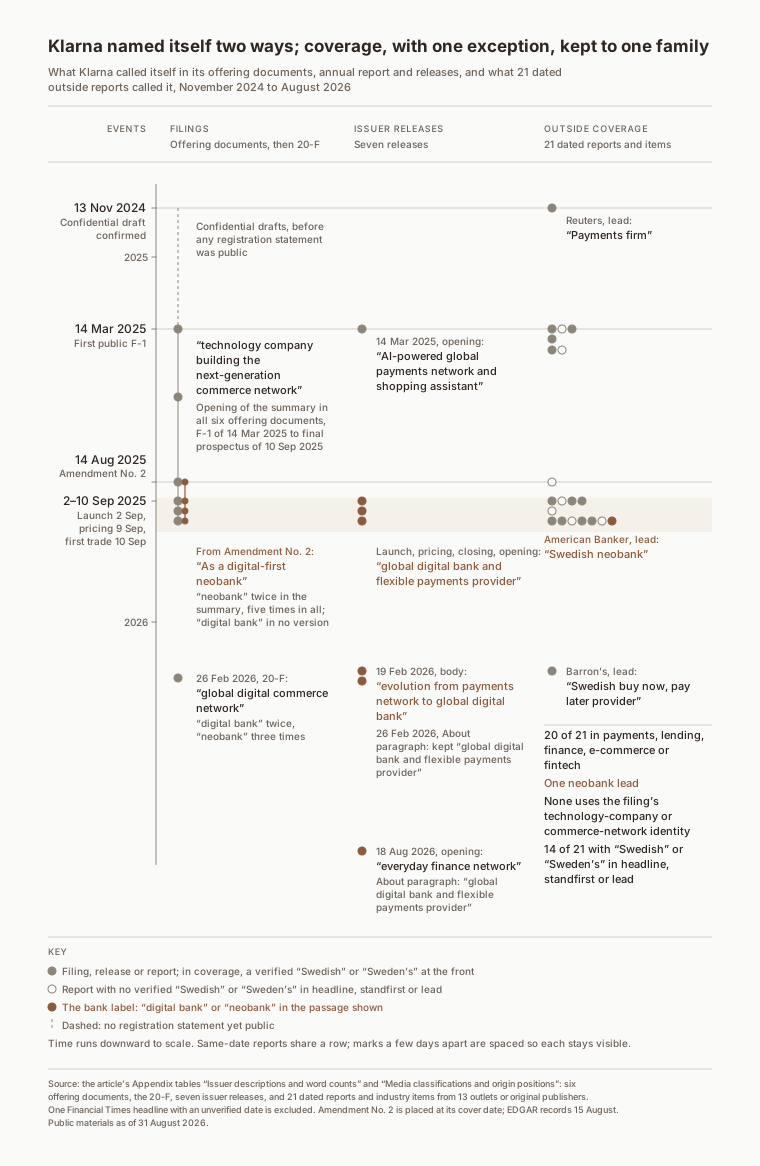
Figure 1. Klarna’s filings and its releases described the company differently through the offering window, and the releases moved toward “bank”. The 21 dated outside reports in the cited set put payments, lending, finance, e-commerce or fintech first from 13 November 2024, before any registration statement was public, and kept there. One American Banker lead calling Klarna a neobank was the exception. Source: Appendix tables “Issuer descriptions and word counts” and “Media classifications and origin positions”; public materials as of 31 August 2026.
What coverage used instead is compatible with things the company itself stated. It often occupies the headline, standfirst or lead, although the Journal’s launch-day classification is in the second paragraph and Renaissance Capital’s weekly preview uses an issuer-specific paragraph. “Buy now, pay later” fits the summary’s first-mover line. “Swedish” fits the summary’s “We began operations in Sweden in 2005, and rapidly expanded through the rest of the Nordics.” What coverage left behind was the frame the company led with: technology company, commerce network, shopping assistant. Compatibility is as far as the record goes, because these usages were in print on 13 November 2024, when Klarna confirmed it had “confidentially submitted a draft Registration Statement on Form F-1” and before any registration statement was public. Reuters that day called it a “Payments firm” in the first paragraph and a “buy now, pay later (BNPL) company” in the second.
Within that family the wording moved, but the category never left it. Reuters went from “Payments firm” to “Swedish fintech company” and “buy now, pay later pioneer” in March 2025, then held at “Swedish fintech”. The Wall Street Journal ran its 14 March 2025 item under “E-Commerce Company Klarna Files for IPO”, with “provider of e-commerce services” and no “Swedish” in the headline or first paragraph; from 4 April it was a “specialty lending and online payments provider”, and on 10 September a “Swedish online-payments firm”. Renaissance Capital moved from “E-commerce payments platform” on 5 September to an “E-commerce loan platform” headline on 10 September. Across the five Reuters items, four Journal items and two Renaissance items, those eleven category descriptions stayed among payments, lending, e-commerce and fintech. Between their pause stories of 4 April and their launch stories of 2 September, both Reuters and the Journal kept their category: “Swedish fintech” and “specialty lending and online payments provider”, respectively.
The bank label was taken up three ways. American Banker on 10 September listed a “Buy now/pay later financier” among its key insights and called Klarna a “Swedish neobank” in the lead: the one direct bank-category description among the 21 dated observations. Sifted kept buy now, pay later fintech as its category and framed neobank as a rebranding. The Financial Times used digital bank as a direction of travel in a headline, but its date remains unverified, so it is recorded separately and excluded from the dated counts. These uses establish that the bank label reached coverage; they supply one direct adoption and two descriptions of a transition.
Origin stayed visible across different business categories. “Swedish” or “Sweden’s” appears in the verified headline, standfirst or lead of 14 of the 21 dated items, including IPO Scoop’s “Sweden’s ‘buy now, pay later’ company” and the AFP story carried by The Local Sweden under a headline beginning “Swedish finance firm Klarna”. No retrieved passage used origin to explain a fact unrelated to origin. Four of the cited reports also gave both ends. IPO Scoop’s subheading read “Roots in Sweden, HQ in London”. Renaissance Capital wrote “Based in the UK but with roots in Sweden, Klarna Group was founded in 2005”. Payments Dive described a company founded in Stockholm whose Swedish parent became a UK parent through a share-for-share exchange in May 2024. TT noted that the legal domicile moved to London that month. The company’s own summary never names Stockholm; London first appears there in the registered office address, 10 York Road, London SE1 7ND, United Kingdom. The 14 verified front occurrences are descriptive, while the four accounts of the Sweden–UK relationship distinguish operating origin from headquarters or legal domicile.
Two facts Klarna’s summary also states, a Swedish start and an early lead in buy now, pay later, were the ones coverage put in front; the technology-company frame it chose for itself did not enter the 21 coded descriptions. The 20 business-category descriptions and one neobank lead show a persistent gap with a specific bank-label exception, rather than complete exclusion of bank language. Unless someone with authority ruled on it, the name stayed with whoever wrote the first paragraph. The channel in the record with binding force over the registration statement was the SEC staff’s review.
What the review checked
Between 10 December 2024 and 5 September 2025, SEC staff sent ten rounds of comments in eleven letters, the fifth round in two, across confidential and public review, and Klarna answered each round. The exchange, 23 documents once duplicates are removed, went up on EDGAR on 15 January 2026, four months after listing, in line with the SEC’s practice of releasing staff letters and issuer responses no earlier than 20 business days after effectiveness. It sits in the UPLOAD and CORRESP filings, to be read against the version each letter addresses, and none of it was public while the offering was being covered.
None of the eleven letters asked Klarna to change its industry self-description. They contained 119 numbered written comments, plus a separate telephone comment recorded in the fourth-round response; the appendix traces letters, responses and revisions. The letters went instead to what its claims committed it to. The first comment asked for the “basis for all your assertions about your competitive position”, including “one of the largest commerce networks in the world”; Klarna’s 23 December 2024 response reported revisions and qualified some claims as its own understanding. Comment 5 asked that US expansion be set beside the net losses it brought; Klarna listed the revised pages. Comment 2 asked whether its WebBank, Apple, AliPay and Amazon arrangements were material contracts to be filed. Klarna argued arrangement by arrangement that each was ordinary course, replaceable or not substantially relied on, and filed none.
The OnePay partnership returned in three letters across the fifth and sixth rounds, dated 21 March, 28 March and 11 April 2025. Staff pressed on materiality, warrants and exclusivity; Klarna described OnePay as “majority-owned by Walmart Inc.”. Its responses gave 15,343,932 warrants and an exclusivity scope covering Walmart’s US non-grocery merchandise. The 21 May amendment added those disclosures, while Klarna maintained that no contract exhibit was necessary. Responses could also contest a requested presentation: the third-round reply added net income but opposed including accumulated deficit in the financial overview. In the seventh round, staff cited Forbes’ account of the CEO describing some AI services as “lower quality”. Klarna disputed the report, then confirmed an AI revision in Amendment No. 2, page 150, in management’s discussion.
Each of the four final rounds touched credit disclosure, alongside questions on active consumers, AI, cash-flow classification or funding. The eighth round’s credit item continued consideration of an earlier IFRS 7 response; it did not introduce a new set of credit questions. The tenth, on 5 September, asked about the numerators and denominators of the delinquency charts, the treatment of loans sold or repaid, and the phrase “at 60 days”. Klarna replied on 8 September that the reference “was inadvertent”. Amendment No. 4, filed that day, states that a loan stays in its cohort’s original-volume denominator “regardless of subsequent repayment, charge-off, transfer or sale” and drops “at 60 days” from the title of the cumulative net charge-off chart. The registration statement became effective the next day, and the offering priced.
The bank label never came before the reviewers as a question. Neither of the two letters after “neobank” entered the summary raised that label, and “digital bank” was absent from all six public offering documents examined. If any consumer lender filing in the United States would meet much the same questions, that is the point: the binding channel works on what is placed before it, the competitive assertions, the contracts, the credit definitions. Klarna’s responses throughout are its own position; the correspondence does not record staff accepting them.
Review moved the commitments and left the name alone: competitive claims were qualified, losses were set beside growth, a denominator was spelled out on the eve of pricing, and the labels Klarna chose either passed through unremarked or never arrived. The review never asked what “bank” meant. The final prospectus answers that anyway, in pieces.
What “bank” rests on in the United States
The launch release of 2 September presented a “global digital bank”. The final prospectus, filed eight days later, says where the bank sits. Klarna Bank AB took its present name after obtaining “a license to carry out banking activities under the supervision of the SFSA”, the Swedish Financial Supervisory Authority (Finansinspektionen), and “Our banking operations in the EEA are conducted through Klarna Bank AB”. For the United States the prospectus gives a different footing: “our operating subsidiary holds primarily money transmission, collection and lending licenses on the state and territorial levels.” Fair Financing and Klarna balance are offered with WebBank, “an FDIC-insured Utah state-chartered industrial bank”, and “Under our agreement with WebBank, WebBank originates such consumer loans, which we then purchase and service.” More broadly, “In the United States, a portion of the loans facilitated through our network are originated through WebBank”.
These passages sit apart, in the company information, the risk factors and the regulatory environment, and a reader of the prospectus has to join them. The prospectus names who holds which licence, who originates, who purchases and services, and which partners are involved, while the materiality of those contracts and Klarna’s dependence on them still rest partly on the company’s own account after several rounds of questions. In the market where Klarna listed, the bank of its releases rests on a Swedish licence, while the lending runs on state and territorial licences and, for a portion of loans, on WebBank’s charter; the prospectus says so only in pieces. All of this was on the record before the first trade. The first pressure after listing did not touch the name either.
Where the pressure landed
On 22 December 2025, Dilip Nayak filed Nayak v. Klarna Group plc et al., No. 1:25-cv-07033, in the US District Court for the Eastern District of New York, against the company, its directors and officers, and the underwriters. The complaint, under Sections 11, 12(a)(2) and 15 of the Securities Act, alleges that the registration statement “understated the potential for provisions for credit losses to be materially raised.” That is the plaintiff’s allegation, not a finding. An amended complaint was filed on 29 June 2026, and as of 31 August 2026 the docket showed no dismissal, withdrawal or settlement.
On 19 February 2026, Klarna released results under the headline “Klarna Accelerates U.S. Growth and Delivers $1bn Revenue Driven by Rapid Banking Service Adoption”. The same day, Barron’s began its report: “Klarna, the Swedish buy now, pay later provider, …”.
The complaint was filed on 22 December 2025, about two months before that headline. It points at the provisioning of credit losses, the same ground the last four rounds of review had covered. The record gives the juxtaposition and the target of the allegation, nothing about cause or the suit’s merit. Credit was where the pressure landed. On the share structure the listing record needed more, and there the issuer supplied it itself.
What the issuer explained after listing
From listing-day materials, the outline of the structure can be rebuilt. Klarna Group plc is a public company incorporated in England and Wales and, since a reorganisation in May 2024, the group’s ultimate parent; Klarna Bank AB, the bank under Swedish law, is an indirect subsidiary. Class B shares carry ten votes and ordinary shares one, and shares can be held as registered ordinary shares or as depositary receipts. The final prospectus also stated that Class B shares are not transferable and that, after certain transfers of interests in ordinary shares by their holders, a related number “will automatically convert into deferred shares, which have no voting or effective economic rights.” Two statements published after listing supplied the working detail, on the investor relations page and in Form 6-K exhibits. Figure 2 draws this structure together with the bank and lending arrangements of the previous chapter, and marks what the issuer wrote out after listing.
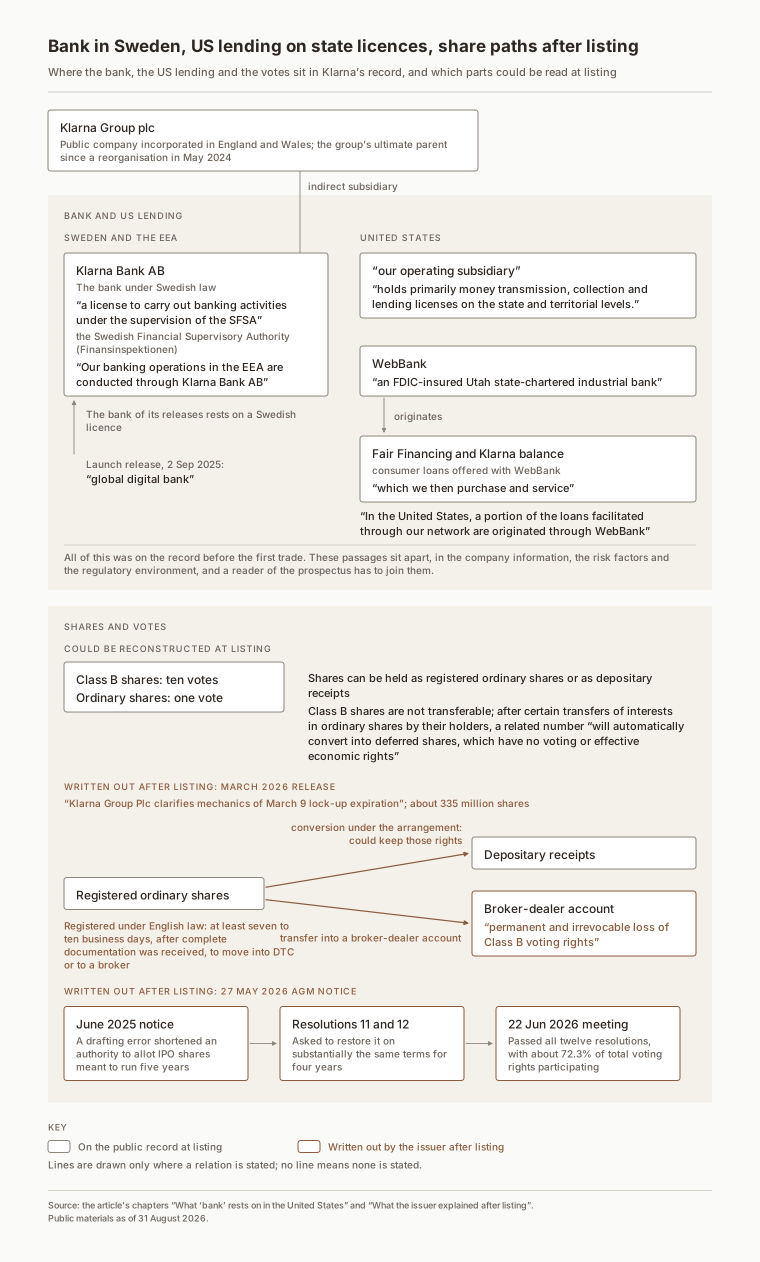
Figure 2. In the market where Klarna listed, the bank of its releases rests on a Swedish licence held by Klarna Bank AB. US lending runs on state and territorial licences and, for a portion of loans, on WebBank’s charter; the final prospectus states these in passages that sit apart. Entities, share classes, voting rights, the two holding routes and the rule converting Class B shares on certain transfers could be reconstructed at listing. Which route kept Class B votes at the first lock-up expiry, and the corrected term of the allotment authority, were written out by the issuer in March and May 2026. Source: the chapters “What ‘bank’ rests on in the United States” and “What the issuer explained after listing”; public materials as of 31 August 2026.
The first was a release of March 2026 titled “Klarna Group Plc clarifies mechanics of March 9 lock-up expiration”. About 335 million shares were involved. Ordinary shares registered under English law needed at least seven to ten business days, after complete documentation was received, to move into DTC or to a broker; a transfer into a broker-dealer account would mean “permanent and irrevocable loss of Class B voting rights”, while conversion into depositary receipts under the arrangement could keep those rights. The second was the notice of the 2026 annual general meeting, filed on 27 May 2026, which explained that a drafting error in the June 2025 notice had shortened an authority to allot IPO shares meant to run five years; resolutions 11 and 12 asked to restore it on substantially the same terms for four years. The meeting on 22 June 2026 passed all twelve resolutions, with about 72.3% of total voting rights participating.
At listing, the legal entities, share classes, voting rights and the Class B conversion rule could be reconstructed from public material; which route kept Class B votes at the first lock-up expiry, how long a move into DTC took, and the corrected term of the allotment authority came in separate issuer statements afterwards. Klarna’s cross-border structure, a plc incorporated in England and Wales above a Swedish bank, with a ten-vote class and two holding routes, was legible in outline at listing and in working detail from March and May 2026, when the issuer wrote it out itself.
Two kinds of claim
The question I began with, which of Klarna’s names would stick and whether it mattered, has a two-part answer, because the record holds two kinds of claim. Category, what the company calls itself and what others call it, went unruled: no comment letter touched it, and the dominant outside categories held across the dated observations. Commitment, meaning the basis for competitive claims, the boundaries of partnerships and licences, the denominators of credit metrics and the mechanics of shares and votes, was tested by registration review and put at issue in pending litigation on the questions the outside category asks first: for a buy now, pay later lender, credit losses and provisions. The issuer’s own statements after listing filled in the mechanics of shares and votes. Figure 3 places these events in order.
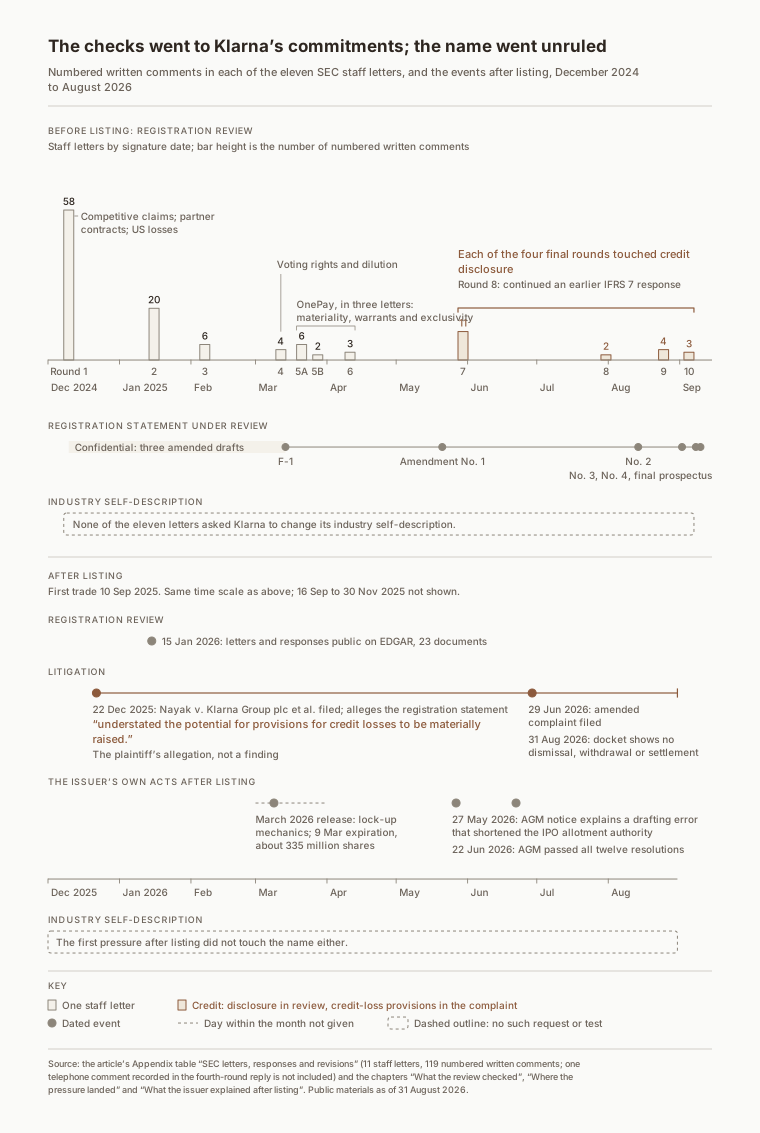
Figure 3. Every check and challenge in the record went to what Klarna’s claims committed it to. Eleven SEC staff letters carried 119 numbered comments, 58 of them in the first, and each of the four final rounds touched credit disclosure. After listing came a class action on credit-loss provisions and the issuer’s own statements on lock-up mechanics and an allotment authority. None of the eleven letters asked Klarna to change its industry self-description. Source: Appendix table “SEC letters, responses and revisions” and the chapters “What the review checked”, “Where the pressure landed” and “What the issuer explained after listing”; public materials as of 31 August 2026.
Two practitioners who work on cross-border listings answered my written questions: Russ Mould, a UK market commentator writing as an individual, and a respondent writing on behalf of New Constructs, a US investment research firm. Both discussed issuers in general, not Klarna, and located the first sign of trouble in the share price. In Mould’s words: “A poor reception to any flotation, whether it is an overseas or a domestic issuer, always shows in the share price first. Mood follows price.” The firm wrote: “We see it first in the stock price, which likely moves counter to how the business is doing because of a breakdown in communication.” (Source: New Constructs research; written response to the author’s questions, September 2026.) It also named analyst notes or missing analyst coverage. Their risks were financial (unrealistic targets and guidance, an offering valuation set too high, poor financial disclosure), and neither chose origin, control, authority or home-market evidence as the account’s weak point. Both placed responsibility with issuer leadership. Mould wrote: “It is up to the CEO, CFO and board to fix it by setting and meeting (or beating) realistic operational and financial performance metrics.” In the firm’s words: “The management team, especially executive management, is responsible for all elements of the organization, and this part of the business is no exception. Next in line for responsibility would be the investor relations team.” (Source: New Constructs research.) The appendix preserves the three-question comparison and these differences. They are accounts of practice, not measured frequencies of issuer problems.
The record holds no sign that Klarna’s commitments were checked differently because it was foreign. What the issuer controls is where each claim goes. Klarna put its technology-company sentence, and later the neobank passage, into the reviewed document, kept the digital bank in its releases, and was examined before and after listing on credit.
Klarna’s public record assigns no joint decision over category and commitment. The category sat with the writers of first paragraphs at wires and IPO data providers; the commitments were worked out in correspondence published only on 15 January 2026, then taken up by a plaintiff and by the issuer’s own statements after listing. The complaint put a credit commitment at issue on the same ground the last rounds of review had examined; it did not decide what the company should be called. Before the first draft goes to the SEC, then, one person or one review has to read the two together.
For a foreign issuer whose self-description runs wider than what the US market will call it, nothing in this record shows a company’s preferred label changing what that market called it. The first draft of the F-1 is in the issuer’s hands, and that draft, written to answer the question the market’s category will ask, is the part of the record the issuer will be held to. In Klarna’s record, matters a pre-listing draft could have settled arrived on other people’s dates. A delinquency-chart denominator was spelled out on 8 September 2025, in answer to the tenth staff letter and the day before effectiveness and pricing. A Swedish licence, US state licences and a WebBank arrangement sit in separate sections of the prospectus for readers to assemble. An allotment authority meant to run five years, shortened by a drafting error in the June 2025 notice, was restored for four years at the meeting of 22 June 2026. Each surfaced in a document someone else read first: SEC staff, a reader of the prospectus, shareholders reading the 2026 meeting notice. Beside those dates sit the deal’s public terms: a base offering of 34,311,274 shares at $40.00, and about 335 million shares reaching the end of lock-up on 9 March 2026.
The steps below follow the issuer’s own calendar, except the last, which applies whenever a new label is adopted; each matches a point where Klarna’s record shows something supplied after the fact:
- Before drafting, read the coverage of the issuer and its peers to fix the category the market will use and the question that category puts first. Klarna’s category was in print on 13 November 2024, before any registration statement was public.
- In the first draft, define every metric that question will reach. Klarna’s delinquency denominator was spelled out in the amendment of 8 September 2025.
- In the same draft, state licences and lending arrangements in one place. Klarna’s sit across the company information, the risk factors and the regulatory environment.
- Before the first draft goes to the SEC, have one person or one review read the category and the commitments together.
- Before listing, write share and depositary mechanics as instructions a holder can follow. Klarna’s prospectus stated the Class B conversion rule; which route kept those votes came in a release of March 2026, ahead of the first lock-up expiry.
- When a new label is adopted, whether in the releases or in the reviewed document, do not count on it to change what coverage calls the company. Klarna’s “digital bank” led its September offering releases and appears in none of the six public offering documents examined; “neobank” entered the reviewed document from Amendment No. 2 and appears five times in all; and 20 of the 21 coded outside descriptions still used payments, lending, finance, e-commerce or fintech.
Klarna priced at $40.00 against a range of $35.00 to $37.00, and on listing day Reuters and the Associated Press still introduced a “Swedish fintech” and a “Swedish buy now, pay later company”. The practice above holds for issuers like Klarna if those who set categories in the receiving market anchor on the products and metrics an issuer discloses and keep their own house conventions. The record is compatible with that: the categories coverage used match facts the company had itself stated (a Swedish start, a first-mover position in buy now, pay later), and the outlets kept their own usual terms, with Reuters holding at “Swedish fintech”. The staff’s letters, the outside first paragraphs and the complaint arrived on dates set by others.
Acknowledgements
This study was built from Klarna’s filings, press coverage, regulatory correspondence and court records. I thank Russ Mould and New Constructs for answering my written questions on how foreign issuers are read after a US listing. Their replies concerned issuers generally, not Klarna. Both pointed to the share price as the first warning sign and placed responsibility with issuer leadership. Between them, they emphasised financial expectations, offering valuation and disclosure, rather than the questions of origin, control, authority and home-market evidence examined here. Their answers provided a point of comparison against which to test my reading. The analysis and judgements are mine, as is responsibility for any errors.
Appendix
Method
This study applies NPA Primitives Version 0.1 and records the case through its six observation dimensions and seven classes of observable outcome. The codebook has not yet been published; the grading anchors used are set out below. Public case material dated after the cutoff of 31 August 2026 is not coded. The September 2026 written practitioner responses are supplementary accounts of experience and are kept separate from the coded case evidence.
Case table
| Company | Source market | Event type | Event date | Materials cutoff | Source coverage |
|---|---|---|---|---|---|
| Klarna Group plc | Sweden (operations); England and Wales (incorporation) | Traditional underwritten IPO by a foreign operating issuer, NYSE | Priced 9 September 2025; first trade 10 September 2025 | 31 August 2026 | Issuer filings and releases; wire, financial, trade, IPO-industry and source-country press; SEC correspondence; exchange records; court records |
Coding
NPA Primitives Version 0.1 requires each study to state the grading anchors it uses until the codebook is published. The anchors used here:
- Identity Divergence: high means the company’s umbrella self-description did not establish a repeated umbrella position in the examined descriptions across outlets and time points; isolated overlaps are reported separately; medium means partial adoption, or convergence within the window; low means the external umbrella category matches the company’s self-description.
- Origin Salience: high means verified origin labels appear at the front of most items examined, in headlines, standfirsts or leads; medium means it appears only later in the body; low means it largely does not appear. Whether the label is used to explain matters unrelated to origin is recorded separately.
- Governance Legibility (a high code means clear): high means an outside reader can fully reconstruct ownership, control, legal entities and share mechanics from the public materials available at listing alone; medium means the skeleton can be reconstructed but some mechanisms need separate explanation from the issuer after listing; low means reconstruction is not possible.
- Authority and Commitment Clarity (a high code means clear): high means who can commit, who is responsible for delivery and what powers each party holds are explicit in public materials without repeated questioning; medium means the parties are named but the significance of the division of roles still rests partly on the company’s own account after several rounds of questioning; low means they cannot be identified.
- Evidence Portability: high means evidence from the source market is taken at face value in receiving-market accounts; low means it is discounted, rewritten or omitted; not observable where there is no material to judge.
- Audience Frame Divergence: high means different audience layers describe the same company at different scales at the same time point, and the difference persists; medium means partial divergence; low means the layers agree.
| Dimension | Code | Basis | Boundary condition |
|---|---|---|---|
| Identity Divergence | High | Six offering-document openings; 20/21 outside descriptions in the payments/lending/finance/e-commerce/fintech family; one neobank lead. | Codes the repeated category pattern in the cited sample; the bank-label exception is retained. It does not code why outlets chose their labels. |
| Origin Salience | High | 14/21 verified front occurrences in the media table. | Codes observed visibility, not absence from inaccessible text or explanatory use; no retrieved passage used origin to explain matters unrelated to origin. |
| Governance Legibility | Medium | Prospectus: entities, share classes, votes and the Class B conversion rule; holder routes at lock-up (March 2026 release) and the allotment authority’s term (May 2026 AGM notice) came after listing. | Codes whether mechanisms could be reconstructed from public material at listing, not governance quality or investor understanding. |
| Authority and Commitment Clarity | Medium | Prospectus names licence holders, originator, purchaser and servicer, and partners; contract materiality and dependence still rest partly on the company’s responses after rounds 1, 5A, 5B and 6. | The company’s responses to staff comments are coded as the company’s position; the correspondence does not record whether staff accepted them. |
| Evidence Portability | Not observable | None | The record examined holds no material showing whether customer, recognition or performance evidence from the source market kept its force in receiving-market accounts; the staff request for a basis behind competitive claims is noted but not coded. |
| Audience Frame Divergence | High | Seven passages in six documents on 2 September 2025; company–coverage contrasts on 10 September 2025 and 19 February 2026. | Codes differences of scale across descriptions dated to the same occasion and treats none of them as wrong; media wording is recovered from later page inspections. |
Observation tables
Issuer descriptions and word counts
These tables cover the six public offering documents, the first annual report and the seven issuer releases used in the argument, all dated by 31 August 2026. Identity entries retain short category terms and record their position; they do not reproduce whole paragraphs. In the counts, “digital bank” and “neobank” are case-insensitive, singular whole-word matches in retrieved visible HTML text. The offering-document summary runs from Prospectus Summary to The Offering, excluding the contents page. Zero means the specified search found no match; an em dash means that field was not counted.
| Date | Document | Summary opening / identity passage | digital bank: full text | neobank: summary / full text | Source |
|---|---|---|---|---|---|
| 14 Mar 2025 | F-1 | technology company / next-generation commerce network | 0 | 0 / 0 | Form F-1 |
| 21 May 2025 | Amendment No. 1 | technology company / next-generation commerce network | 0 | 0 / 0 | Amendment No. 1 |
| 14 Aug 2025 cover; 15 Aug EDGAR | Amendment No. 2 | technology company / next-generation commerce network | 0 | 2 / 5 | Amendment No. 2 |
| 2 Sep 2025 | Amendment No. 3 | technology company / next-generation commerce network | 0 | 2 / 5 | Amendment No. 3 |
| 8 Sep 2025 | Amendment No. 4 | technology company / next-generation commerce network | 0 | 2 / 5 | Amendment No. 4 |
| 10 Sep 2025 | Final prospectus, 424(b)(4) | technology company / next-generation commerce network | 0 | 2 / 5 | Final prospectus |
| 26 Feb 2026 | First annual report, 20-F | global digital commerce network (Item 4, company history) | 2 | — / 3 | Annual report |
The first six rows are the offering-document denominator; the 20-F is a later observation. The neobank counts exclude the plural “neobanks”, which also occurs in competitor descriptions. The annual report’s identity entry is in Item 4, company history, rather than an offering summary.
| Document | buy now, pay later: summary / full text | BNPL: summary / full text | Source |
|---|---|---|---|
| F-1, 14 Mar 2025 | 1 / 7 | 0 / 0 | Form F-1 |
| Final prospectus, 10 Sep 2025 | 1 / 7 | 0 / 0 | Final prospectus |
| Date | Release | Identity terms | Position | Source |
|---|---|---|---|---|
| 14 Mar 2025 dateline | Filing announcement | AI-powered global payments network and shopping assistant | Opening | March filing release |
| 2 Sep 2025 | Launch | global digital bank and flexible payments provider; technology company / next-generation commerce network | Opening; About | IPO launch release |
| 9 Sep 2025 | Pricing | global digital bank and flexible payments provider | Opening | IPO pricing release |
| 11 Sep 2025 | Closing | global digital bank and flexible payments provider; technology company | Opening; About | IPO closing release |
| 19 Feb 2026 | US growth and banking adoption | evolution from payments network to global digital bank | Body | Banking-adoption release |
| 26 Feb 2026 | Full-year results | global digital bank and flexible payments provider | About | Full-year results release |
| 18 Aug 2026 | Second-quarter results | everyday finance network; global digital bank and flexible payments provider | Opening; About | Second-quarter results release |
The three September offering releases supply the three-of-three comparison in the text. The March announcement’s body dateline is 14 March; the investor-relations page displays 15 March.
Media classifications and origin positions
The unit is one cited report or industry item, counted once, as dated in the retrieved record. Every item in the table has a recoverable categorising passage and a verified publication date; reports for which either could not be established, including paywalled pages whose dates could not be confirmed, are left out of the counts, and the one such headline carrying a bank label is recorded separately below. The 21 items are a purposive set used in this article, rather than a census of Klarna coverage or a representative media sample. Video titles are outside this count. TT/Sweden Herald and AFP/The Local are each one original/hosted item. Reuters’ pause item followed the Journal’s report, so counting both descriptions does not make them independent confirmation of the pause.
The category code follows the description in the headline, standfirst or lead; where those supply no category, the first recovered categorising passage is used and its location is stated. A bank label presented as a destination of rebranding is recorded alongside the existing category, rather than coded as a completed reclassification. American Banker’s neobank lead is the bank-category observation; its BNPL Key insights phrase is also retained.
Origin front: 1 means a verified “Swedish” or “Sweden’s” in the headline, standfirst or lead. Zero records no verified front occurrence in the inspected passages, not absence from inaccessible text. The front-occurrence total is therefore a count of observed appearances.
| Date | Publisher / outlet | Short category wording | Position | Category code | Origin front | Source |
|---|---|---|---|---|---|---|
| 13 Nov 2024 | Reuters | “Payments firm”; “buy now, pay later (BNPL) company” | Lead; second paragraph | Payments | 1 (headline) | Reuters |
| 14 Mar 2025 | Reuters | “Swedish fintech company”; “buy now, pay later pioneer” | Lead | Fintech / BNPL | 1 (headline and lead) | Reuters |
| 14 Mar 2025 | The Wall Street Journal | “E-Commerce Company”; “provider of e-commerce services” | Headline; third paragraph | E-commerce | 0 (origin later in body) | The Wall Street Journal |
| 14 Mar 2025 | IPO Scoop | “Sweden’s”; “buy now, pay later” company | Lead | BNPL | 1 (headline and lead) | IPO Scoop |
| 16 Mar 2025 | Payments Dive | “Swedish buy now, pay later juggernaut” | Standfirst | BNPL | 1 (standfirst) | Payments Dive |
| 4 Apr 2025 | Reuters | “Swedish fintech” | Lead | Fintech | 1 (headline and lead) | Reuters |
| 4 Apr 2025 | The Wall Street Journal | “specialty lending and online payments provider” | Lead | Lending / payments | 0 (Sweden-based in second paragraph) | The Wall Street Journal |
| 14 Aug 2025 | Sifted | “buy-now-pay-later fintech”; “neobank” as rebranding target | Standfirst | BNPL / fintech | 0 (no front occurrence verified) | Sifted |
| 2 Sep 2025 | Reuters | “Swedish fintech” | Lead | Fintech | 1 (headline and lead) | Reuters |
| 2 Sep 2025 | The Wall Street Journal | “specialty lending and online payments provider” | Second paragraph | Lending / payments | 0 (origin later in body) | The Wall Street Journal |
| 2 Sep 2025 | TechCrunch | “Swedish buy now, pay later (BNPL) startup” | Lead | BNPL | 1 (lead) | TechCrunch |
| 2 Sep 2025 | TT / Sweden Herald | “Swedish fintech conglomerate” | Lead | Fintech | 1 (lead) | TT / Sweden Herald |
| 5 Sep 2025 | Renaissance Capital | “E-commerce payments platform” | Klarna paragraph in weekly preview | E-commerce / payments | 0 (London in the table) | Renaissance Capital |
| 10 Sep 2025 | Reuters | “Swedish fintech” | Lead | Fintech | 1 (lead) | Reuters |
| 10 Sep 2025 | The Wall Street Journal | “Swedish online-payments firm” | Standfirst | Payments | 1 (standfirst) | The Wall Street Journal |
| 10 Sep 2025 | Renaissance Capital | “E-commerce loan platform”; “platform for e-commerce payment plans” | Headline; first sentence | E-commerce / lending | 0 (Swedish roots later in body) | Renaissance Capital |
| 10 Sep 2025 | American Banker | “Swedish neobank”; “Buy now/pay later financier” | Lead; Key insights | Neobank | 1 (lead) | American Banker |
| 10 Sep 2025 | AFP / The Local Sweden | “Swedish finance firm”; “buy now, pay later” financial firm | Headline; lead | Finance / BNPL | 1 (headline and lead) | AFP / The Local Sweden |
| 10 Sep 2025 | Associated Press | “Swedish buy now, pay later company” | Lead | BNPL | 1 (lead) | Associated Press |
| 10 Sep 2025 | Finextra | “BNPL giant” | Opening | BNPL | 0 (origin later in body) | Finextra |
| 19 Feb 2026 | Barron’s | “Swedish buy now, pay later provider” | Lead | BNPL | 1 (lead) | Barron’s |
Totals: 21 dated items from 13 outlets or original publishers; 20 payments/lending/finance/e-commerce/fintech category descriptions and one neobank lead; 14 verified front occurrences of the Swedish origin label. The source names in each row link to the full entries below.
One additional bank-label observation has an unverified publication date and is excluded from those totals:
| Publisher | Verified wording | Position / treatment | Source |
|---|---|---|---|
| Financial Times | “shift to digital bank” | Headline; a transition, with publication date unverified | Financial Times |
SEC letters, responses and revisions
The unit is one staff letter, dated by its signature, with its numbered written comments counted once. The eleven letters form ten rounds because round five has two letters. Subject summaries identify the matters raised; they are not an exhaustive comment inventory or a count of comments by topic. Response entries distinguish company explanations and reported revisions from directly located text changes.
| Round | Staff letter | Written comments | Subjects raised | Response / revision | Source |
|---|---|---|---|---|---|
| 1 | 10 Dec 2024 | 58 | Competitive claims; partner contracts; US losses; metrics, funding, regulation, AI and financial disclosures | 23 Dec 2024 reply and confidential Amendment No. 1. Company reported qualification of competitive claims and balanced US-loss disclosure; argued that the named partner arrangements did not require contract exhibits. | First-round correspondence |
| 2 | 16 Jan 2025 | 20 | Bank/card partners; deposits and Raisin; PSP fees and transaction margin; bank–fintech regulation; securitisation and exhibits | 24 Jan 2025 reply and confidential Amendment No. 2. Response and version record cover additional partner, regulatory and financial disclosure. | Second-round correspondence |
| 3 | 7 Feb 2025 | 6 | Accumulated deficit and net income; transaction margin; AI governance; bonuses; director and officer loans | 25 Feb 2025 reply and confidential Amendment No. 3. Added net income, opposed including accumulated deficit in the overview, and deferred two transaction-margin answers. | Third-round correspondence |
| 4 | 12 Mar 2025 | 4 | Voting rights and dilution; foreign-private-issuer ownership; deferred shares; controlled-company disclosure; recent securities sales | 14 Mar 2025 reply and first public F-1. A separate telephone comment on digital assets is recorded in the reply. | Fourth-round correspondence |
| 5A | 21 Mar 2025 | 6 | Regulatory capital; unregistered securities and warrants; UK legal opinion; OnePay contract materiality | 24 Mar 2025 partial reply answered comment 6, giving the OnePay/warrant analysis. Remaining items were answered in the shared 21 May reply. | 21 March correspondence; 11 April / 21 May correspondence |
| 5B | 28 Mar 2025 | 2 | OnePay agreements and warrants as ordinary-course/material contracts; Walmart arrangement, lending mix and funding | 1 Apr 2025 reply gave a combined contract analysis, disputed a significant change in lending offerings and proposed additional MD&A disclosure. | 28 March correspondence |
| 6 | 11 Apr 2025 | 3 | Warrant quantities and exclusivity; KCO disposal; active-consumer definition | 21 May 2025 reply and public Amendment No. 1. Company reported OnePay quantity and exclusivity revisions on pages 15 and 261; the reply also covered outstanding 5A items. | 11 April / 21 May correspondence; Amendment No. 1 |
| 7 | 30 May 2025 | 11 | Active consumers; AI statements; credit and delinquency metrics; product-level balances and provisions; IAS 7, IFRS 7 and non-IFRS measures | 16 Jul reply and 12 Aug supplement on comment 9. Company disputed the AI report; its 14 Aug reply subsequently confirmed the AI revision in Amendment No. 2, page 150. | 30 May correspondence; 31 July / 14 August correspondence; Amendment No. 2 |
| 8 | 31 Jul 2025 | 2 | IAS 7 cash-flow classification; continued consideration of prior IFRS 7 credit-risk comment 9 | 14 Aug 2025 reply gave the accounting explanation. The credit item continued review of an earlier response rather than setting out fresh credit questions. | 31 July / 14 August correspondence |
| 9 | 25 Aug 2025 | 4 | Updated credit metrics; reminder fees; Nelnet/Santander funding terms and contracts; debt collection | 2 Sep 2025 reply and public Amendment No. 3, with updated credit and funding disclosure. | 25 August correspondence; Amendment No. 3 |
| 10 | 5 Sep 2025 | 3 | Delinquency-chart numerators and denominators; cumulative net charge-off title; Santander warehouse funding and liquidity | 8 Sep 2025 reply and public Amendment No. 4. Cohort denominator clarified on pages 149–151; cumulative net charge-off title corrected on page 152. | 5 September correspondence; Amendment No. 4 |
Totals: 11 staff letters and 119 numbered written comments. One telephone comment recorded in the fourth-round reply is not included. The 21 May response is shared by rounds 5A and 6 and counted once; the seventh round has an additional 12 August response. That gives 12 distinct issuer responses and 23 documents in the correspondence chain, released on EDGAR on 15 January 2026. The independent price-range letter and the acceleration requests are outside this count.
None of the eleven letters asks for a change in the issuer’s industry self-description. All four final rounds include credit disclosure or follow-up, but the eighth round’s credit item continues an earlier IFRS 7 response. Neither the later effectiveness notice nor the company’s statements that it revised a passage are coded as staff acceptance of every answer.
Combined practitioner responses
Two written responses collected in September 2026 are summarised under the terms agreed with the respondents. The questions below are paraphrases of the three questions sent; the answers are a combined summary. Two quotations from each response appear in “Two kinds of claim”, with the respondent’s permission. Those from the individual response are attributed to Mould. Those from the response written on behalf of New Constructs carry the firm’s requested attribution, “Source: New Constructs research”, and come from its written answers to the author’s questions. Both responses describe experience with issuers in general, not Klarna, and do not enter the media counts, the SEC counts or the case’s dimension codes.
| Question asked, in summary | Combined answers | Difference or scope |
|---|---|---|
| Where does the problem first become visible? | Both responses began with the share price. The combined account also included a mismatch in analyst notes or missing analyst coverage as a subsequent signal. | The answers added a signal outside the drafting/comment-letter/analyst-note/coverage choices offered in the question. |
| Which part of the issuer’s account goes wrong? | The risks named were unrealistic operating or financial promises, an offering valuation set too high, and poor financial disclosure. One answer also described the risk of several companies in a fashionable sector listing together. | The answers emphasised financial expectations and disclosure rather than choosing origin, control, authority or home-market evidence; the valuation point was a general account, not a finding about Klarna. |
| Who owns the problem after the deal team leaves? | Both located responsibility at the top of the issuer. The accounts differed between CEO, CFO and board, and executive management followed by investor relations. | One answer expressly applied its observations to domestic as well as foreign issuers. |
Observable outcomes
Recorded as actions in the public record, without scoring:
- Clarification request: eleven SEC staff comment letters, 10 December 2024 to 5 September 2025 (made public 15 January 2026).
- Amended disclosure: three confidential amended drafts and four public amendments (21 May 2025; cover date 14 August 2025; 2 September 2025; 8 September 2025), including qualification of competitive claims, balanced presentation of US losses, OnePay warrants and exclusivity scope, the AI passage in management’s discussion, and the definitions and titles of the delinquency charts.
- Delay: the pause in offering plans first reported by the Wall Street Journal on 4 April 2025 and followed by Reuters; the filing chain shows no corresponding company announcement or filing.
- Price revision: priced at $40.00, above the $35.00 to $37.00 range; company shares reduced from 5,555,556 to 5,000,000; selling shareholders’ shares increased from 28,755,718 to 29,311,274.
- Governance change: the annual general meeting of 22 June 2026 passed resolutions 11 and 12 restoring the IPO share allotment authority.
- Public correction: the AGM notice’s explanation of the drafting error in the June 2025 notice; the tenth-round response stating that the “at 60 days” title reference “was inadvertent”, and the related amendment.
- Partner restatement: none in the record examined.
Notes on the record
- This is a single case; no comparison company was examined. “Routine” describes the kind of question SEC staff asked, and the expectations in the closing paragraphs rest on the assumption stated there.
- Outside categories were in print on 13 November 2024, before any registration statement was public; their relation to the filings is compatibility.
- The media counts describe the cited set of 21 dated items, with one undated Financial Times headline recorded separately. They are counts of descriptions, not estimates of the whole media market or of investor beliefs. Multiple items from the same publisher remain separate observations.
- Media wording was recovered in September and October 2026 and attached to the verified publication dates. The records are not archived snapshots of every page as it first appeared; current headlines, standfirsts and leads may have been updated. The counts describe those retrieved passages.
- The two practitioner responses concern general experience and were collected after the public-case cutoff. They are supplementary summary material, not additional Klarna event observations or a survey of issuer outcomes.
- The pricing above the range is recorded as a public fact about the deal; no part of it is attributed to how the company was described.
Versions and citation
This study is versioned. Factual corrections and changes in method are recorded here with their date and the version they apply to; earlier versions remain available on request.
Klarna’s US IPO: What the Company Was Called, and What Was Checked. Version 1.0.
Suggested citation: Klarna’s US IPO: What the Company Was Called, and What Was Checked. Version 1.0. Cross-Border Narrative Friction Monitor, Research. Published 22 October 2026. https://huangyousee.com/research/klarna-us-ipo-called-and-checked/
Sources
Accessed 1 October 2026 unless otherwise noted.
- Klarna Group plc, Draft Registration Statement (confidential submission), EDGAR filing date 13 November 2024. Issuer filing. First confidential draft; legal form and 2024 reorganisation. https://www.sec.gov/Archives/edgar/data/2003292/000162827924000371/0001628279-24-000371-index.htm
- Klarna Group plc, Form F-1, 14 March 2025. Issuer filing. First public registration statement. https://www.sec.gov/Archives/edgar/data/2003292/000162828025012824/klarnagroupplcf-1.htm
- Klarna Group plc, Form F-1/A (Amendment No. 1), 21 May 2025. Issuer filing. https://www.sec.gov/Archives/edgar/data/2003292/000162828025026990/klarnagroupplcf-1a.htm
- Klarna Group plc, Form F-1/A (Amendment No. 2), as filed 14 August 2025 (EDGAR filing date 15 August 2025). Issuer filing. https://www.sec.gov/Archives/edgar/data/2003292/000200329225000015/klarnagroupplcf-1a2.htm
- Klarna Group plc, Form F-1/A (Amendment No. 3), 2 September 2025. Issuer filing. First public price range. https://www.sec.gov/Archives/edgar/data/2003292/000200329225000024/klarnagroupplcf-1a3.htm
- Klarna Group plc, Form F-1/A (Amendment No. 4), 8 September 2025. Issuer filing. Last registration statement before effectiveness. https://www.sec.gov/Archives/edgar/data/2003292/000200329225000036/klarnagroupplcf-1a4.htm
- Klarna Group plc, Prospectus (Rule 424(b)(4)), 10 September 2025. Issuer filing. Final prospectus. https://www.sec.gov/Archives/edgar/data/2003292/000200329225000052/klarnagroupplc424b4.htm
- Klarna Group plc, Annual Report on Form 20-F for the year ended 31 December 2025, 26 February 2026. Issuer filing. https://www.sec.gov/Archives/edgar/data/2003292/000200329226000007/klar-20251231.htm
- Klarna Group plc and underwriters, requests for acceleration of effectiveness, 8 September 2025. Regulatory correspondence. https://www.sec.gov/Archives/edgar/data/2003292/000200329225000039/0002003292-25-000039-index.html; https://www.sec.gov/Archives/edgar/data/2003292/000200329225000041/0002003292-25-000041-index.html
- SEC notice of effectiveness, effective 9 September 2025. Regulatory record. https://www.sec.gov/Archives/edgar/data/2003292/999999999525002887/9999999995-25-002887-index.htm
- Klarna Group plc, Form 8-A, 9 September 2025. Exchange registration. https://www.sec.gov/Archives/edgar/data/2003292/000200329225000045/0002003292-25-000045-index.htm
- Klarna Group plc, supplemental letter on the price range, 1 April 2025 (made public on EDGAR). Regulatory correspondence. https://www.sec.gov/Archives/edgar/data/2003292/000162828025015842/filename1.htm
- SEC staff comment letter of 10 December 2024 and Klarna response of 23 December 2024 (made public 15 January 2026). Regulatory correspondence. https://www.sec.gov/Archives/edgar/data/2003292/000000000024013625/filename2.txt; https://www.sec.gov/Archives/edgar/data/2003292/000162827924000430/filename1.htm
- SEC staff comment letter of 16 January 2025 and Klarna response of 24 January 2025. Regulatory correspondence. https://www.sec.gov/Archives/edgar/data/2003292/000000000025000498/filename2.txt; https://www.sec.gov/Archives/edgar/data/2003292/000162827925000028/filename1.htm
- SEC staff comment letter of 7 February 2025 and Klarna response of 25 February 2025. Regulatory correspondence. https://www.sec.gov/Archives/edgar/data/2003292/000000000025001346/filename2.txt; https://www.sec.gov/Archives/edgar/data/2003292/000162827925000075/filename1.htm
- SEC staff comment letter of 12 March 2025 and Klarna response of 14 March 2025. Regulatory correspondence. https://www.sec.gov/Archives/edgar/data/2003292/000000000025002754/filename2.txt; https://www.sec.gov/Archives/edgar/data/2003292/000162828025012860/filename1.htm
- SEC staff comment letter of 21 March 2025 and Klarna response of 24 March 2025. Regulatory correspondence. https://www.sec.gov/Archives/edgar/data/2003292/000000000025003083/filename2.txt; https://www.sec.gov/Archives/edgar/data/2003292/000162828025014476/filename1.htm
- SEC staff comment letter of 28 March 2025 and Klarna response of 1 April 2025. Regulatory correspondence. https://www.sec.gov/Archives/edgar/data/2003292/000000000025003333/filename2.txt; https://www.sec.gov/Archives/edgar/data/2003292/000162828025015986/filename1.htm
- SEC staff comment letter of 11 April 2025 and Klarna response of 21 May 2025. Regulatory correspondence. https://www.sec.gov/Archives/edgar/data/2003292/000000000025003870/filename2.txt; https://www.sec.gov/Archives/edgar/data/2003292/000162828025026991/filename1.htm
- SEC staff comment letter of 30 May 2025 and Klarna responses of 16 July and 12 August 2025. Regulatory correspondence. https://www.sec.gov/Archives/edgar/data/2003292/000000000025005760/filename2.txt; https://www.sec.gov/Archives/edgar/data/2003292/000162828025034998/filename1.htm; https://www.sec.gov/Archives/edgar/data/2003292/000162828025039784/filename1.htm
- SEC staff comment letter of 31 July 2025 and Klarna response of 14 August 2025. Regulatory correspondence. https://www.sec.gov/Archives/edgar/data/2003292/000000000025008092/filename2.txt; https://www.sec.gov/Archives/edgar/data/2003292/000200329225000016/filename1.htm
- SEC staff comment letter of 25 August 2025 and Klarna response of 2 September 2025. Regulatory correspondence. https://www.sec.gov/Archives/edgar/data/2003292/000000000025009062/filename2.txt; https://www.sec.gov/Archives/edgar/data/2003292/000200329225000026/0002003292-25-000026-index.htm
- SEC staff comment letter of 5 September 2025 and Klarna response of 8 September 2025. Regulatory correspondence. https://www.sec.gov/Archives/edgar/data/2003292/000000000025009600/filename2.txt; https://www.sec.gov/Archives/edgar/data/2003292/000200329225000037/0002003292-25-000037-index.htm
- U.S. Securities and Exchange Commission, Division of Corporation Finance, draft registration statement processing procedures. Regulator guidance. https://www.sec.gov/about/divisions-offices/division-corporation-finance/draft-registration-statement-processing-procedures-expanded
- Klarna, “Klarna confidentially submits draft registration statement for proposed initial public offering”, 13 November 2024. Issuer release. https://view.news.eu.nasdaq.com/view?id=bc40d4258560e7e3440306fb638ddd209&lang=en&src=listed (accessed 2 September 2026)
- Klarna, “Klarna files registration statement for proposed initial public offering”, 14 March 2025. Issuer release. https://investors.klarna.com/News--Events/news/news-details/2025/Klarna-files-registration-statement-for-proposed-initial-public-offering-2025-LPUCwQOvvh/default.aspx
- Klarna, “Klarna Announces Launch of its Initial Public Offering”, 2 September 2025. Issuer release. https://investors.klarna.com/News--Events/news/news-details/2025/Klarna-Announces-Launch-of-its-Initial-Public-Offering-2025-R-t6UQGLyO/default.aspx
- Klarna, “Klarna Announces Pricing of its Initial Public Offering”, 9 September 2025. Issuer release. https://investors.klarna.com/News--Events/news/news-details/2025/Klarna-Announces-Pricing-of-its-Initial-Public-Offering-6ecaa93d7/default.aspx
- Klarna, “Klarna Completes Initial Public Offering”, 11 September 2025. Issuer release. https://investors.klarna.com/News--Events/news/news-details/2025/Klarna-Completes-Initial-Public-Offering-1f8a0a074/default.aspx
- Klarna, “Klarna Accelerates U.S. Growth and Delivers $1bn Revenue Driven by Rapid Banking Service Adoption”, 19 February 2026. Issuer release. https://investors.klarna.com/News--Events/news/news-details/2026/Klarna-Accelerates-U-S--Growth-and-Delivers-1bn-Revenue-Driven-by-Rapid-Banking-Service-Adoption-03f04cd93/default.aspx
- Klarna, “Klarna Group plc Publishes Full Year 2025 Results”, 26 February 2026. Issuer release. https://investors.klarna.com/News--Events/news/news-details/2026/Klarna-Group-plc-Publishes-Full-Year-2025-Results/default.aspx
- Klarna, “Klarna Reports Second Quarter 2026 Results”, 18 August 2026. Issuer release. https://investors.klarna.com/News--Events/news/news-details/2026/Klarna-Reports-Second-Quarter-2026-Results/default.aspx
- Klarna, “Klarna Group Plc clarifies mechanics of March 9 lock-up expiration”, March 2026. Issuer release. https://investors.klarna.com/News--Events/news/news-details/2026/Klarna-Group-Plc-clarifies-mechanics-of-March-9-lock-up-expiration-2026-fmB3oS8vW-/default.aspx
- Klarna Group plc, Notice of 2026 Annual General Meeting (Form 6-K exhibit), 27 May 2026. Issuer filing. https://www.sec.gov/Archives/edgar/data/2003292/000162828026038366/a2026agm-noticeofmeeting.htm
- Klarna Group plc, results of 2026 Annual General Meeting held 22 June 2026 (Form 6-K exhibit, filed 23 June 2026). Issuer filing. https://www.sec.gov/Archives/edgar/data/2003292/000162828026044898/a2026agm-results.htm
- CNBC Television, “Klarna CEO: We are a ‘neobank’ but people still associate us with buy now, pay later”, 14 May 2025. Video title. https://www.youtube.com/watch?v=ZXQXPZao0b0
- Reuters, “Sweden’s Klarna moves towards long-awaited US IPO with confidential filing”, 13 November 2024. Wire. https://www.reuters.com/markets/deals/swedens-klarna-confidentially-files-us-ipo-2024-11-13/
- Reuters, “Sweden’s Klarna discloses 24% revenue surge in much-awaited U.S. IPO filing”, 14 March 2025. Wire. https://www.reuters.com/markets/deals/swedish-fintech-klarna-reveals-us-ipo-paperwork-2025-03-14/
- Reuters, “Sweden’s Klarna pauses US IPO plans as tariffs roil markets, sources say”, 4 April 2025. Wire. https://www.reuters.com/technology/klarna-pauses-us-ipo-plans-amid-tariff-turmoil-wsj-reports-2025-04-04/
- Reuters, “Sweden’s Klarna targets up to $14 billion valuation in eagerly awaited US IPO”, 2 September 2025. Wire. https://www.reuters.com/business/finance/swedens-klarna-targets-up-14-billion-valuation-eagerly-awaited-us-ipo-2025-09-02/ (accessed 2 September 2026)
- Reuters, “Klarna valued at nearly $20 billion as shares jump in NYSE debut”, 10 September 2025. Wire. https://www.reuters.com/business/finance/klarna-valued-nearly-20-billion-shares-jump-nyse-debut-2025-09-10/
- The Wall Street Journal, “E-Commerce Company Klarna Files for IPO”, 14 March 2025. Financial press (live coverage). https://www.wsj.com/livecoverage/stock-market-today-dow-nasdaq-sp500-03-14-2025/card/e-commerce-company-klarna-files-for-ipo-bpxZt5reAmlM7PyIF0ce
- The Wall Street Journal, “Exclusive: Klarna Pauses Planned IPO in Wake of Trump Tariff Announcement”, 4 April 2025. Financial press (live coverage). https://www.wsj.com/livecoverage/stock-market-tariffs-trade-war-04-04-2025/card/exclusive-klarna-pauses-planned-ipo-after-trump-tariff-turmoil-NMXYuKXzW6Xv4ao3CSxr
- The Wall Street Journal, “Klarna Seeks to Raise Up to $1.46 Billion From New York IPO”, 2 September 2025. Financial press. https://www.wsj.com/business/klarna-seeks-to-raise-up-to-1-46-billion-from-new-york-ipo-c264e657
- The Wall Street Journal, “Klarna Rises 15% in First Day of Trading on NYSE”, 10 September 2025. Financial press. https://www.wsj.com/finance/klarna-ipo-nyse-klar-stock-4209012b
- Financial Times, “Klarna accelerates shift to digital bank ahead of second IPO attempt”, 2025. Financial press (headline only). https://www.ft.com/content/c0b696e0-4453-4f2a-a762-ba1f33f958a7
- Sifted, “Klarna’s quarterly losses more than double amid IPO speculation”, 14 August 2025. Trade press. https://sifted.eu/articles/klarna-q2-results (accessed 7 October 2026)
- American Banker, “Klarna debuts on the New York Stock Exchange”, 10 September 2025. Trade press. https://www.americanbanker.com/payments/news/klarna-debuts-on-the-new-york-stock-exchange
- TechCrunch, “Klarna revives IPO plans, aims to raise $1.27B”, 2 September 2025. Trade press. https://techcrunch.com/2025/09/02/klarna-revives-ipo-plans-aims-to-raise-1-27b/
- IPO Scoop, “The IPO Buzz: Sweden’s Klarna Files its IPO Plans for Deal Pegged at Up to $1 Billion”, 14 March 2025. IPO industry. https://www.iposcoop.com/the-ipo-buzz-swedens-klarna-files-its-ipo-plans-in-deal-pegged-at-up-to-1-billion/
- Renaissance Capital, “US IPO Week Ahead: Klarna among 6 large deals set to IPO in the coming week”, 5 September 2025. IPO industry. https://www.renaissancecapital.com/IPO-Center/News/113284/US-IPO-Week-Ahead-Klarna-among-6-large-deals-set-to-IPO-in-the-coming-week
- Renaissance Capital, “Buy now trade later: E-commerce loan platform Klarna prices IPO above the range at $40”, 10 September 2025. IPO industry. https://www.renaissancecapital.com/IPO-Center/News/113374/Buy-now-trade-later-E-commerce-loan-platform-Klarna-prices-IPO-above-the-range
- Payments Dive, “Klarna whittled workforce via AI ahead of IPO”, 16 March 2025. Trade press. https://www.paymentsdive.com/news/klarna-buy-now-pay-later-bnpl-payments-workforce-ipo/742627/ (standfirst checked 7 October 2026)
- Sweden Herald (English edition of TT News Agency), “Klarna Plans New York Stock Exchange Listing with $13.6 Billion Valuation”, 2 September 2025. Source-country press. https://swedenherald.com/article/klarna-to-list-on-new-york-stock-exchange
- The Local Sweden (AFP), “Swedish finance firm Klarna ups IPO target to $1.37 bn”, 10 September 2025. Wire via source-country outlet. https://www.thelocal.se/20250910/swedish-finance-firm-klarna-ups-ipo-target-to-1-37-bn
- Associated Press, “Klarna shares rise 15% in their first day of trading on Wall Street”, 10 September 2025. Wire. https://apnews.com/article/5d62ad1d9617d4bdc780b07eb3db482e
- Finextra, “Klarna goes to market with elevated price tag”, 10 September 2025. Trade press. https://www.finextra.com/newsarticle/46572/klarna-goes-to-market-with-elevated-price-tag
- Barron’s, “Klarna’s Quarterly Revenue Tops $1 Billion. Wall Street Isn’t Happy.”, 19 February 2026. Financial press. https://www.barrons.com/articles/klarna-earnings-stock-price-bc1b8928
- Complaint, Nayak v. Klarna Group plc et al., No. 1:25-cv-07033 (E.D.N.Y. filed 22 December 2025). Court filing. https://ksfcounsel.com/wp-content/uploads/2025/12/Klarna-Group-Complaint-rd.pdf
- Docket, Nayak v. Klarna Group plc, No. 1:25-cv-07033 (E.D.N.Y.). Court record. https://www.courtlistener.com/docket/72070248/nayak-v-klarna-group-plc/
- New Constructs, written response on behalf of the firm to the author’s three questions on foreign issuers after a US listing, September 2026. Unpublished practitioner correspondence, quoted with permission. Attribution: “Source: New Constructs research”.
- Russ Mould, written response to the author’s three questions on foreign issuers after a US listing, September 2026. Unpublished practitioner correspondence, quoted with permission.