The Guarantor Is the Buyer
Italy's export credit agency SACE stands behind about $3 billion of bank lending to Saudi Arabia's Public Investment Fund. Italy's support takes effect on signing; the purchases it is meant to win come with no named contract and no minimum.
PIF did not need Italy’s guarantee. Italy needed PIF’s shopping list.
Financial news tends to put the borrower at the front of the sentence, and the announcement of November 3 kept the habit. Saudi Arabia’s Public Investment Fund said it had obtained a facility worth about $3 billion from 25 international banks, guaranteed by SACE, Italy’s export credit agency. The joint release ran under a line about strengthening cooperation with Italian businesses, and Reuters covered it as PIF borrowing through an Italian agency. Read with that grammar, the story is short. PIF wanted money and found some.
Put Italy at the front instead and the sentence changes. A European state has agreed to stand behind $3 billion of bank lending to a fund that Moody’s rates Aa3, that signed a $15 billion revolving credit facility for general corporate purposes in 2024, and that has sold four bond and sukuk issues since January 2025, the largest of them for $7 billion. PIF has no trouble finding lenders. The party that wanted this transaction enough to put its balance sheet behind it was Italy, which makes Italy the buyer, and a buyer ought to be able to say what it paid for.
What Italy paid for is a ticket, a seat at the table where PIF and its companies decide what to buy. PIF signs a letter, turns up to matchmaking events with Italian suppliers, and sends SACE a private list of whatever contracts it signs with them. The announcement names no contract and no minimum. Italy bought the same ticket once before, in January 2025, for a NEOM loan that PIF itself guaranteed. Eighteen months later Rome’s foreign ministry told parliament that no Italian contract had been signed under it. Italy put its national credit behind $3 billion for Saudi Arabia, and what came back was a promise to buy that does not have to be kept.
How the ticket is built
SACE sells this ticket under the name Push. In ordinary export credit the contract comes first: an exporter wins a sale abroad, and the agency guarantees the loan that pays for it. Push runs the other way. The foreign buyer takes a long-term loan from banks for general corporate purposes, sized against its own procurement and investment plans, and SACE guarantees the loan. Only then does SACE start introducing Italian suppliers. Since the money is attached to no particular export, the trade calls this untied financing.
The two halves of the bargain are nowhere near the same size. The borrower’s half is the Push Letter, the matchmaking, and the list of contracts it signs with Italian suppliers, which SACE does not publish. SACE’s guarantee to the lending banks covers up to 80% of the loan, and its product terms call that guarantee unconditional, irrevocable and payable on first demand. Behind SACE stands the Italian state, which carries 90% of this kind of risk and leaves SACE with the remaining 10%. The November release does not give the cover ratio for this facility. If the cover is at the product’s 80% ceiling, the Italian state would ultimately bear up to 72 cents of every dollar the 25 banks lent.
The release kept to that shape. It describes two tranches, $1.78 billion with no label and €1.035 billion as a green tranche, and quotes SACE’s chief executive, Michele Pignotti, saying the deal is part of the Push strategy and aims to “increase procurement of Italian goods and services.” PIF’s quote, from Rasees AlSaud of its global capital finance division, says the financing is “aligned with our long-term investment priorities.” Neither of them mentions a contract. The release also leaves out the tenor, the pricing, the names of the banks, the amount drawn, and any minimum share of purchases from Italy.
The green tranche is the one part of the facility that comes with public accounting. It falls under PIF’s Green Finance Framework, which sets out seven categories of eligible projects and an exclusion list, carries a second-party opinion from DNV, and commits the fund to annual allocation and impact reports. PIF has delivered on that kind of promise before: by June 30, 2025, its three earlier green issues, $9 billion in all, had been fully allocated across 122 projects. So PIF made two promises. The one about green projects will be reported on in public every year. The one about Italian procurement, which is the reason Italy signed, goes into a list that only SACE sees.
An outside reader has already filed the product. In its 2024 Competitiveness Report, the US Export-Import Bank classifies Push as untied support and names two burdens that untied programs escape: tracking and monitoring the export content of what gets financed, and observing the limits of the OECD Arrangement, the shared rulebook for officially backed export credit. Set that next to Pignotti’s quote. The thing Italy says it is buying, more Italian goods in Saudi procurement, is the one thing the instrument does not have to measure.
The seller has other customers
If Italy is the buyer, PIF is the seller, and it has sold this seat before. Its funding over the past three years comes in two kinds. One is the borrowing any well-rated issuer does in the open market. The other is a run of arrangements with export credit agencies from four countries, and in each of them what PIF offers in return is the prospect of future purchases.
| Date | Agency | Terms |
|---|---|---|
| Nov 2023 | K-SURE, Korea | Loan fully insured by K-SURE, $3bn initially and expandable to $5bn, 13 years, 9 banks, untied. $2.65bn drawn by end-2023. No Korean procurement figures published. |
| Jan 2025 | SACE, Italy | About $3bn for NEOM from 9 banks, PIF as guarantor, under Push. |
| Oct 2025 | UKEF, UK | Memorandum of understanding. UKEF’s available cover for the whole Saudi market is $6.8bn. |
| Jul 2026 | US EXIM | Framework of up to $15bn to support portfolio companies buying US goods and services. PIF says it has bought $65bn of US goods and services since 2017. |
| Nov 2026 | SACE, Italy | About $3bn equivalent from 25 banks, in two tranches, under Push. |
Source: announcements by PIF, SACE and the agencies named; PIF financial disclosures.
The market borrowing over the same stretch needs no foreign state behind it: a $15 billion revolving facility from 23 institutions in August 2024, a $7 billion murabaha facility from 20 institutions and a $4 billion bond in January 2025, a €1.65 billion green bond in October 2025, a $2 billion ten-year sukuk in January 2026, and a $7 billion three-tranche bond in May 2026. Fitch rates the fund A+.
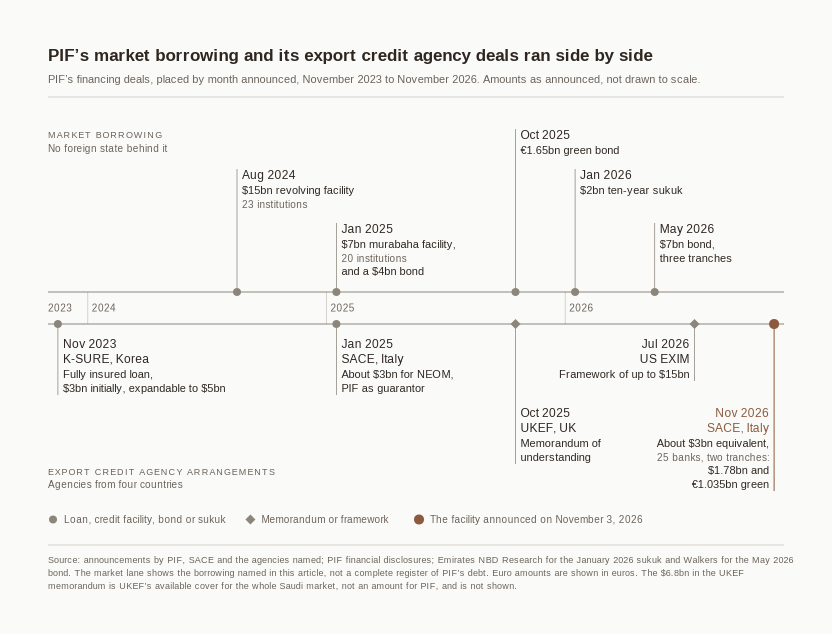
Figure 1. PIF kept borrowing in the market while it signed with export credit agencies from four countries. The November 2026 SACE facility followed a $7 billion bond sale in May.
A fund that raised $7 billion in a single bond sale in May does not need Italy’s help to borrow $3 billion in November (Figure 1). What the agency deals give PIF is another pool of bank money carrying another government’s credit, obtained for the price of a letter and some meetings. BCR’s account of the November deal set out who gets what: the banks get credit support, PIF gets room to borrow, and suppliers get future procurement opportunities. The first two arrive on signing; only the suppliers’ share is written in the future tense.
The idea that the guarantee costs Italy nothing because PIF is unlikely to default overlooks what the banks and PIF get from it. The banks count Italy’s support as something they receive, and PIF counts the extra room as something it receives. Nobody asks for a guarantee that adds nothing, so whatever it is worth to them is the measure of what Italy gave.
Agencies from four countries are courting one borrower. Korea insured its loan in full, Italy covers up to 80%, and Washington has offered a framework of up to $15 billion for purchases of American goods and services. A borrower with that many offers has every reason to keep its commitments loose, because a firm undertaking to buy from one country is worth less to it than the freedom to buy from all of them. PIF has never described its strategy this way, and the reasoning here is an inference from the pattern of its deals. It is also the simplest explanation for why a fund with Aa3 credit keeps collecting guaranteed loans.
Italy, meanwhile, keeps coming back. SACE’s Saudi business over the past three years includes a proposed €1 billion loan to the finance ministry with 80% cover (February 2024), a $100 million arrangement for ACWA Power with up to $500 million more under consideration (January 2025, the same month as the NEOM facility), and a $1 billion facility from 13 banks for Saudi Electricity, a PIF-affiliated company (November 2025). When SACE and PIF signed a memorandum in 2025, SACE said it would consider up to $3 billion of further support for PIF and its portfolio companies, which had already received more than $3 billion of SACE-backed financing. The November facility is about the size of that pledge.
Counting the stubs
A ticket leaves a stub, and the stub is where you check what was bought. SACE publishes the size of the program readily enough. Financing disbursed under Push guarantees came to €9.7 billion in 2024, and in 2025 the ESG version of Push alone accounted for €3.533 billion across 11 deals. The results get far less space. SACE’s own tally, published in July 2022, said that since its launch in 2017 Push had completed 21 operations with 19 foreign buyers, held 39 matchmaking events attended by about 2,000 Italian companies, and brought in €1.6 billion of new contracts or additional exports. The figure has no breakdown by year or by deal, and SACE has not updated it since. The €1.6 billion tally and the financing figures for 2024 and 2025 cover different periods and measure different things, so dividing one by the other would not show how much procurement Push produced. What can be compared is how they are published: the program’s size comes with figures for 2024 and for 2025, and its results were reported once, as a single cumulative number.
The comparable deals are no easier to check. Korea’s insured loan to PIF has no published procurement count, and neither does SACE’s $1 billion facility for Saudi Electricity. The clearest case is SACE’s first untied deal in Bahrain, a $300 million, ten-year loan to nogaholding (now Bapco Energies) in 2022. The borrower’s own accounts disclose that SACE covers 80% of principal and interest and that the base margin is SOFR plus 1.75%, and the loan was fully drawn in 2023. SACE held a matchmaking event for it in July 2023. Anyone can look up the spread on that loan to the basis point. Nobody has published what it bought from Italy.
The one deal that has been counted on its own is NEOM. On January 26, 2025, SACE guaranteed about $3 billion of multi-currency financing for NEOM from nine banks, with PIF as guarantor, under Push. The announcement noted that Italian companies had already won about $6.3 billion of NEOM contracts. On July 29, 2026, Maria Tripodi, an undersecretary at Italy’s foreign ministry, answered parliamentary question 4-08049 in writing. Under the SACE financing, she wrote, NEOM had not yet signed contracts with Italian companies (“non sono ancora stati sottoscritti contratti”). Her answer described this kind of procurement as future contracts that cannot be identified in advance.
The question had not been about SACE. Laura Boldrini and Fabio Porta, the deputies who asked it, were mainly concerned with relocations, labor conditions and human rights at NEOM, and the contract count came out as part of the government’s reply. The only public reconciliation of a Push deal happened almost by accident, and the number it produced was zero.
There is a serious defense of Push, and it is the one the product’s design invites. Push, on this account, is a door-opener. It gets Italian companies into rooms they would not otherwise enter, and the payoff arrives over years, through channels that no contract list captures. On this view Italian firms are doing well in Saudi Arabia. They had won $6.3 billion of NEOM work before the 2025 guarantee. Webuild secured a Diriyah Square contract worth about $600 million in July 2025, and Pirelli formed a joint venture with PIF worth about $550 million in October 2023; Arab News cited both as background to the November deal. Counting only the contracts signed under one financing misses how a product like this is supposed to work.
The examples carry less weight than they seem to. The $6.3 billion of NEOM contracts came before the guarantee. It was the reason Italy offered the guarantee, so it cannot also be the result. Webuild’s and Pirelli’s own announcements make no mention of SACE or the memorandum; the connection exists only in the newspaper’s background paragraph. The deeper claim, that the payoff is indirect and hard to attribute, describes the design and calls it a defense. If nobody can trace a benefit to the guarantee, nobody can hold the borrower to it, and a promise nobody can hold you to is one you do not have to keep.
Italy’s own government has stopped accepting that defense in full. CIPESS resolution 58/2025, adopted on December 23, 2025 and published in the Gazzetta Ufficiale on April 8, 2026, approved SACE’s activity plan for 2026. Its preamble calls for monitoring the exports that Push generates, and for an assessment of writing into every new Push contract a minimum share of Italian exports, with remedies if the minimum is missed. A government does not ask whether to add a clause its contracts already contain. The release for the November 3 facility, issued seven months after the resolution was published, mentions no minimum.
Where else the shape appears
The same structure turns up wherever a state backs money for a buyer that does not need it, in exchange for future business the buyer controls. It is there in Korea’s insured loan to the same fund, and in any arrangement that trades something delivered today for an investment or purchase pledge delivered later. Two kinds of obligation sit inside one document. One takes effect on signing. The other takes effect only if the counterparty chooses.
Such a deal reads most clearly with the guarantor as the subject of the sentence. The question then is whether anything in the text gives the promise force: a named contract, a minimum, a remedy. When none of them is there, the announcement is describing a payment that runs in one direction.
For now the reading in circulation is the headline’s. EnterpriseAM’s version said the credit was “tied to buying from Italian suppliers,” a description the product’s own classification as untied rules out, and the release itself led with cooperation with Italian businesses. The people most likely to act on that reading are Italian suppliers weighing whether to spend on bid teams, travel and local partners to court PIF’s portfolio companies. Their rereading will come at budget time, when a pipeline built on the size of the facility has to be squared with the orders it actually produced.
The syndicate banks read the deal accurately, because their credit committees have to. Their exposure runs to SACE and, behind SACE, to the Italian state, and Saudi procurement plays no part in whether they are repaid. The reading matters most for the agencies and sovereign borrowers negotiating the next arrangement of this kind, because Italy’s planning resolution calls for assessing a minimum-share clause in every new Push contract. Such a clause would make the procurement promise binding, but a borrower with three other agencies offering similar money could walk away. An agency that adopts it is likely to win fewer mandates, and to be able to show what each of them bought.
The easy mistake, for suppliers and for the officials who announce these deals, is to count the size of the facility as if it were sales. The suppliers who do best out of Push will be the ones who treat a matchmaking day as what it is, a room of potential customers who have promised to listen, and who budget for it on that basis. When the gap between headline and order book comes to light, it will most likely look like NEOM’s: a line in a written answer to a question about something else, long after the press release has been forgotten.
Anyone who has booked a table at a busy restaurant knows who pays the deposit. The diner says they will come on Friday, and the restaurant takes a deposit, because if the diner does not turn up, the restaurant is the one left with an empty table. Whoever makes the promise puts down the money. In Italy’s deal the restaurant put down the money, in the one currency that cannot be taken back, its own credit, signed and irrevocable. The diner kept the booking and the freedom to eat somewhere else. Nobody broke a rule along the way. When four restaurants chase one diner on a quiet night, the diner gets to set the terms. A promise to buy starts to count once it has a number and a date, and once breaking it costs the one who made it. That is all a deposit is, and it is what the minimum share in Italy’s planning resolution would do. A restaurant that asks for the deposit may lose the booking. One that never asks keeps paying to hold a table that may stay empty.
Sources
- PIF and SACE, joint announcement of the SACE-backed facility, November 3, 2026, on SACE’s site, on PIF’s site and as a PDF.
- Reuters report on the facility, November 3, 2026, republished by Euronext.
- BCR, report on the facility, November 3, 2026.
- Arab News, report on the facility, November 3, 2026.
- EnterpriseAM, report on the facility, November 4, 2026.
- SACE, Push Strategy product sheet.
- SACE Education, Ambictionary, entry “Push Strategy”, for the Push Letter, the matchmaking and the list of signed contracts.
- SACE, Untied financing for Italian procurement, product page, for the terms of the guarantee.
- CIPESS, Resolution 58/2025, adopted December 23, 2025, published in the Gazzetta Ufficiale on April 8, 2026. Its preamble cites Article 6(9-bis) of Decree-Law 269/2003 for the 90% and 10% split between the state and SACE, and sets out the Push monitoring and minimum-share assessment.
- Export-Import Bank of the United States, 2024 Competitiveness Report, June 2025, pp. 17 and 21.
- OECD, Arrangement on Officially Supported Export Credits, 2026 edition.
- PIF, Green Finance Framework, August 2024; DNV, second-party opinion on the framework, August 8, 2024; PIF, Allocation and Impact Report 2025, allocation as of June 30, 2025.
- PIF, K-SURE covered loan, November 28, 2023; PIF and GACI, First Supplemental Offering Circular, January 22, 2024, p. 8, for the $2.65 billion drawn.
- PIF, UKEF memorandum, October 28, 2025.
- PIF, US EXIM memorandum, July 24, 2026.
- PIF, $15 billion revolving credit facility, August 28, 2024; $7 billion murabaha facility, January 6, 2025; $4 billion bond, January 28, 2025; €1.65 billion green bond, October 16, 2025.
- Emirates NBD Research, PIF 2036 USD sukuk, January 22, 2026; PIF, Capital Markets Program, securities list.
- Walkers, PIF multi-tranche bond issuance, May 19, 2026.
- Moody’s Ratings, Public Investment Fund: Update to credit analysis, October 5, 2026; Fitch Ratings, Public Investment Fund, November 28, 2025. Both are hosted on PIF’s site.
- SACE, loan to the Saudi Ministry of Finance, February 6, 2024.
- ACWA Power, partnership with SACE, January 26, 2025; SACE, agreements signed in Saudi Arabia, January 26, 2025.
- SACE, Saudi Electricity Company facility, November 25, 2025; PIF, Consolidated Financial Statements 2024, Note 12.2, for the company’s link to PIF.
- SACE and PIF, memorandum of understanding, March 5, 2025.
- SACE, annual report 2024, p. 7, for Push disbursements in 2024; annual report 2025, consolidated report p. 39, for ESG Push.
- SACE, five years of Push Strategy, July 14, 2022.
- SACE, nogaholding Push facility, November 15, 2022; Bapco Energies, 2024 Financial Statements, Notes 1 and 19; SACE, business matching with nogaholding in Bahrain, July 4, 2023.
- SACE, NEOM financing under Push, January 26, 2025.
- Camera dei Deputati, question 4-08049 (Boldrini, Porta), written answer by Undersecretary Maria Tripodi, Ministry of Foreign Affairs, July 29, 2026.
- Webuild, Diriyah Square contract, July 14, 2025; Pirelli, joint venture with PIF, October 26, 2023.
Notes on the sources
Four statements in the text go a step beyond what the cited record says.
- The 90% and 10% split between the Italian state and SACE comes from the preamble of CIPESS Resolution 58/2025, which cites Article 6(9-bis) of Decree-Law 269/2003. That provision covers SACE’s commitments to insure and guarantee risks that EU law defines as non-market. No public document for this facility says that it falls under the provision. The figure of up to 72 cents on the dollar assumes that it does.
- The four bond and sukuk issues since January 2025 are the ones listed in the sources. The count does not come from a complete register of PIF’s debt.
- The statement that SACE has not updated its 2022 results figure rests on a search of SACE’s annual reports, results statements and event pages up to November 8, 2026. SACE has not said this itself.
- SACE’s product page calls the guarantee “unconditional, irrevocable, on-demand.” The text’s “payable on first demand” paraphrases that wording.