UKEF's Ukraine Limit Is Measured in Liability
The UK has announced a £3bn rise in UKEF's Ukraine cover limit. For exporters and lenders, the limit is used at maximum liability, and each transaction needs its own written consent.
Prepared from publicly available information as of 2 November 2026.
On 28 October 2026 the UK government announced that UK Export Finance’s cover limit for Ukraine would rise from £3.5bn to £6.5bn, an increase of £3bn. The announcement went out as a press release from UKEF and Jonathan Reynolds addressed to exporters, and on the same day GOV.UK published the two letters behind it.
What the two letters settle
The first is Tim Reid’s letter of 23 October. Reid is UKEF’s Chief Executive and writes to the Secretary of State as its Accounting Officer. He finds that the proposed support “does not meet the regularity test”, because it falls outside UKEF’s normal underwriting criteria as set under the terms of HM Treasury’s consent. On value for money he writes that he is “unable to conclude” whether the support qualifies, which stops short of finding that it does not. He raises no objection on propriety or feasibility.
Most of the rest of the letter is about losses. Reid describes the probability of default and the expected loss as very high. Expected losses are recognised when support is issued and could exceed UKEF’s annual operating income. Future debt relief, he writes, is likely to lead to a restructuring of UKEF-guaranteed debt, with corresponding losses to the Exchequer, and he expects UKEF to report a significant net operating deficit for 2025-26, driven by its support for Ukraine. He also writes that UKEF is close to the existing £3.5bn limit. The letter gives no figure for the amount used or the amount remaining.
The second document is the ministerial direction of 25 October, signed by Jonathan Reynolds as Secretary of State for Business, Innovation, Science & Trade and President of the Board of Trade, and addressed to Reid as Chief Executive and Accounting Officer. It does not dispute the risk assessment. Having weighed the financial risk against wider national security, foreign policy and economic interests, Reynolds concludes that continuing cover and raising the limit to £6.5bn is “in the national interest”. The operative paragraph instructs UKEF to “continue providing support for Ukraine through the National Interest Account” and to “take the necessary steps to increase UKEF’s market limit”. The direction is one page long. It names no loan, policyholder, guarantee beneficiary or transaction-level waiver.
HM Treasury’s Managing Public Money sets out the procedure the two letters follow. Under paragraph 3.6.2, where a proposal cannot be modified to meet the standards and the minister still decides to proceed, the accounting officer must seek a formal written direction. Paragraph 3.6.7 states: “A direction on regularity or propriety grounds does not change that position – it does not make the action regular or proper.” Reid set out his assessment; Reynolds accepted it, weighed it against policy and directed UKEF to proceed. On the handbook’s own terms, the support goes ahead without becoming regular.
Reid says that additional support requires a formal written ministerial direction and the necessary HM Treasury consent. The direction now exists. As of 2 November, neither the documents published with the letters nor HM Treasury’s 28 October announcements, the Budget and “Further support for Ukraine”, record whether consent has been obtained, its form or date, or a start date for the additional £3bn. The Budget does record a priority: in section 6.5 the additional capacity is “prioritised for military support”. Ukraine’s Ministry of Finance, reporting the change on 29 October, gave the total cover limit as GBP 6.5bn and used the future tense, “will increase the financing limit”.
On a first reading, Reid’s letter is a risk warning. The losses Reid describes fall on the Exchequer; a bank holding a UKEF guarantee has a claim against a government department. Once the additional capacity opens, money is not the scarce input for exporters and lenders working under UKEF cover; three other things are. The first is country capacity, which a transaction uses at its liability, with room for interest and risk premium, rather than at its contract price. The second is consent, which on the published arrangement the minister and HM Treasury give in writing for each transaction. The third is public tolerance for support that its own Accounting Officer has said, in a published letter, does not meet the regularity test. The two letters settle who bears the loss; an exporter or a lender has to know who decides a transaction, against what standard, and how much of the limit it uses.
For an exporter, the contract is one figure among six
The Thales transaction shows how a contract and a limit differ. It appears in five public documents under six figures, and each figure counts something else.
| Figure | What it measures | Where it appears |
|---|---|---|
| £1.6bn | The contract with Thales UK | Letter to the Business and Trade Committee, 4 March 2025 |
| approximately £2.9bn | Expected use of the existing £3.5bn country limit, at a point when loan-term negotiations were “expected to commence shortly” | The same letter |
| £1,176 million | Expected loss estimated at the effective date of the buyer credit facility issued in June 2025 | UKEF Annual Report and Accounts 2024 to 2025, post-balance-sheet events |
| £2.5bn | Guarantee announced with a 19-year financing agreement | UK government announcement, 10 July 2025 |
| nearly £1.7bn | Loan announced on the same day | Ministry of Finance of Ukraine, 10 July 2025 |
| £1,853,947,688.61 | Maximum liability of the buyer credit guarantee; buyer Ukraine, Ministry of Defence; air defence system | UKEF, Business supported 2025 to 2026 |
The six lines describe six different objects: a contract, a forecast use of the limit, an accounting estimate of loss on one facility, an announced guarantee, an announced loan and a liability ceiling. None of them converts into another. In March 2025 the financing for a contract described as £1.6bn was expected to use approximately £2.9bn of the £3.5bn limit. The annual table later recorded the guarantee’s maximum liability, which UKEF’s glossary defines as the maximum amount UKEF could be liable for, including interest. The House of Lords International Agreements Committee made a related point in paragraph 17 of its October 2024 report: the £2bn defence credit framework sat within the £3.5bn country limit, and that limit also had to accommodate interest and risk premium. The £1,176 million belongs to a single facility at its effective date. It is neither a payout nor a portfolio figure.
For an exporter, the contract price is not the figure that draws on the limit. Interest sits inside maximum liability, so the length of the financing adds to it, and the Thales financing was announced as a 19-year agreement. Defence contracts under the 2024 UK-Ukraine framework agreement on official credit support carry their own conditions, including goods and services of UK origin worth at least 20% of the relevant contract’s value, with each financed contract allocated to a credit agreement.
In March 2025 Global Trade Review ran the headline “UKEF reaches capacity limit in Ukraine”, and a UKEF spokesperson described case-by-case assessment and written consent for each transaction. UKEF’s 2024/25 annual report showed £3.4bn allocated to Ukraine at 31 March 2025, covering “effective business and forecasted committed business to be underwritten in 2025/26”. That figure is capacity allocated, including business not yet underwritten. It is not issued, drawn or at-risk business, and it cannot be taken from £3.5bn to produce a figure for what was left.
The annual Business supported tables show how the shape of the Ukraine book changed (Figure 1). By maximum liability, the Ukraine rows came to £50.7m across 11 facilities in 2021/22 and £16.6m across two export insurance policies in 2022/23. In 2023/24 they came to £333.4m across five facilities: four buyer credit guarantees for bridges and minehunters and one export insurance policy. In 2024/25 they came to £179.6m across two facilities, a Urenco buyer credit guarantee of £176.6m and an export insurance policy of £3.0m.
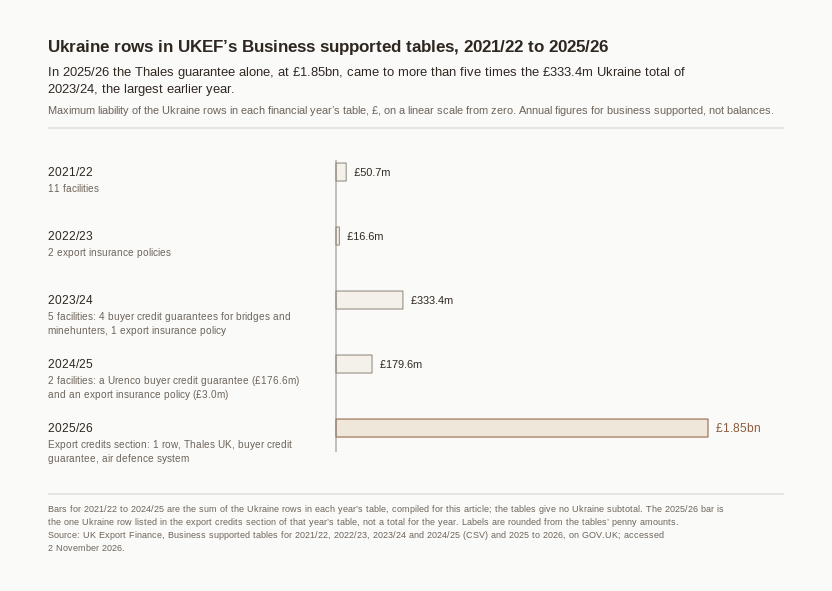
Figure 1. Maximum liability of the Ukraine rows in UKEF’s annual Business supported tables, by financial year.
For 2025/26 the export credits section of the table lists one Ukraine row, the Thales guarantee, and at £1.85bn it came to more than five times the £333.4m Ukraine total of 2023/24, the largest earlier year in the series. These are annual figures for business supported, not balances; UKEF’s glossary defines amount at risk separately as the outstanding risk on issued business.
Ukraine’s presidential office described the additional £3bn of UK export support as “primarily to supply much-needed weapons”, and the finance ministry said the new capacity “will be prioritized for military support”. UKEF’s press release, written for exporters, lists examples and pipeline projects across defence, energy, transport and reconstruction. An energy, transport or reconstruction exporter finds its sector in the press release and a military priority in the Budget. The published statements give the priority without saying how it applies to other transactions.
What a lender holds, and who decides
Under UKEF’s general Buyer Credit Facility, the lending bank is protected against non-payment of the instalments of principal and interest due under the guaranteed loan; the terms of the Ukraine transactions are not public. The guarantor is UKEF, which describes itself as “a UK government ministerial department”. Section 14(2) of the Export and Investment Guarantees Act 1991, as enacted, provides that sums needed to meet liabilities, where not paid out of money provided by Parliament, are “charged on and paid out of the Consolidated Fund”.
Seen from a guaranteed lender’s position, Reid’s warnings are about the guarantor. Every loss he counts, from expected losses recognised at issue to the restructuring he anticipates, falls on UKEF’s accounts or on the Exchequer. For a lender, the sentence on restructuring raises a further question, how claims under guarantees already issued would be treated.
A written ministerial statement of 16 January 2024, HCWS185, says support for Ukraine is assessed case by case, with written consent from the minister and HM Treasury obtained before each support is provided. UKEF’s 2024/25 annual report repeats the case-by-case and specific-approval description. The 2026 direction names no transaction and no transaction-level waiver, which leaves the 2024 description as the latest published account of how individual Ukraine transactions are approved.
The same press release also announces a change to lenders’ delegated approval powers, and it concerns a different borrower. The General Export Facility’s delegated approval threshold will rise from £10m to £15m, to be implemented with lenders. As of 2 November, UKEF’s GEF guidance still reads “up to £10 million per UK exporter”. Under GEF, participating banks receive the guarantee automatically when a facility meets the rules, without UKEF approving each case, and the borrower is the UK exporter. According to UKEF’s GEF product page and guidance, the guarantee is partial, covering up to 80% of a facility, and supported facilities can have repayment terms of up to five years. Eligibility includes UK export sales of at least 20% of annual turnover in any one of the last three financial years, or at least 5% in each of them, and the guidance lists 16 participating lenders. Under GEF a bank decides, within rules, on credit to a UK company. Under the Ukraine limit, the minister and the Treasury decide, case by case, on support for transactions with Ukrainian buyers (Figure 2).
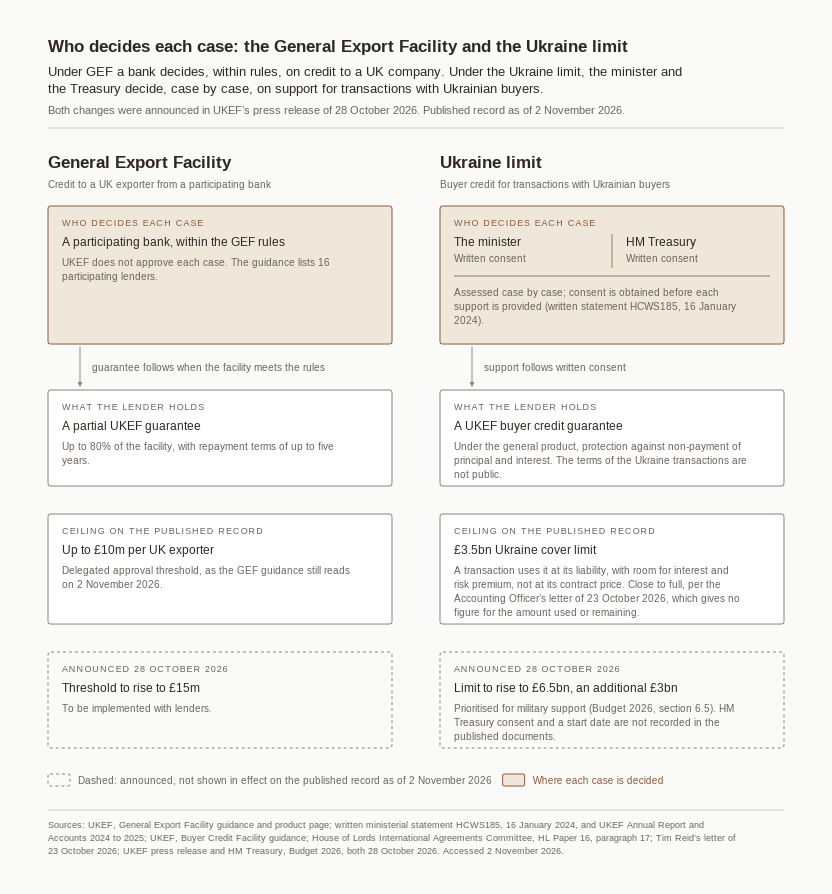
Figure 2. Who decides each case under the General Export Facility and under buyer credit for Ukrainian buyers, on the published record as of 2 November 2026.
The case that nothing has changed
The strongest objection to reading much into 28 October is that it was routine procedure and that, for a bank, nothing has changed.
Directions are a recurring, published instrument at UKEF. Since 2018 GOV.UK has published seven exchanges of Accounting Officer letters and ministerial directions for UKEF: Qatar Typhoon in 2018, Iraq in 2019, Ukraine in 2021, 2022 and 2026, the Poland NAREW air defence contract in 2024 and Jaguar Land Rover in 2025. HM Treasury’s ministerial directions collection lists six of them and omits NAREW. The seven are the published exchanges, not an official total.
Ukraine has been on this footing since 2021. Accounting Officer Louis Taylor wrote on 7 December 2021, and the Secretary of State, Anne-Marie Trevelyan, directed on 8 December, raising the Ukraine limit to £3.5bn. The same-day statement said: “This will leave around £1.2 billion available for UKEF to support further priority projects”. Taylor wrote again on 10 March 2022, citing regularity and value for money, and Trevelyan directed on 11 March to keep cover open and maintain the £3.5bn limit after Russia’s invasion. The National Audit Office records that “UKEF originally had to withdraw all cover for Ukraine in the aftermath of Russia’s invasion”, and UKEF’s 2022/23 annual report that “UKEF had to withdraw all cover for Ukraine after it fell below normal underwriting standards and risk frameworks.” Ministers reconfirmed the direction in May 2023 and July 2024, according to UKEF’s 2023/24 annual report and Reynolds’s March 2025 letter to the committee. Neither was a new direction.
Case-by-case consent was already the published arrangement in 2024, and the 2026 direction names no transaction, so on its face it addresses no existing position. For a bank with a UKEF guarantee on an existing Ukraine transaction, the published documents describe the same guarantor, the same statute and the same approval procedure as before 28 October.
The routine reading leaves out three things. The first is the guarantor’s own account of the risk. In 2021 the Accounting Officer wrote that he did not think exceeding the Ukraine limit in UKEF’s exposure management framework would expose it to an “extreme or catastrophic risk of loss”, and that UKEF would “charge adequate premium” so that its Ukraine business ran “at no net cost”. In 2026 Reid describes the probability of default and the expected loss as very high. Both assessments were made by UKEF Accounting Officers in published letters concerning support for Ukraine. Nothing published alters the guarantee in a lender’s file. The published account of what the programme costs the guarantor has moved.
The second is allocation. The additional £3bn is new capacity with a stated military priority, and on Reid’s terms additional support waits for HM Treasury’s consent. That change concerns new business. For a bank’s pipeline, what can be written, from when, and in which sector first now depends on a consent with no published date and a priority with no published rule.
The third is the record that each new transaction joins. Reid’s letter says copies of the request and the direction will go to the Comptroller and Auditor General, the Treasury Officer of Accounts and the chairs of the Public Accounts Committee and the Business and Trade Select Committee. The Guardian’s budget live blog ran the subheading “£6.5bn loan for Ukraine” and linked both letters. BCR Publishing headlined its report “UK minister overrides UKEF risk warning to raise Ukraine cover to £6.5bn”, while noting that the published letters do not confirm that Treasury consent has been given. The documents themselves describe a cover limit and a market limit, and a direction that does not dispute the risk assessment.
The first transaction against the new £3bn
A raised limit and a used limit are separate events, and UKEF’s own record has an example. Liam Fox’s direction of 12 April 2019 raised UKEF’s risk appetite for Iraq from £1bn to £2bn, with HM Treasury consent obtained. UKEF’s 2020/21 annual report states that, as at 18 June 2021, more than two years after the direction, no business had yet been underwritten under it. The Iraq measure was risk appetite rather than a cover limit, so the comparison concerns sequence, not size.
For Ukraine, the published sequence stops a step earlier. The direction and the announcement are public, and the consent is not recorded. Reid’s letter makes additional support conditional on that consent, so a first transaction drawing on the new £3bn would also be the first public sign that the consent had been given.
Such a transaction, once public, would show how the military priority is applied in practice, how much maximum liability one transaction places against the new capacity, and how the government chooses to describe it. UKEF’s press release referred to “financing for more than 5,000 air-defence missiles”. Ukrinform, which said it was relaying the UK government’s official press release, wrote in its fifth paragraph that Ukraine “has already received more than 5,000 missiles”. Ukrinform reported the missiles in UKEF’s financing announcement as already received; on the same day, the Guardian’s live blog described the £6.5bn limit as a loan.
Other export credit agencies run their Ukraine capacity on different designs. Finland’s Finnvera announced on 27 October 2026 that it had signed the SISU guarantee agreement with the European Commission, enabling up to EUR 240m of financing, and that it could start issuing guarantees under it. The Czech agency EGAP’s Ukraine Fund sets a single-entity cap of EUR 5m and a maximum term of two years, without assessing Ukraine’s current country risk in individual cases, and EGAP has announced its capacity raised to CZK 1bn. Sweden’s EKN offers cover of up to 95% under its Ukraine facility, with a consultation of Sida required for each transaction. In Finland the step that opened capacity was an agreement signed with the Commission. In the UK, on Reid’s terms, it is the Treasury’s consent, after which each transaction still needs written consent of its own.
Some gaps in the published record matter for credit work. Reid says the £3.5bn limit is close to full and gives no figure for what is used or left. The published documents record neither HM Treasury’s consent nor its form or date. The treatment of existing guarantees in a restructuring, and the rule for applying the military priority, are not in the published documents either.
Managing Public Money says that a direction on regularity grounds does not make the action regular. Any transaction supported under the additional capacity would proceed under Reynolds’s published direction, issued after Reid found, in a published letter, that the proposed support did not meet the regularity test.
The two letters settle who carries the loss: the Exchequer, on the Accounting Officer’s assessment, which the minister did not dispute. The terms that govern an exporter’s or a lender’s next Ukraine transaction are set elsewhere. Each transaction is decided in writing by the minister and HM Treasury. The standard is the national interest, weighed against a risk the Accounting Officer calls very high, with the new capacity carrying a military priority. The measure is liability, interest included.
Sources
- UK Export Finance and Jonathan Reynolds, “British exporters to be given greater access to finance as UKEF strengthens support for Ukraine”, press release, 28 October 2026. https://www.gov.uk/government/news/british-exporters-to-be-given-greater-access-to-finance-as-ukef-strengthens-support-for-ukraine
- GOV.UK, “Increase of UK Export Finance cover limit for Ukraine”, publication page with both letters, 28 October 2026. https://www.gov.uk/government/publications/increase-of-uk-export-finance-cover-limit-for-ukraine
- Tim Reid, letter to the Secretary of State setting out UKEF’s cover position for Ukraine, 23 October 2026 (PDF). https://assets.publishing.service.gov.uk/media/6adf55e69223b6191dab33e7/261023_-_Letter_from_UKEF_CEO_to_BIST_SoS_.pdf
- Jonathan Reynolds, ministerial direction to Tim Reid, 25 October 2026 (PDF). https://assets.publishing.service.gov.uk/media/6adf557a9223b6191dab33e5/BIST_SoS_to_Tim_Reid_-_UKEF_Ukraine_251026_-_Ministerial_Direction.pdf
- HM Treasury, Budget 2026, section 6.5, 28 October 2026. https://www.gov.uk/government/publications/budget-2026-document/budget-2026-html
- HM Treasury, “Further support for Ukraine”, 28 October 2026. https://www.gov.uk/government/news/further-support-for-ukraine
- UK Export Finance, “General Export Facility”, guidance. https://www.gov.uk/guidance/general-export-facility
- Export and Investment Guarantees Act 1991, as enacted (PDF). https://www.legislation.gov.uk/ukpga/1991/67/pdfs/ukpga_19910067_en.pdf
- UK Export Finance, “About us”. https://www.ukexportfinance.gov.uk/about-us/
- UK Parliament, written ministerial statement HCWS185, “UK Export Finance Support for Ukraine”, 16 January 2024. https://questions-statements.parliament.uk/written-statements/detail/2024-01-16/hcws185
- UK Export Finance, Annual Report and Accounts 2024 to 2025. https://www.gov.uk/government/publications/uk-export-finance-annual-report-and-accounts-2024-to-2025/uk-export-finance-annual-report-and-accounts-2024-to-2025
- HM Treasury, Managing Public Money, April 2026 (PDF). https://assets.publishing.service.gov.uk/media/69e0b17861d2e8e9b9e42e13/Managing_Public_Money_-_April_2026.pdf
- Louis Taylor, letter to the Secretary of State setting out UKEF’s cover position for Ukraine, 7 December 2021. https://www.gov.uk/government/publications/increase-to-uk-export-finances-cover-limit-for-ukraine/letter-from-ukef-accounting-officer-to-dit-secretary-of-state-setting-out-ukefs-cover-position-for-ukraine
- Anne-Marie Trevelyan, letter confirming the increase in UKEF’s cover for Ukraine, 8 December 2021. https://www.gov.uk/government/publications/increase-to-uk-export-finances-cover-limit-for-ukraine/letter-from-dit-secretary-of-state-to-ukef-accounting-officer-confirming-increase-in-ukefs-cover-for-ukraine
- Hansard, “UK Export Finance: Ukraine”, written statement, 8 December 2021. https://hansard.parliament.uk/commons/2021-12-08/debates/21120876000009/UKExportFinanceUkraine
- Louis Taylor, letter to the Secretary of State setting out UKEF’s cover position for Ukraine, 10 March 2022. https://www.gov.uk/government/publications/maintenance-of-uk-export-finance-cover-limit-for-ukraine/letter-from-ukef-accounting-officer-to-secretary-of-state-for-international-trade-setting-out-ukefs-cover-position-for-ukraine
- Anne-Marie Trevelyan, ministerial direction to Louis Taylor, 11 March 2022 (PDF). https://assets.publishing.service.gov.uk/media/6231ca61e90e070edf052e01/SOSFOR_1.PDF
- National Audit Office, An Overview of the Department for Business and Trade for the new Parliament 2023-24, March 2025 (PDF). https://www.nao.org.uk/wp-content/uploads/2025/03/department-for-business-overview-2023-24.pdf
- UK Export Finance, Annual Report and Accounts 2022 to 2023. https://www.gov.uk/government/publications/uk-export-finance-annual-report-and-accounts-2022-to-2023/uk-export-finance-annual-report-and-accounts-2022-23-web-accessible
- UK Export Finance, Annual Report and Accounts 2023 to 2024. https://www.gov.uk/government/publications/uk-export-finance-annual-report-and-accounts-2023-to-2024/uk-export-finance-annual-report-and-accounts-2023-to-2024
- Jonathan Reynolds, letter to the chair of the Business and Trade Committee, 4 March 2025. https://committees.parliament.uk/publications/47130/documents/244070/default/
- UK Export Finance, Business supported 2025 to 2026, 21 July 2026. https://www.gov.uk/government/publications/uk-export-finance-business-supported-2025-to-2026/business-supported-2025-to-2026
- UK government, “British investment boost in Ukraine to benefit both countries”, 10 July 2025. https://www.gov.uk/government/news/british-investment-boost-in-ukraine-to-benefit-both-countries
- Ministry of Finance of Ukraine, announcement of the loan agreement signed under the UK guarantee, 10 July 2025. https://mof.gov.ua/en/news/ukraine_will_receive_17_billion_under_the_uk_guarantee_to_strengthen_its_defense_capabilitiesthe_minister_of_finance_ceremonially_signed_the_loan_agreement-5238
- Global Trade Review, “UKEF reaches capacity limit in Ukraine”, 20 March 2025. https://www.gtreview.com/news/europe/ukef-reaches-capacity-limit-in-ukraine/
- House of Lords International Agreements Committee, HL Paper 16, October 2024. https://publications.parliament.uk/pa/ld5901/ldselect/ldintagr/16/1604.htm
- UK Export Finance, Glossary of terms. https://www.gov.uk/government/publications/uk-export-finance-annual-report-and-accounts-2025-to-2026/glossary-of-terms
- UK Export Finance, Business supported 2021 to 2022 (CSV), 30 June 2022. https://www.gov.uk/csv-preview/62bc25838fa8f535b40ea0fd/ukef-list-of-businesses-supported-2021-22.csv
- UK Export Finance, Business supported 2022 to 2023 (CSV), 28 June 2023. https://www.gov.uk/csv-preview/6499fb879e7a8b0013932bea/ukef-list-of-businesses-supported-2022-23.csv
- UK Export Finance, Business supported 2023 to 2024 (CSV), 30 July 2024. https://www.gov.uk/csv-preview/66976d7349b9c0597fdafe38/UK_Export_Finance_-_business_supported_2023_to_2024.csv
- UK Export Finance, Business supported 2024 to 2025 (CSV), 17 July 2025. https://www.gov.uk/csv-preview/685bc3667d72089d199760bb/UK_Export_Finance_business_supported_2024_to_2025.csv
- Liam Fox, ministerial direction on UKEF cover for Iraq, 12 April 2019 (PDF). https://assets.publishing.service.gov.uk/media/5cb5a4d640f0b66867b3573f/Letter_from_DIT_Secretary_of_State_to_UKEF_AO_Iraq.pdf
- GOV.UK, “UK Export Finance increases cover for Iraq”, 16 April 2019. https://www.gov.uk/government/publications/uk-export-finance-increases-cover-for-iraq
- HM Treasury, Ministerial directions collection. https://www.gov.uk/government/collections/ministerial-directions
- GOV.UK, “UK Export Finance support for export of Typhoon aircraft to Qatar”, 19 September 2018. https://www.gov.uk/government/publications/uk-export-finance-support-for-export-of-typhoon-aircraft-to-qatar
- GOV.UK, “UK Export Finance support for export of air defence systems to Poland”, 31 October 2024. https://www.gov.uk/government/publications/uk-export-finance-support-for-export-of-air-defence-systems-to-poland
- GOV.UK, “Government supports Jaguar Land Rover through provision of a guarantee for a commercial loan”, 27 October 2025. https://www.gov.uk/government/publications/government-supports-jaguar-land-rover-through-provision-of-a-guarantee-for-a-commercial-loan
- GOV.UK, “Increase to UK Export Finance’s cover limit for Ukraine”, 9 December 2021. https://www.gov.uk/government/publications/increase-to-uk-export-finances-cover-limit-for-ukraine
- GOV.UK, “Maintenance of UK Export Finance cover limit for Ukraine”, 16 March 2022. https://www.gov.uk/government/publications/maintenance-of-uk-export-finance-cover-limit-for-ukraine
- EGAP, Ukraine Fund terms. https://www.egap.cz/en/fond-ukraina
- EGAP, “Fond Ukrajina je navýšen na miliardu”. https://www.egap.cz/cs/fond-ukrajina-je-navysen-na-miliardu-do-zeme-miri-prvni-cesky-traktor/
- EKN, “Frequently asked questions about the new Ukraine facility”. https://www.ekn.se/en/guarantees/more-about-guarantees/frequently-asked-questions-about-the-new-ukraine-facility/
- Finnvera, announcement of the signed SISU guarantee agreement with the European Commission, 27 October 2026. https://www.finnvera.fi/finnvera/uutishuone/uutiset/finnvera-ja-euroopan-komissio-allekirjoittivat-sopimuksen-240-miljoonan-euron-rahoitusmahdollisuus
- The Guardian, Budget 2026 live blog, 28 October 2026. https://www.theguardian.com/uk-news/live/2026/oct/28/budget-2026-latest-updates-john-healey-andy-burnham-labour-uk-politics
- Ukrinform, report on the UK’s expanded export finance support and UKEF limit for Ukraine (in Ukrainian), 28 October 2026. https://www.ukrinform.ua/amp/rubric-economy/4179087-britania-rozsirue-finansovu-pidtrimku-eksporteriv-ta-zbilsue-limit-kreditnogo-agentstva-dla-ukraini.html
- BCR Publishing, “UK minister overrides UKEF risk warning to raise Ukraine cover to £6.5bn”, 29 October 2026. https://bcrpub.com/news/uk-minister-overrides-ukef-risk-warning-to-raise-ukraine-cover-to-6-5bn/
- Office of the President of Ukraine, readout of the call with the UK Prime Minister and Chancellor, 28 October 2026. https://www.president.gov.ua/en/news/velika-britaniya-nadast-ukrayini-dodatkovu-pidtrimku-na-10-m-107053
- Ministry of Finance of Ukraine, statement on UK budget and economic support for 2027-2029, 29 October 2026. https://mof.gov.ua/en/news/ukraine_to_receive_gbp_7_billion_in_budget_and_economic_support_from_the_uk_over_2027-2029-5993
- UK Export Finance, “Buyer Credit Facility”, guidance. https://www.gov.uk/guidance/buyer-credit-facility
- UK-Ukraine Framework Agreement on Official Credit Support for the Development of Ukraine’s Defence Capabilities, CP 1147, signed 19 July 2024 (PDF). https://assets.publishing.service.gov.uk/media/66d1a277d107658faec7e3e7/CS_Ukraine_2.2024_UK_Ukraine_Framework_Official_Credit_Support_Defence_Capabilities.pdf
- UK Export Finance, “General Export Facility”, product page. https://www.ukexportfinance.gov.uk/products-and-services/general-export-facility/
- UK Export Finance, Annual Report and Accounts 2020 to 2021, Accountability section (PDF), 22 June 2021. https://assets.publishing.service.gov.uk/media/60d5df8d8fa8f50abb3261b1/UK_Export_Finance_Annual_Report_and_Accounts_2020_to_2021_Accountability.pdf