When the Big Story Turns
When a big market story turns, the companies that borrowed it change what they say. Across eighteen of them and three turns, in 2000, 2011 and 2022, the ones that fell changed their words as quickly as the ones that lasted. Money and the business decided who lasted; a number with a date let outsiders see the answer sooner.
Prepared from publicly available information as of November 16, 2026.
On November 11, 2026, the board of NVIDIA accepted the resignation of Jensen Huang as president, chief executive and director, effective immediately. Colette Kress, the chief financial officer, was named interim chief executive, and Harvey C. Jones was named chairman. In the company’s announcement the next day, Jones said: “we expect the company’s operations, customer commitments and product roadmap to continue without interruption.”
I have admired NVIDIA and Huang for a long time, and my first reaction was shock. The second was doubt about my own work. I help companies that operate across borders explain themselves to the markets on each side. NVIDIA, as I saw it, was about as good at that as a company gets, with a version of its story for each country and region it sold into. If a company that practiced could lose the person at the center of its story in one filing, I had to wonder what my own work was worth.
I do not know why he left, and this piece does not try to find out. What I could do with the doubt was turn it into a question that public records can answer.
The question begins with the story he told. Huang had been one of the loudest voices in a story much larger than his company. “We are at the iPhone moment of AI,” NVIDIA’s blog quoted him telling its GTC conference in March 2023. “The next industrial revolution has begun,” he said in an earnings release in May 2024. At the World Governments Summit in Dubai that February he said: “It codifies your culture, your society’s intelligence, your common sense, your history – you own your own data”.
By then other companies were using the same story to explain why they deserved belief. CoreWeave’s final prospectus, dated March 2025, says on the first page of its summary: “We are the AI Hyperscaler™ driving the AI revolution.” Lenovo’s chairman and chief executive, Yuanqing Yang, opened the company’s 2024/25 annual report with: “Looking ahead, I believe our fifth decade will be Lenovo’s AI decade.” SoftBank Corp., the Japanese telecom operator, put the heading “Turning cloud and AI infrastructure for Japan into a growth opportunity” in the chief executive’s message of its 2025 integrated report. Hon Hai’s chairman, Young Liu, told analysts in March 2024 that “we believe that AI servers will be the main growth driver for this year.” TSMC’s chairman and chief executive, C.C. Wei, said in January 2025: “As a key enabler of AI applications, the value of our technology platform is increasing”.
What these companies were doing is ordinary. Every company has a story of its own. Around it there is usually a bigger one that the company did not write and cannot steer: the internet will remake retail, solar power will match the grid on cost, AI is the next industrial revolution. A company borrows the bigger story because the people it needs to convince already believe it.
The day after the resignation, one of those companies, Hon Hai, held its third-quarter call in Taipei. Asked about customers’ funding, AI spending and visibility, Liu answered that “the AI demand we see keeps increasing” (「我們所看到 AI 的需求是持續不斷的增加」; translations from Chinese in this piece are mine). The twenty-page transcript records no question about Huang’s departure.
One of the story’s loudest voices had left, and the next afternoon the story was still being told. Nobody can say whether it will turn, and I will not guess. What can be checked is what happened the last three times a story this large did turn: the internet in 2000, clean energy around 2011, and growth at any cost in 2022. Each time, companies had borrowed the story, the story changed, and what they said before and after is on the public record.
So I read that record for eighteen companies, six from each turn. Seven of them ended in liquidation, in bankruptcy court or in a debt restructuring. I took one question to the record. When the big story turned, what happened to the things these companies had said while borrowing it, and what separated the ones that lasted from the ones that fell?
The day the words changed
A big story can turn without ending. The market that had been paying for one thing starts paying for another, and companies that borrowed the story find their old sentences pointing the wrong way. Each of the three turns can be dated to within a few weeks.
The first turn was the internet’s. On March 20, 2000, Barron’s ran a cover story called “Burning Up.” It counted 207 internet companies and estimated that at least 51 of them would run out of cash within twelve months if they kept earning and spending as they had in the last quarter of 1999. It quoted Ravi Suria, head of convertible-bond research at Lehman Brothers: “Slowly the door’s beginning to shut on the pure Internet plays in the convertible market”. Three months later the same writer’s follow-up, “Up In Smoke,” quoted Greg Kyle, president of Pegasus Research International: “The focus has now shifted from growth-at-any-price to how soon profitability can be achieved.” The internet story went on. Investors had stopped paying for growth alone.
The second turn, in clean energy, came in the autumn of 2011. In May 2010 President Obama had spoken at Solyndra, a solar manufacturer with a federal loan guarantee, and said that “the nation that leads the clean energy economy is likely to lead the global economy.” On August 31, 2011, Solyndra suspended manufacturing. On September 12 Peter Thiel was reported telling a technology conference: “Cleantech is an increasingly large disaster”. Two days later, at a House hearing on Solyndra and the loan guarantee program, Representative Fred Upton questioned whether the government was qualified to act as “a venture capitalist, picking winners and losers in speculative ventures”. The following year the investor Vinod Khosla wrote: “Clean tech went through a time when it was in vogue and now it is not.”
Yet investment itself had not fallen. Bloomberg New Energy Finance counted about $260 billion of clean energy investment worldwide in 2011, a record, of which about $55.9 billion was in the United States. The price of the product was another matter. A Congressional Research Service report put solar module prices at more than $3.50 a watt in 2007 and about $1.15 a watt in 2011.
The third turn began with interest rates. On March 16, 2022, the Federal Reserve raised its target range to 0.25% to 0.50%. On May 16 Sequoia Capital gave a presentation called “Adapting to Endure,” which it published a month later. Two of its slides are titled “Growth at all costs is no longer being rewarded” and “Focus is shifting to companies with profitability”. Two years earlier Reid Hoffman had defined blitzscaling as “prioritizing speed over efficiency” in the face of uncertainty.
With dates this clear, the natural expectation is that the companies that changed their words fastest came through best.
The ones that fell changed their words too
Amazon is the company people remember getting this right. Its 1997 shareholder letter had said that, at that stage, “we choose to prioritize growth”. On April 26, 2000, five weeks after the Barron’s cover, its chief financial officer, Warren Jenson, said that “over the next three quarters combined, Amazon.com will be operating cash flow positive”.
The next day eToys reported its results. Its chief executive, Toby Lenk, said “the company’s flagship domestic business is well on its way to achieving profitability in fiscal 2002”. Two companies selling goods over the internet had reached for the same kind of sentence one day apart. eToys filed for bankruptcy a little over ten months later.
The pairing repeats. In September 2000 the chief executive of Webvan, the online grocer, said the company was “focusing our key resources on bringing our existing operations to profitability”. In December the chief executive of Priceline said: “we are re-focusing all of our efforts on achieving profitability with our core businesses”. Webvan filed for bankruptcy the following July. Priceline, in its annual report for 2004, was calling itself “a leading online travel company”.
In 2022 it went faster. Uber’s chief financial officer, Nelson Chai, said on May 4: “we now expect to generate meaningful positive free cash flows for full-year 2022”. Bird Global, the scooter-rental company, said on May 16, the day of Sequoia’s presentation, that it would “accelerate its path to profitability by streamlining and consolidating its resourcing against its core business”. Shopify’s chief executive wrote in a public letter on July 26 that a bet had failed, and announced cuts of about 10% of staff. Sea, the owner of Shopee, said on August 16 that “we are nevertheless rapidly prioritizing profitability and cash flow management”. Grab set a date for group breakeven on September 27. Lyft, in a filing on November 3, cited targets for adjusted EBITDA and free cash flow in 2024 and cut about 13% of its staff. That is all six companies from this turn inside eight months of the Fed’s March increase. Bird filed for bankruptcy in December 2023. The other five were still reporting results in 2024 or later.
A decade earlier, the solar manufacturers had changed their words twice in one autumn. China’s national feed-in tariff was published on August 1, 2011. On August 23 Trina Solar said: “we have seen increased opportunities to expand our domestic shipment allocations as the market expands.” On August 29 LDK Solar said: “We have an established, strong market position in our domestic market and see significant long-term growth opportunities.” On September 28 JinkoSolar called China “a market that is expected to grow rapidly following the nation’s new feed-in tariff announcement last month”.
In November the words changed again, this time to discipline. On November 21 Trina said that “long-term success will ultimately depend on the effective delivery of innovative solutions based on efficient manufacturing and customer-driven value-added support services.” The next day LDK said “we remain focused on strengthening our balance sheet, increasing our operating efficiencies and improving our cost structure”, and Suntech said “we will accelerate initiatives to strengthen our financial and operational discipline and streamline our organization.” Trina was shipping almost four times as much in 2015 as in 2011. LDK and Suntech did not make it.
Nor was the vocabulary new at the turn, on either side. eBay had called 1999 “a terrific year of strong, profitable growth” in January 2000, and had net income of $10.8 million to show for it. Uber had said in February 2022 that it was “poised to continue to grow at scale while expanding profitability.” But Webvan had told investors in 1999 that “our core business of operating distribution centers is highly cash generative”, and Bird’s results release of November 2021 spoke of plans to “further our path to profitability driven by strong execution and compelling unit economics.”
So neither the speed of the change nor the words chosen tells the two groups apart. The companies that fell changed their words as quickly as the ones that lasted, and used the same ones. Figure 1 sets the dates side by side.
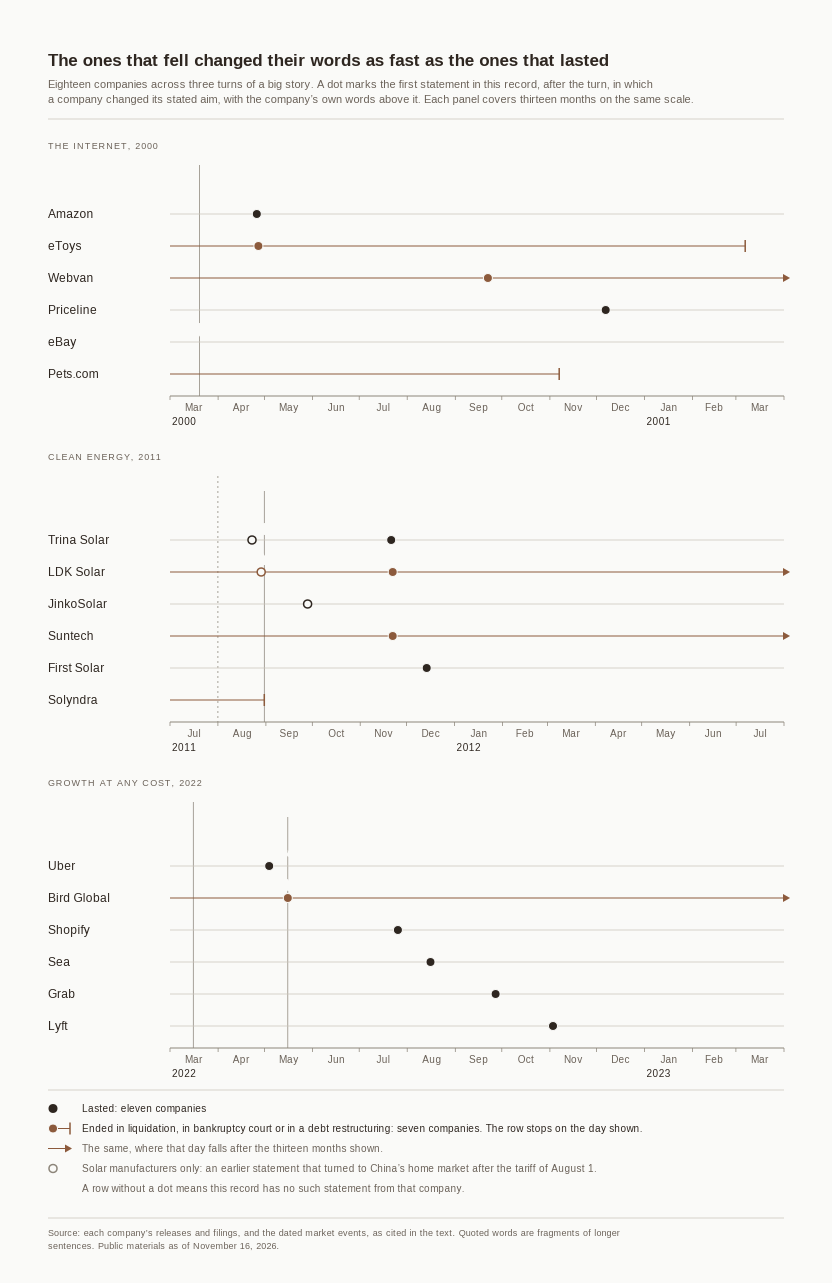
Figure 1. After each of the three turns, the companies that later fell changed their words in the same months as the ones that lasted. Amazon and eToys did so one day apart, and all six companies of 2022 did so within eight months of the Federal Reserve’s March increase. A row without a dot means this record has no such statement from that company. Source: company releases and filings, and the dated market events, as cited in the text; public materials as of November 16, 2026.
What the new words were tied to
Amazon’s sentence of April 2000 did more than change the vocabulary. It named a measure, operating cash flow, and a period, the next three quarters combined. Jenson added that the cash would “more than cover our planned capital expenditures”. Anyone could check it the following spring. The annual report shows operating cash flow of minus $54.0 million, minus $3.7 million and plus $247.7 million for those three quarters, which adds up to plus $189.9 million. The company bought $134.8 million of fixed assets in the whole of 2000, $26.6 million of it in the first quarter, which leaves about $108 million for the last three.
In January 2001 Amazon did it again. Jenson said: “we expect Amazon.com as a whole to reach operating profitability in the fourth quarter of this year”, on a pro forma basis. A year later the company reported pro forma operating profit of $59 million for that quarter and GAAP net income of $5 million. The same two releases show a promise that was not kept. Amazon had guided to sales growth of 20% to 30% for 2001, and sales grew 13%.
Amazon was not the only company to name a number. For thirteen of the eighteen, the table follows a statement made after the turn to its result. Figure 2 first shows how long one number from each took to be answered.
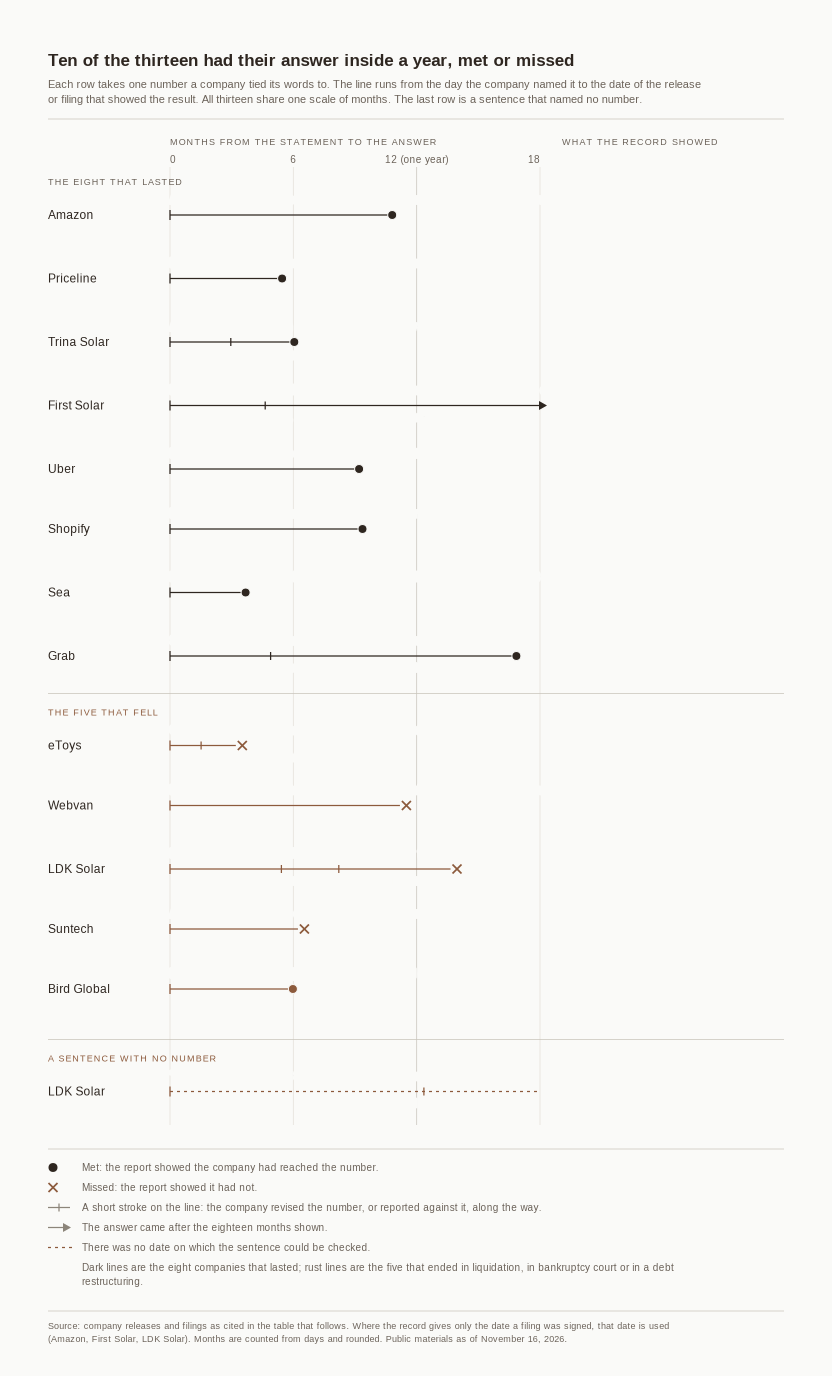
Figure 2. Ten of the thirteen companies had an answer on one named number within a year, and for four of the five that fell the answer was a miss. First Solar’s took 56 months, after it moved its date from 2014 to 2016. Bird Global met its number, and a filing signed the same day said two and a half years of its accounts could not be relied on. The figure takes one number from each company, and the table below gives the rest. Where the record gives only the date a filing was signed, that date is used (Amazon, First Solar, LDK Solar). Source: company releases and filings as cited in the table; public materials as of November 16, 2026.
| Company | What it said after the turn | What the record shows next |
|---|---|---|
| Amazon | April 2000: operating cash flow positive over the next three quarters combined. January 2001: pro forma operating profit in the fourth quarter of 2001. | Both met: $189.9 million of operating cash flow over the three quarters, and $59 million of pro forma operating profit in the fourth quarter of 2001. Sales growth of 13% in 2001 fell short of the 20% to 30% it had guided to. |
| Priceline | February 2001: targeting a pro forma operating profit in the second quarter of 2001. | Met: $9.9 million of pro forma operating profit and $2.8 million of GAAP net income that quarter. |
| Trina Solar | August 2011: non-silicon manufacturing cost below $0.70 a watt by year-end, a figure it then gave in its quarterly results. | Below $0.70 by the third quarter of 2011 and $0.64 in the fourth. $0.58 in the first quarter of 2012, when it lowered the year-end target to below $0.50. It ended 2012 at about $0.51, a cent short, with a net loss of $266.6 million for the year. |
| First Solar | December 2011: substantially all new revenue from “sustainable markets” by the end of 2014. May 2012: 2.6 to 3.0 gigawatts of such sales and a 13% to 17% return on invested capital by 2016. | Its compensation committee certified in July 2016, for an executive incentive plan, that sales in those markets had reached at least 2.8 gigawatts, with a cash-adjusted return of at least 15%, over the twelve months to June 30, 2016. |
| Uber | May 2022: positive free cash flow for full-year 2022. | Met: $390 million for the year. |
| Shopify | May 2023: free cash flow positive in each quarter of 2023. | Met: $86 million, $97 million, $276 million and $446 million, or $905 million for the year. |
| Sea | November 2022: aiming for Shopee to break even on adjusted EBITDA by the end of 2023. | Shopee reported adjusted EBITDA of $196.1 million for the fourth quarter of 2022, the quarter in which the statement was made. |
| Grab | September 2022: group adjusted EBITDA breakeven in the second half of 2024. February 2023: brought forward to the fourth quarter of 2023. | The fourth quarter of 2023 came in at plus $35 million. The full year was minus $22 million. |
| eToys | April 2000: its domestic business on the way to profitability in fiscal 2002. October 2000: holiday-quarter revenue of $210 million to $240 million and $100 million to $120 million of cash at the end of it. | Revenue for the quarter was $131.2 million and cash was $62.8 million. In December it said it no longer expected to reach profitability by its fiscal year ending March 2003. Chapter 11 in March 2001. |
| Webvan | From 1999: each distribution center to generate significant cash flow from its fifth quarter of operation, if it reached planned volumes and costs. | November 2000: “Oakland did not break-even on a cash flow basis in the third quarter of 2000”. April 2001: “To date no Webvan facility has become profitable on a cash-flow basis”. Chapter 11 in July 2001. |
| LDK Solar | March 2011: revenue of $3.5 billion to $3.7 billion for the year. | Guidance cut to $2.5 billion to $2.7 billion in August and to $2.20 billion to $2.25 billion in November. Actual: about $2.16 billion. Net sales in 2012: $863 million. |
| Suntech | August 2011: shipments of at least 2.2 gigawatts for the year. | Shipped 2,096 megawatts. In December 2012 it said its 2010 and 2011 financial statements “should not be relied upon by investors”. In March 2013 it did not repay $541 million of convertible notes at maturity. |
| Bird Global | May 2022: positive adjusted EBITDA in the third quarter of 2022 and for full-year 2023. | Reported plus $0.2 million for the third quarter of 2022. The same release said its $38.5 million of unrestricted cash would not cover the next twelve months without new funding. A filing signed the same day said its statements for 2020, 2021 and the first half of 2022 “should no longer be relied upon”. |
The first eight rows are companies that lasted. Each tied its new words to a number an outsider could look up, gave a date for it, in most cases a year away or less, and met it. First Solar and Grab started with dates further out. Grab pulled its date in. First Solar pushed its date back: the annual report it signed in February 2012 speaks of a “transition to primarily sustainable opportunities by the end of 2014”, and the quarterly report it signed that May says “by the end of 2016”.
Several of the eight missed something else along the way. Amazon missed its sales guidance. Trina cut its shipment guidance for 2011 from as much as 1.80 gigawatts to about 1.4, and was a cent short on cost at the end of 2012. Grab’s full year was still negative. Sea’s quarter included reversals of earlier accruals. Each went on reporting the number it had named, and Trina reported it in the quarter it fell short.
Which number a company named also shaped how the result read. In the year Uber delivered $390 million of free cash flow, its net loss under GAAP was $9.1 billion. Lyft shows the same thing from the other side. Its November 2022 filing cites two targets for 2024, $1 billion of adjusted EBITDA and more than $700 million of free cash flow. Its annual report for 2024 shows free cash flow of $766.3 million and adjusted EBITDA of $382.4 million, and in between the company had changed how it defined adjusted EBITDA. One target was met. The other was missed by more than half, on a measure that had been redefined.
The last five rows are companies that fell, and naming a number does not separate them from the first eight. All five named one. eToys took in $131.2 million in a quarter for which it had guided to at least $210 million. Webvan reported that its Oakland center had not broken even. LDK cut its revenue guidance twice in 2011 and finished below the second cut. Suntech shipped 2,096 megawatts against a guide of at least 2,200. Bird is the odd one. It named a number one quarter away and hit it, and on the same day told investors that two and a half years of its accounts could not be relied on and that it did not have the cash for another twelve months.
What separates the two groups in the table is whether the number was met, and that is a fact about the business. What the dated number did, for both groups, was bring the answer forward. By December 2000 anyone could see that eToys’ holiday quarter was running at little more than half of what it had guided to. By November 2000 Webvan’s own filing said Oakland had not broken even.
The sentences that were taken back
Several of the companies that lasted did one more thing in public. They took back the sentences that had claimed too much.
Amazon’s shareholder letter for 2000, public by April 2001 when the Seattle Post-Intelligencer quoted it, says: “we believed passionately in the ‘land rush’ metaphor”. Then it says of the metaphor: “we now believe its usefulness largely faded away”.
Priceline’s founder, Jay Walker, had written in the 1999 annual report that “the priceline.com business model will find applications in most sectors of the economy”. In December 2000 the company postponed its business-to-business, term life insurance and wireless ventures indefinitely and cut about 48 jobs, roughly 11% of its staff. Four years later its annual report described a travel company.
Shopify had written in May 2020 that “The global pandemic has accelerated nearly a decade of ecommerce evolution into ninety days.” Two years later its chief executive, Tobias Lütke, wrote that he had bet e-commerce’s share of retail would “permanently leap ahead by 5 or even 10 years”, and then: “It’s now clear that bet didn’t pay off.”
JinkoSolar had set a target of 1.5 gigawatts of capacity in each of its three production stages for the end of 2011. In November it cut that “from 1.5 GW each to approximately 1.2 GW each by the end of 2011 due to weak market conditions.” Its next annual report said: “Instead of expanding our production capacity, we plan to focus on improving our efficiency to reduce our unit cost.” A year before the cut, its chairman, Xiande Li, had said of vertical integration that it would “ensure our gross margin when the market fluctuates” (「从而保证市场波动情况下我们的毛利率」). Gross margin fell from 29.2% in 2010 to 15.6% in 2011. In 2015 the company shipped 4.5 gigawatts of modules at a gross margin of 20.3%.
Sea’s annual report for 2020 had said: “building our user base and increasing engagement first will allow us to maximize our monetization in the future.” In November 2022 its chairman, Forrest Li, said: “we have entirely shifted our mindset and focus from growth to achieving self-sufficiency and profitability as soon as possible, without relying on any external funding”. Lyft’s founders had told shareholders in the 2022 proxy statement, “Fundamentally, we are a growth company.” By November the company was cutting staff and pointing to profit targets.
The older sentences were not gone for good. In March 2026 Sea’s prepared remarks on Shopee said: “For the near-term, we choose to prioritize growth while upholding financial discipline.” That is nearly word for word what Amazon wrote in 1997.
By contrast, several of the companies that fell kept their largest sentences to the end. LDK’s annual report for 2010 had carried the line “LONG-TERM WINNER IN SOLAR”. Its annual report for 2011, signed on August 1, 2012, still had a full page reading “WE ARE A LONG-TERM WINNER IN THE SOLAR INDUSTRY”. Three months earlier the company had reported a gross margin of minus 65.5% for the fourth quarter. In March 2012 Suntech was still speaking of plans to “maintain our position as the leading supplier of solar products.” Solyndra’s chief executive, Brian Harrison, wrote to two members of Congress on July 13, 2011: “For 2011, revenues are projected to nearly double again.” Seven weeks later the company suspended manufacturing.
There are, then, two different things that get called falling. In one, the company survives and a sentence does not. The company had said more than its business could carry, and it withdrew the sentence itself. That is a failure of the telling, and a company can recover from it. In the other, the company itself goes.
How far the telling reaches
The companies that went left a record of why, and it is nearly the same record each time.
Pets.com, in its closing announcement of November 7, 2000: “no party was prepared to provide capital or acquire the company.” eToys, on February 14, 2001: “We do not believe that additional capital will be available to us.” Webvan’s last annual report shows $211.8 million of cash and securities, which it expected to last into the fourth quarter of 2001, and weeks later the company said “we will need $25 million in capital” to reach a break-even it now placed in the second half of 2002. Solyndra’s chief financial officer, in his affidavit to the bankruptcy court: “Without the Bridge Financing, Solyndra was unable to continue operations.” The company owed $783.8 million of secured debt. Suntech did not repay $541 million of notes when they came due. LDK restructured its main offshore debts in December 2014. Bird had $38.5 million of unrestricted cash and said it would not last twelve months.
The strongest objection to reading company statements this closely starts here. It is usually put as fundamentals driving the story and never the reverse. It was the money and the business, and the words are only the record. The companies that lasted could name a near number because they already knew they would hit it, and the companies that fell had nothing true to name. On this reading, studying what companies say tells you about their finances at one remove and nothing more.
The research mostly supports the objection. Elizabeth Demers and Baruch Lev studied 84 consumer internet companies in 2000 and found that a measure of how long each could sustain its cash burn was related to its valuation in 1999 as well as in 2000. Investors were watching the runway even in 1999. Goldfarb, Kirsch and Miller followed 788 internet businesses and found that “48% of the businesses originally described in the solicitations survived through 2004”, counting a service as surviving if it was still offered, including under a new owner. Eighteen famous names are not a sample. Huang, Teoh and Zhang studied 14,475 company-years and found that their measure of abnormal tone in earnings releases “predicts negative future earnings and cash flows”. On that evidence, tone that runs ahead of the numbers is a warning about the business.
I think the objection is mostly right. Nothing in this record suggests that any of the seven fell because of a sentence, or that a better sentence would have paid Suntech’s notes. Bird is the cleanest case. It changed its words on the day of Sequoia’s presentation, named a number one quarter out, and reported a positive figure on time. It filed for bankruptcy thirteen months later.
And where the record shows it at all, the companies that lasted had the money to reach the date they named. Amazon’s letter for 2000 says it ended the year with “cash and marketable securities of $1.1 billion”, “thanks to our early 2000 euroconvert financing”. Uber’s free cash flow was already positive, at $382 million, in the quarter in which it made its promise, and Chai called it “a new phase for Uber, self-funding future growth”.
Still, the objection leaves something standing, even if it is small. The telling decided how soon and how clearly an outsider could find out, and nothing about who lasted. Three things were in a company’s own hands on the day the story turned, whatever was in its bank account: how much its sentences claimed, which number it tied the new ones to and how soon that number fell due, and whether it reported against the number when the day came. A company that named a near number and met it could be checked within a year. A company that named one and missed was found out in months. LDK’s full-page line could not be checked against anything, and it was still in print in August 2012.
There are also two things the record cannot show. One is how the numbers were chosen. A company that names only what it already has in hand and a company that names a target and then works to reach it publish the same sentence. The other is whether investors at the time read these companies by their numbers and dates, or only by their cash. If it was only the cash, the three things describe solvent companies and little else.
Standing under two stories at once
So far each company has been read against one big story. Some of them stood under two, one in each of the markets they depended on. The record has two such groups, and they behaved in opposite ways.
The first group is four Chinese solar manufacturers that filed their reports with the SEC and, in 2011, made most of their sales outside China. On their Western side the story turned in the autumn of 2011 and kept turning. SolarWorld’s American subsidiary filed a trade petition against Chinese cells and modules on October 19. Within a week Suntech said it would work with customers “to ensure business as usual”, Trina said the allegations “will eventually prove to be unfounded”, and JinkoSolar said the petition “does not reflect the position of the U.S. Government.” A year later the Commerce Department’s final determination set dumping margins of 18.32% for Trina, 31.73% for Suntech and 25.96% for a group that included JinkoSolar and LDK. A complaint in Europe followed in July 2012, and the European Union’s definitive duties of December 2013 named rates between 41.2% and 46.7% for the four.
On their Chinese side the story was moving the other way in the same months. The feed-in tariff of August 2011 set a national price of 1.15 yuan or 1 yuan per kilowatt-hour for solar projects outside the tender system, depending on when a project was approved and built. In July 2013 the State Council called solar “a sunrise industry with enormous potential for development” (「具有巨大发展潜力的朝阳产业」) and set a target of about 10 gigawatts of new installations a year through 2015.
The companies moved toward the side that was rising, and the sentence was already in their files. Trina’s prospectus supplement of July 2009 says: “China is one of our key growth markets.” In May 2009 a Suntech results release had named “China’s recently announced national solar subsidy”, alongside incentives in Japan and the United States, as a foundation for growth. Trina’s sales in China went from 7.1% of revenue in 2011 to 33.3% in 2013. JinkoSolar’s went from 17.4% in 2011 to 45.5% in 2012. LDK’s went from 38.6% in 2011 to 51.8% in 2014. The three companies define China differently, so each figure compares a company with itself and not with the others. For Suntech I have only 2011, at 11.8%, from accounts the company later withdrew.
Yet having somewhere else to sell did not decide who lasted. LDK had more than half its sales in mainland China by 2014 and still ended in a debt restructuring. Trina lost $266.6 million in 2012 and was shipping 5.74 gigawatts in 2015. Figure 3 puts the two sides and the four companies on one time scale. The filings show where these companies sold. They do not show who financed them through 2012 and 2013, or what the banks, officials and buyers on the Chinese side were being told about them while the Western side was imposing duties. I have no record from that side at all, and it is the largest gap in this piece.
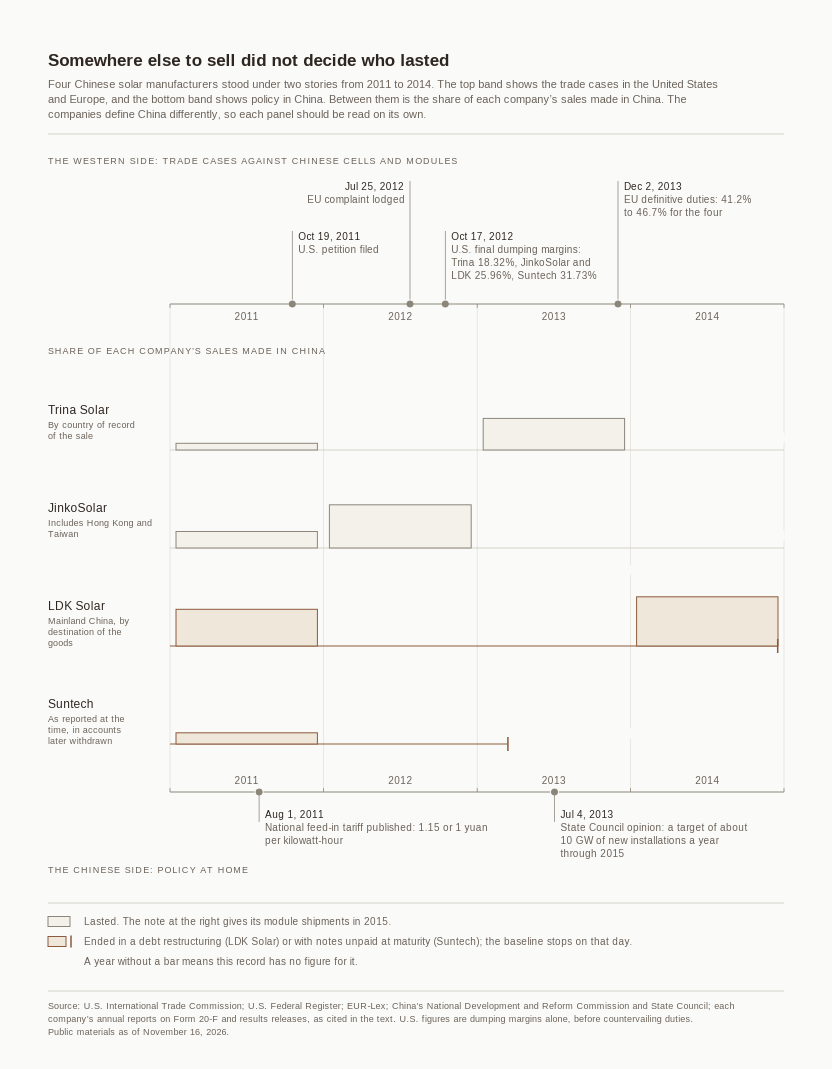
Figure 3. From 2011 to 2014 the trade cases in the United States and Europe and the policy in China moved in opposite directions, and the share of sales made in China rose at each company for which the record has two years. LDK Solar had more than half its sales in mainland China in 2014, the year its main offshore debts were restructured. The companies define China differently, so each panel compares a company only with itself, and Suntech’s single figure comes from accounts it later withdrew. The U.S. figures are dumping margins alone, before countervailing duties. Source: trade and policy documents and company annual reports as cited in the text; public materials as of November 16, 2026.
The second group is Sea and Grab, Southeast Asian internet companies that file with the SEC. Here the two stories look more like one. Google, Temasek and Bain publish an annual report on the region’s internet economy. The 2021 edition was called “Roaring 20s: The SEA Digital Decade”. When Grab announced its NASDAQ listing on December 1, 2021, the announcement cited the report: “40 million new internet users came online in 2021 in Southeast Asia.”
The American side turned in May 2022. The regional report followed a year behind. The 2022 edition, published that October, was called “Through the waves, towards a sea of opportunity”, and only the 2023 edition was called “Reaching new heights: Navigating the path to profitable growth”. Sea and Grab did not wait for it. Both had changed their words by the autumn of 2022, on the American timetable.
Meanwhile, what they said to small businesses at home, in the few statements I have, kept its shape. A Sea release in April 2021 said Shopee Indonesia was working with a partner “to create 500,000 exporters from the country by 2030.” In October 2022, a fortnight after Grab set its breakeven date, Grab and Mastercard announced a program for small businesses and gig workers, “supporting them to digitize their operations, unlock their access to financial services and more effectively participate in the digital economy.” In January 2023 another Sea release, on Shopee Malaysia, said its findings could help businesses “tap e-commerce and digital services to drive resilience and stay relevant.”
From two groups I can only offer an inference. When one side’s story turns, the other side can hold a company up to the extent that its story is told by different people and paid for with different money. The solar companies had that. Beijing’s tariff and Washington’s duties came from different governments acting for their own reasons, and the Chinese market took product the West had started to tax. Sea and Grab did not have it. Their regional story was part of what they told the investors who funded them, so when those investors changed what they paid for, the regional story followed.
Back to the doubt
Half of my doubt was right. The seven companies that fell did not fall because of how they told their story, and nothing they could have said would have replaced the money they lacked. A story cannot stand in for cash, and someone whose work is the story should say so first.
The other half was wrong. When the big story turned, companies on both sides of the outcome changed their words within months, so the change itself told an outsider nothing about who would last. What could tell an outsider something was a sentence that could be checked: a number, a date, and a report when the date came. It saved no company that lacked the money to get there. It let the rest be told apart from those, and sooner. The companies that lasted also withdrew the sentences that had claimed more than the business could carry, and several of those that fell never did. How large a company’s sentences are, and whether they can be checked, stays in its own hands when the bigger story moves.
For a company that stands in two markets, it may be that a second story helps only when it is really a second one, with its own tellers and its own money.
Having followed the record this far, I can finally see where the weight of my work lies and what it is worth. Much of what I look into from here will come back to this conclusion. It may be right, or it may have many more twists still to be worked through.
Either way, it reminds me of something Huang said on the Chinese interview program Boshi Tang (《波士堂》), broadcast in 2008, long before NVIDIA was the company it is today. He described NVIDIA’s work as a blend of technology and art. Producing graphics is only the technical part, he said, and there is no straight road to making them beautiful. “Everybody’s beauty, every year’s beauty, very different,” he went on, and then: “the road is long and winding. That’s why we have good opportunity.” The question I have been following is a road of that kind, and that is why every bend on it is a place where judgment and experience can leave something behind.
I like that description a great deal. In my own work, telling a company’s story across borders rests on technique and experience, and that is the part this piece could test: a number, a date, and a report when the date came. Beyond it is the part Huang called art. I take that to mean a beauty that carries across cultures and regions and wakes what people already want and hope for, and I think it is the part most worth pursuing.
Sources
All sources were accessed on November 16, 2026. They are listed in the order in which the text first cites them.
- NVIDIA, Form 8-K, Item 5.02, event date November 11, 2026 (SEC)
- NVIDIA, “NVIDIA Announces CEO Transition,” November 12, 2026
- NVIDIA blog, summary of the GTC keynote, March 21, 2023
- NVIDIA, results for the first quarter of fiscal 2025, May 22, 2024
- NVIDIA blog, report from the World Governments Summit in Dubai, February 12, 2024
- CoreWeave, final prospectus (Form 424B4), cover dated March 27, 2025 (SEC)
- Lenovo, chairman and CEO’s opening letter to the 2024/25 annual report, June 20, 2025
- SoftBank Corp., Integrated Report 2025, message from the CEO
- Hon Hai, fourth-quarter 2023 results call, English transcript, March 14, 2024
- TSMC, fourth-quarter 2024 earnings call transcript, January 16, 2025
- Hon Hai, third-quarter 2026 results call, Chinese transcript, November 12, 2026
- Barron’s, Jack Willoughby, “Burning Up,” March 20, 2000 (publisher’s page)
- “Burning Up,” full text as preserved on a New York University faculty page
- Barron’s, Jack Willoughby, “Up In Smoke,” as preserved on a New York University faculty page
- The White House, remarks by the President on the economy at Solyndra, May 26, 2010
- Solyndra, affidavit of chief financial officer W. G. Stover Jr. in support of its Chapter 11 filing, copy signed September 5, 2011 (court document as preserved by the Business Journals)
- VentureBeat, Matthew Lynley, report on Peter Thiel at TechCrunch Disrupt, September 12, 2011
- U.S. House Committee on Energy and Commerce, hearing “Solyndra and the DOE Loan Guarantee Program,” September 14, 2011 (GovInfo)
- Vinod Khosla, “The big green opportunity,” November 27, 2012
- Bloomberg New Energy Finance, “Solar Surge Drives Record Clean Energy Investment in 2011,” January 12, 2012 (press release as preserved by Power Engineering)
- Congressional Research Service, report R42058, October 25, 2011 (EveryCRSReport mirror)
- Federal Reserve, FOMC statement, March 16, 2022
- Sequoia Capital, “Adapting to Endure,” presented May 16, 2022, published June 14, 2022
- Sequoia Capital, “Adapting to Endure,” slides (PDF)
- Reid Hoffman, “Is Blitzscaling Over?,” Greylock, May 7, 2020
- Amazon.com, 1997 letter to shareholders
- Amazon.com, first-quarter 2000 results release, datelined April 26, 2000
- eToys, results release for the quarter and fiscal year ended March 31, 2000, dated April 27, 2000 (Internet Archive)
- eToys, Chapter 11 announcement, March 7, 2001 (SEC exhibit)
- Webvan, announcement of September 22, 2000 (Internet Archive)
- Priceline, announcement of December 7, 2000 (Form 8-K exhibit, SEC)
- SEC, order in the matter of Webvan Group, Release 34-50993, January 7, 2005
- Priceline, Form 10-K for 2004, signed March 15, 2005 (SEC)
- Uber, first-quarter 2022 results release, May 4, 2022 (SEC)
- Bird Global, first-quarter 2022 results release, May 16, 2022 (SEC)
- Shopify, Tobias Lütke, “Changes to Shopify’s team,” July 26, 2022
- Sea, second-quarter 2022 results release, August 16, 2022 (SEC)
- Grab, Investor Day announcement, September 27, 2022 (SEC)
- Lyft, Form 8-K, November 3, 2022 (SEC)
- National Development and Reform Commission, notice on the feed-in tariff for solar power (Fagai Jiage [2011] No. 1594), dated July 24, 2011, published August 1, 2011 (text on the National Energy Administration site)
- Trina Solar, second-quarter 2011 results release, August 23, 2011 (SEC)
- LDK Solar, second-quarter 2011 results release, August 29, 2011 (SEC)
- JinkoSolar, announcement on a 38 MW project with CGN, September 28, 2011
- Trina Solar, third-quarter 2011 results release, November 21, 2011 (SEC)
- LDK Solar, third-quarter 2011 results release, November 22, 2011 (SEC)
- Suntech, third-quarter 2011 results release, November 22, 2011 (SEC)
- eBay, fourth-quarter and full-year 1999 results release, January 25, 2000
- Uber, fourth-quarter and full-year 2021 results release, February 9, 2022 (SEC)
- Webvan, Form 10-Q for the third quarter of 1999, November 30, 1999 (SEC)
- Bird Global, third-quarter 2021 results release, November 15, 2021 (SEC)
- Amazon.com, Form 10-K405 for 2000, signed March 21, 2001 (SEC)
- Amazon.com, Form 10-Q for the first quarter of 2000 (SEC)
- Amazon.com, fourth-quarter 2000 results release, January 30, 2001 (Form 8-K exhibit, SEC)
- Amazon.com, fourth-quarter 2001 results release, datelined January 22, 2002
- Priceline, fourth-quarter 2000 results release, February 15, 2001 (Form 8-K exhibit, SEC)
- Priceline, second-quarter 2001 results release, July 31, 2001 (Form 8-K, SEC)
- Trina Solar, fourth-quarter and full-year 2011 results release, February 23, 2012 (SEC)
- Trina Solar, first-quarter 2012 results release, May 23, 2012 (SEC)
- Trina Solar, fourth-quarter and full-year 2012 results release, February 26, 2013 (PR Newswire)
- First Solar, announcement of December 14, 2011 (Form 8-K exhibit 99.2, SEC)
- First Solar, first-quarter 2012 results release, May 3, 2012 (SEC)
- First Solar, Form 10-Q for the second quarter of 2016, Item 5, signed August 3, 2016 (SEC)
- Uber, fourth-quarter and full-year 2022 results release, February 8, 2023 (SEC)
- Shopify, first-quarter 2023 results release, May 4, 2023 (SEC)
- Shopify, second-quarter 2023 results release, August 2, 2023 (SEC)
- Shopify, third-quarter 2023 results release, November 2, 2023 (SEC)
- Shopify, fourth-quarter and full-year 2023 results release, February 13, 2024
- Sea, third-quarter 2022 results release, November 15, 2022 (SEC)
- Sea, fourth-quarter and full-year 2022 results release, March 7, 2023 (SEC)
- Grab, fourth-quarter and full-year 2022 results release, February 23, 2023 (SEC)
- Grab, fourth-quarter and full-year 2023 results release, February 22, 2024 (SEC)
- eToys, results release for the quarter ended September 30, 2000, dated October 30, 2000 (Internet Archive)
- eToys, Form 10-Q for the quarter ended December 31, 2000, dated February 14, 2001 (SEC)
- eToys, announcement of December 15, 2000 (Form 8-K exhibit, SEC)
- Webvan, Form 10-Q for the third quarter of 2000, November 14, 2000 (SEC)
- Webvan, Form 10-K for 2000, filed April 2, 2001 (SEC)
- LDK Solar, fourth-quarter 2010 results release, datelined March 17, 2011 (SEC)
- LDK Solar, Form 20-F for 2011, signed May 15, 2012 (SEC)
- LDK Solar, Form 20-F for 2012, signed May 13, 2013 (SEC)
- Suntech, second-quarter 2011 results release, August 22, 2011 (SEC)
- Suntech, fourth-quarter and full-year 2011 results release, March 8, 2012 (SEC)
- Suntech, preliminary third-quarter 2012 results announcement, December 7, 2012 (PR Newswire)
- Suntech, announcement of May 1, 2013 (SEC)
- Bird Global, third-quarter 2022 results release, November 14, 2022 (SEC)
- Bird Global, Form 8-K, Item 4.02, signed November 14, 2022 (SEC)
- First Solar, Form 10-K for 2011, signed February 29, 2012 (SEC)
- First Solar, Form 10-Q for the first quarter of 2012, signed May 4, 2012 (SEC)
- Trina Solar, guidance update, November 3, 2011 (SEC)
- Lyft, Form 10-K for 2024, signed February 14, 2025 (SEC)
- Lyft, fourth-quarter and full-year 2022 results release, February 9, 2023 (SEC)
- Seattle Post-Intelligencer, “A brutal year for Amazon.com,” April 16, 2001
- Amazon.com, 2000 letter to shareholders
- Priceline, 1999 annual report, letter from Jay S. Walker
- Shopify, “Reunite 2020,” page dated May 20, 2020
- JinkoSolar, fourth-quarter and full-year 2010 results release, February 28, 2011 (SEC)
- JinkoSolar, third-quarter 2011 results release, November 21, 2011 (SEC)
- JinkoSolar, Form 20-F for 2011, April 18, 2012 (SEC)
- JinkoSolar, Chinese-language company release, December 10, 2010
- JinkoSolar, fourth-quarter and full-year 2015 results release, March 1, 2016
- Sea, Form 20-F for 2020, signed April 16, 2021 (SEC)
- Lyft, 2022 proxy statement, letter from the co-founders (SEC)
- Sea, prepared remarks for the fourth-quarter and full-year 2025 earnings call, March 3, 2026
- LDK Solar, annual report to shareholders for 2010 (Form 6-K), July 22, 2011 (SEC)
- LDK Solar, annual report to shareholders for 2011 (Form 6-K), signed August 1, 2012 (SEC)
- LDK Solar, fourth-quarter 2011 results release, April 30, 2012 (SEC)
- U.S. House hearing record containing Solyndra CEO Brian Harrison’s letter of July 13, 2011 (GovInfo)
- Pets.com, closing announcement, November 7, 2000 (SEC exhibit)
- Webvan, first-quarter 2001 results and restructuring release, as reprinted in Troubled Company Reporter, April 30, 2001
- LDK Solar, Form 20-F for 2014, signed May 11, 2015 (SEC)
- Elizabeth Demers and Baruch Lev, “A Rude Awakening: Internet Shakeout in 2000,” working paper, September 2000
- Goldfarb, Kirsch and Miller, “Was there too little entry during the Dot Com Era?,” working draft, April 24, 2006
- Huang, Teoh and Zhang, “Tone Management,” The Accounting Review, May 2014
- Bird Global, Form 8-K on its Chapter 11 filing of December 20, 2023 (SEC)
- Uber, second-quarter 2022 results release, August 2, 2022 (SEC)
- U.S. International Trade Commission, Publication 4360, on the petition of October 19, 2011
- Suntech, response to the U.S. trade petition, October 20, 2011 (SEC)
- Trina Solar, response to the U.S. trade action, datelined October 24 (SEC)
- JinkoSolar, response to the U.S. trade petition, October 25, 2011 (SEC)
- U.S. Department of Commerce, final antidumping determination, 77 FR 63791, October 17, 2012
- European Commission, notice of initiation 2012/C 269/04, September 6, 2012
- Council of the European Union, Implementing Regulation (EU) No 1238/2013, December 2, 2013
- State Council of China, opinions on the healthy development of the solar industry (Guofa [2013] No. 24), dated July 4, 2013 (abridged text reposted by the National Energy Administration)
- Trina Solar, preliminary prospectus supplement, July 27, 2009 (SEC)
- Suntech, first-quarter 2009 results release, May 21, 2009 (SEC)
- Trina Solar, Form 20-F for 2011 (SEC)
- Trina Solar, Form 20-F for 2013, April 2, 2014 (SEC)
- JinkoSolar, Form 20-F for 2012, April 30, 2013 (SEC)
- Suntech, Form 20-F for 2011, April 27, 2012 (SEC)
- Trina Solar, fourth-quarter and full-year 2015 results release, March 3, 2016 (SEC)
- Google, Temasek and Bain, e-Conomy SEA 2021, “Roaring 20s: The SEA Digital Decade,” November 10, 2021
- Grab, NASDAQ listing announcement, December 1, 2021 (SEC)
- Google, Temasek and Bain, e-Conomy SEA 2022, “Through the waves, towards a sea of opportunity,” October 27, 2022
- Google, Temasek and Bain, e-Conomy SEA 2023, “Reaching new heights: Navigating the path to profitable growth,” November 1, 2023
- Sea, release on Shopee Indonesia, April 1, 2021
- Grab and Mastercard, program announcement, October 12, 2022
- Sea, release on Shopee Malaysia, January 6, 2023
- 《波士堂》 (Boshi Tang), interview with Jensen Huang, broadcast in 2008 on 第一财经 and 东方卫视; video repost on Bilibili, from 32:50
- Sina Finance, broadcast schedule for 《波士堂》, 2008