How Institutional Readers Reconstruct a Cross-Border Company
What an analyst or diligence team builds from a company's public record, why that working model outlives its maker, and when reading is not the failing part.
Somewhere in a city where a certain company has no office, an analyst has been handed ten days and a template. The assignment: initiate coverage on a company that listed on a foreign exchange eight months ago. The template wants a business description, a peer set, three years of forecasts, a risk section, and a recommendation. The analyst opens the prospectus the company’s advisers spent four months polishing, reads for an hour, and starts a list of things the document does not settle.
The company will never see that list. It will see what it turns into: a report, a rating, a price target, a sentence describing the company that other people begin to repeat.
In between, something else happens. Companies tend to picture their public materials being received: read, weighed, accepted or rejected. What an institutional reader actually does is closer to construction. They take the company’s account apart, test the pieces against records the company did not supply, and assemble something of their own, built to answer their question rather than the company’s. That construction, a working model of the company, is what they act on. The most useful way to understand it is to watch one get built.
Ten days, one document
The analyst’s question was fixed before the prospectus was opened. Not “what does this company have to say,” but: does this stock enter the coverage universe, against which peers, at what multiple, with which risks flagged for clients who will skim everything except the summary table. Institutional readers rarely read to understand a company in general. They read to answer a question their institution has already asked, in a form their institution can file.
The prospectus gets the first hour, and it holds up well as a document. The self-description is coherent: a technology platform, globally diversified, scaling efficiently. The numbers sit less comfortably inside that description. Margins run closer to a distributor’s than to the platform peers’. Revenue concentration surfaces in a footnote: three customers, unnamed, just under half of sales. The research line is thinner than the story implies. None of this is damning. Together, it raises the question the analyst is actually paid to answer. What is this company an instance of? The prospectus asserts a category. The analyst’s job is to test the assertion, not to inherit it.
Testing it means leaving the document, and this is the part companies rarely picture. The footnotes lead to peer filings, to check whose margin structure this really resembles. The peer filings lead to the home-market corporate registry, where the operating subsidiary files under a different accounting basis, on a different calendar, in a language the analyst reads through a translation layer, under a name that two databases transliterate two different ways. The registry turns up a four-year-old administrative notice from a home-market agency. Routine in its own context, or not; at this distance the analyst cannot tell, so it goes on the list as found, unresolved. Then the company’s home-market website, in machine translation, where the company describes itself with a different emphasis than the listing document. At home: a champion of domestic infrastructure. In the prospectus: a global platform with diversified end markets. Neither claim is false. They were written for different rooms. They are now open in adjacent tabs.
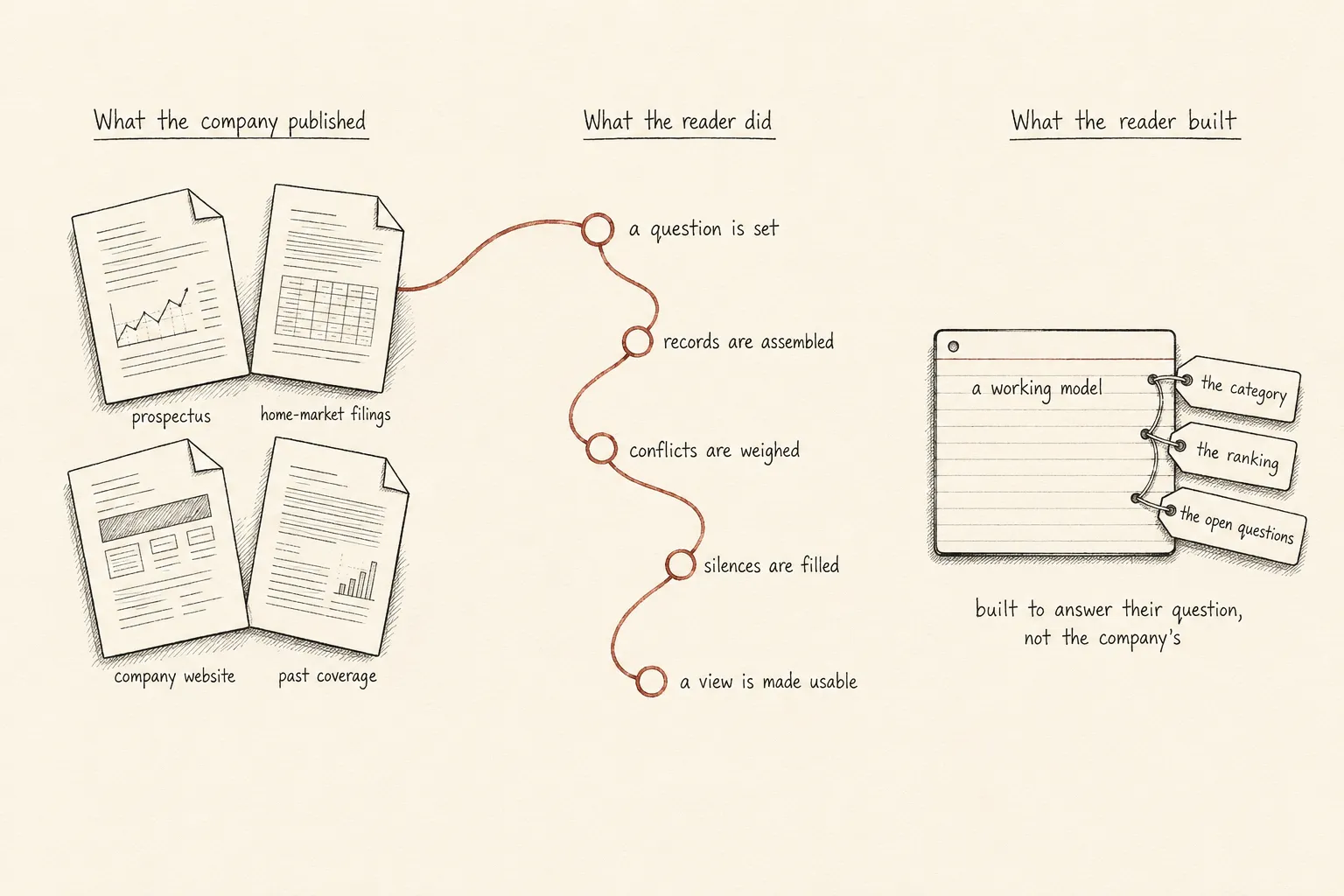
By day six the analyst holds a margin question mostly resolved, a category decision made with reservations (the platform peer set, plus a paragraph on why a discount to that set is deserved), one home-market record marked unresolved, and a folder of prior coverage in which a single early description of the company, written by a reporter on deadline two years ago, reappears in four later pieces, lightly reworded each time.
The judgments have also begun to separate. Whether this is a proper, acceptable holding: yes, without much hesitation. How it ranks against the chosen peers: middle of the pack, reservation attached. Where it sits on the map: unstable, hence the reservation. What explains the customer concentration: unknown, and recorded as unknown. Four different judgments, formed from different evidence, moving at different speeds.
On day ten the report ships. The comparables table, category decision embedded, loads into a database. The paragraph of reservations does not; prose has no field in the schema. Eighteen months later, an associate at another firm pulls the comp set as given and builds on it. The reservation is gone. The category survives. The working model has started to outlive its maker.
This is one reader, one material, one path. A credit officer, a filing reviewer, a diligence team, a journalist would each walk a different route through different records. The operations recur: a question is set, a record is assembled, conflicts are weighed, silence is filled with something, and a view is made usable for a decision.
The question arrives before the company does
Begin with the analyst’s question, which existed before the company’s document was opened. Every institutional reader arrives the same way. A filing reviewer starts from disclosure requirements. A credit officer starts from policy and limits. A journalist starts from an angle agreed at a story meeting. A diligence team starts from a risk framework with the company’s country already in it. The mandate decides what counts as relevant, what counts as evidence, and what counts as answered. The company’s materials are received as input to a question the company did not write.
Frequently the question has also been sharpened by someone else’s text before the company’s arrived: an earlier article, a short seller’s thesis, a competitor’s positioning, a category convention in that market. Once the frame is set, everything the company publishes is read as a response to it, including things written before the company knew it existed. A company in this position is negotiating inside someone else’s definition of the problem, and the definition is doing more work than any answer. How a particular account becomes the default question is a subject of its own, taken up in who controls interpretation.
From published to cited
Of everything the company had published, only some entered the model, and what entered was not what the company would have chosen. The prospectus was read because reading it was mandatory. The website was read against the prospectus, which is not the reading its authors intended. The CEO’s favorite interview never came up.
Institutional reading runs on citation. Material becomes real for an institution when it enters an artifact: quoted in the memo, loaded into the model, attached to the file. Before that, it is ambient. So the useful questions about any piece of a company’s public record are sequential: whether it arrived where these readers actually look, whether it was read, whether it was believed, whether it was recorded. Each step loses passengers, and each loss produces a recognizable state.
Some companies publish constantly and are somehow never cited; to the readers who matter, all that output is noise, production without reach. Some accounts arrive and are discounted on arrival, because the source is the company itself, so they sit in the file with a question mark attached. A meeting can go well, the reader visibly persuaded, and nothing gets written down; the agreement evaporates because it never became an artifact. And a record can be written once and refreshed never, an entry no one currently believes, exactly, but everyone inherits.
From inside the company these four look identical. In each case, the company said the right thing. The difference is on the reader’s side, in what happened to the company’s words after they left the company’s hands.
Several judgments, several clocks
A company watching its “perception” is usually watching an average of things that move independently. Whether the company is acceptable at all is a threshold judgment, formed early, sticky, revisited only under provocation. Where it ranks gets recalculated on a schedule, every quarter, every review cycle. What the company is an instance of is decided once, encoded in a comp set or a risk category, and rarely rethought after that, because rethinking categories is expensive and nobody’s job. Why the company is the way it is is usually a story inherited from whoever wrote first, and confidently. Set side by side, they run at very different speeds: the ranking fastest, the category slowest, the threshold and the inherited story in between, moving only when something forces the question.
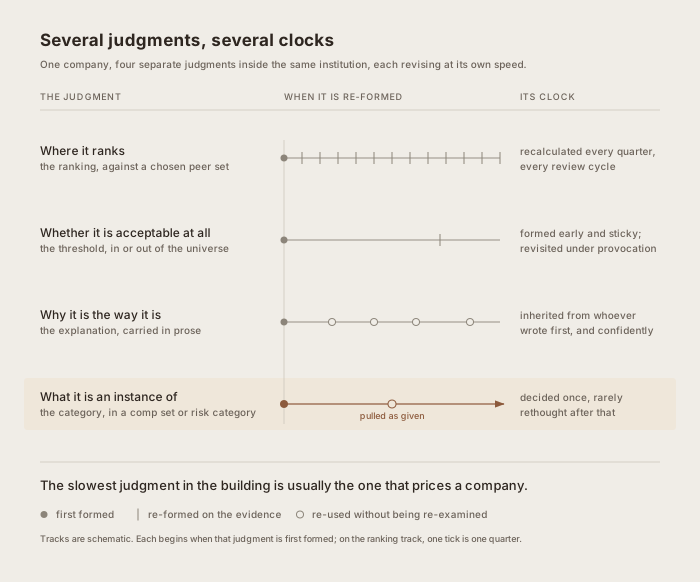
The clocks matter more than the content. A wrong ranking corrects itself in two good quarters. A wrong category can sit under a company’s valuation for years, because the readers applying it are not aware they are making a judgment at all. They are using furniture. The slowest judgment in the building is usually the one that prices a company.
Judgments become furniture
Follow the analyst’s comp table one step further and the general mechanism appears. Institutions record judgments precisely so that judgment does not have to be re-performed. The rating means the next reader does not re-underwrite. The checklist means the reviewer does not re-derive what to check. The comp set means the associate does not re-fight the category question. This is rational, and it is the only way a finite staff reads a thousand companies.
The consequence is that an encoded judgment gets applied by people who never saw the evidence, at a confidence the evidence may never have supported. Some of this furniture is public. In some regimes, the questions a securities regulator raised in a filing review, and the company’s answers, can be published once the review closes, where every later reader can cite them. Most of it is not: the risk tier in a bank’s system, the standing note in a diligence file, the flag whose origin nobody remembers. Records like these are honest in their purpose and indifferent to their age. A reading can keep working on a company years after everyone who formed it has changed desks.
A company’s versions are now adjacent
Everything above happens to purely domestic companies too. What changes at a border is the record itself. A domestic company has one record that accumulates. A cross-border company has several, and they were never written to be read together.
A cross-border company maintains versions, necessarily. Home-market filings under home accounting and host-market filings under another regime, on another calendar. A website per market. Interviews in two languages. Employees in several countries, some with public opinions. Each version is written for a room and tuned to that room’s expectations, and for most of corporate history the rooms had walls: language, distance, jurisdiction. Versions did not meet. Managing them separately was less a strategy than physics.
The walls are gone, and it is worth being precise about how. Institutions do not continuously monitor everything a company has ever published; that would not pay. What digital circulation abolished is the cost of retrieval. Any reader with a live question can now pull a company’s versions into one field and read them against each other. Diligence teams demonstrably run home-language searches under multiple transliterations of the company’s name. Reviewers in major merger regimes can request the internal documents behind a company’s public position and read the two side by side. A web archive puts a company’s current claim next to its claim from five years ago. A screenshot puts an employee’s enthusiasm next to the official line.
When versions become adjacent, the thing being read changes. Whether any single version is persuasive matters less than whether the versions, read together, hold up. Coherence is a property no single document can display; it exists, or fails, only in the juxtaposition. So it is entirely possible for every individual version to be excellent, professionally produced, locally true, and for the record as a whole to read as evasive. Each room was managed. The building was not.
This is also where descriptions of parallel reading tend to tip into paranoia, so proportion is worth stating. No reader compares every surface all the time. Comparison scales with stakes: a live transaction, a formal review, an alert from a screening tool, an inconsistency someone happened to notice. These buy the additional work. What has changed is not that every discrepancy is found. It is that any discrepancy is now findable at the moment a reader has reason to look. Companies still enjoy the old walls on ordinary days, and lose them on precisely the days that matter.
When this is the wrong lens
A reading problem is worth analyzing only when the reading is the part that is failing, and often it is not.
If the economics are broken, the readers may have reconstructed the company accurately. An account that says margins are structurally thin and the customer base is concentrated is not a misreading when margins are thin and the base is concentrated. Being understood correctly and declined on substance is not a reading problem, and treating it as one postpones the real work.
If a rule decides, the reading barely matters. Sanctions, licensing requirements, and eligibility thresholds leave readers little discretion for any reconstruction to influence.
If the decision runs on non-public evidence, a data room, a direct performance history, measured delivery against contract, then the public record only set the entry hypothesis. This lens explains how the first meeting was framed, not how the outcome was decided.
If there is almost no public footprint yet, there is nothing to reconstruct. Databases will return fragments, but no working model has formed, and analyzing one is premature.
And institutions decline companies for reasons that never touch the company at all: portfolio concentration, mandate limits, timing. Not every no contains a judgment about the company.
The right use of this lens is discrimination among causes. It identifies the cases, common but not universal, where the decision turned on how the record was assembled and read rather than on what the record contained. What a structured examination of that question covers and produces is described in what an engagement examines.
What one sees of it
Everything in this note concerns the observable side of institutional reading. From outside, one can establish what a company published and when, which records exist, which questions recur, which descriptions travel from artifact to artifact. What cannot be observed is the deliberation in between: what the committee actually believed, why the reviewer really narrowed the inquiry. Claims about that are inference, and should be labeled as inference. Where that line sits is set out in what public information can and cannot establish.
Which returns us to the asymmetry this note began with. The working model of a company is real, consequential, and mostly invisible to the company. What the company encounters is its output: the question that now opens every meeting, the peer set the company would never have chosen, the fourth article using the same phrase as the first, the extra document one counterparty always requests. It is tempting to treat each of these as a separate irritation with a separate fix. They are better read as what they are: the visible edges of a model someone built from the company’s record, for their question, some time ago. They may not have looked at it since.