Who Controls Interpretation: The Four Ports
A claim can be visible, understood, and still fail to move the judgment governing an outcome. Where it stopped acquiring force, and what that will not explain.
The communications dashboard is doing exactly what it was built to do. Coverage is up, sentiment is steady, and share of voice remains comfortably ahead of key competitors. In the same quarter, a committee’s draft opinion remains unchanged.
Nothing in the dashboard is wrong. It shows how far the company’s account has travelled and how it is being described. What it cannot show is what happened when that account entered the institution whose judgment mattered. A claim can be visible, widely repeated, and fully understood without altering the classification or procedure that governs the outcome.
That leaves a narrower question: where did the claim stop acquiring force?
What the instruments measure
Most communications instruments begin with the company’s own activity. They track what it published, how prominently it appeared, and the tone of the surrounding coverage. Share-of-voice dashboards measure presence in a conversation; sentiment monitoring classifies how the texts in that conversation read. Good evaluation practice already separates exposure from effect. What these measures cannot show on their own is what an institution did with a particular claim once it arrived.
Most evaluation frameworks likewise take the company’s program as their starting point: what it set out to do, what it published, and what response followed. An institutional reading begins elsewhere. It follows a specific claim into the external system that will frame it, receive it, judge it, and, in some cases, write that judgment into a durable form.
Following a claim through the four ports
Consider a company arguing that a proposed cross-border acquisition will strengthen local industrial capacity. The argument may be clearly stated and supported by economic data. Whether it shapes the judgment governing the outcome depends on four distinct functions.
At production, the question is who defines the problem the claim is expected to answer. Committees, officials, experts, journalists, and other participants may establish the issue’s boundaries, explain its causes, attach moral significance to it, and mark out which remedies count as reasonable. A claim rarely arrives in an empty arena; it enters a question it did not write. If the company cannot engage that frame, the rest of its argument will run inside someone else’s account of the problem.
At circulation, the question is whether the claim reaches the channels the relevant audience actually uses. A text can be highly public and still be absent from the working papers of a review board, the methodology of a rating agency, or the formal record from which a judgment is formed. To matter there, it must arrive in a form the institution can use, through channels it recognizes.
At evaluation, arrival becomes judgment. The audience may ask whether the company belongs in the arena at all, how its conduct or record compares with available alternatives, and where it stands among recognized peers or incumbents. These judgments do not necessarily move together. A company can be respected for execution while still being treated as an entity that does not quite belong. What follows also depends on the sources the evaluator trusts, how open the existing view is to revision, and whether an established category has begun to substitute for a fresh examination of the facts.
At institutionalization, the question is whether a judgment acquires durable form. A view held by one person may carry immediate weight and disappear when that person leaves. Embedded in a classification, formal procedure, eligibility list, precedent, or recognized convention, the same view can persist beyond the people who originally formed it and be applied by later actors. Credibility secured in a press briefing does not necessarily carry to the drafting table where those durable forms are written.
Interpretation control runs through four ports: who defines the problem, who circulates the text, who forms the judgment, and who turns it into rules. These are production, circulation, evaluation, and institutionalization.
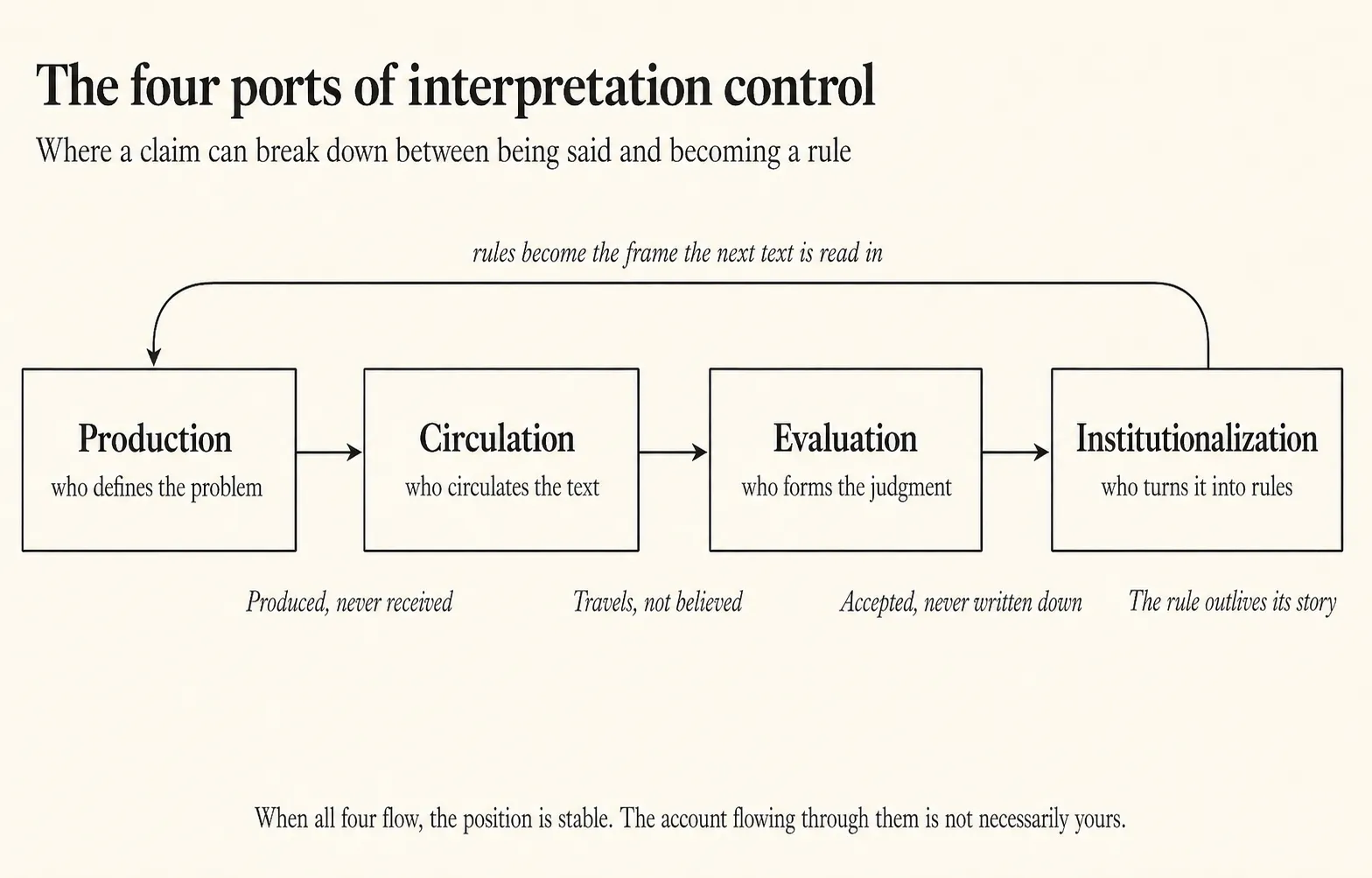
The ports name functions, not fixed organizations or job titles. A single regulatory agency may evaluate a claim and institutionalize the outcome in the same administrative act. A platform that ranks what its users see may circulate and evaluate in the same motion. The relevant unit is the act being performed, not the formal identity of the actor.
Every reading is also indexed to one claim, before one audience, within one institutional arena and jurisdiction, at a particular point in time. The same argument about industrial capacity may be accepted by financial investors and stall before a foreign investment committee in the same month. It may hold in one jurisdiction and fail in another because the two rely on different channels, categories, and procedures. Asking whether a company controls its interpretation in the aggregate recreates the dashboard problem. Asking what happened to this claim, before this audience, now produces an answer that can be tested against the record.
Nor do the ports form a strictly linear pipeline. Prior classifications shape how later claims are framed and whether they receive attention at all. An established judgment can determine which new evidence appears relevant, while an existing rule can become the frame through which the next claim is read. The sequence runs forward, but institutional systems also reach back upstream.
Where it breaks
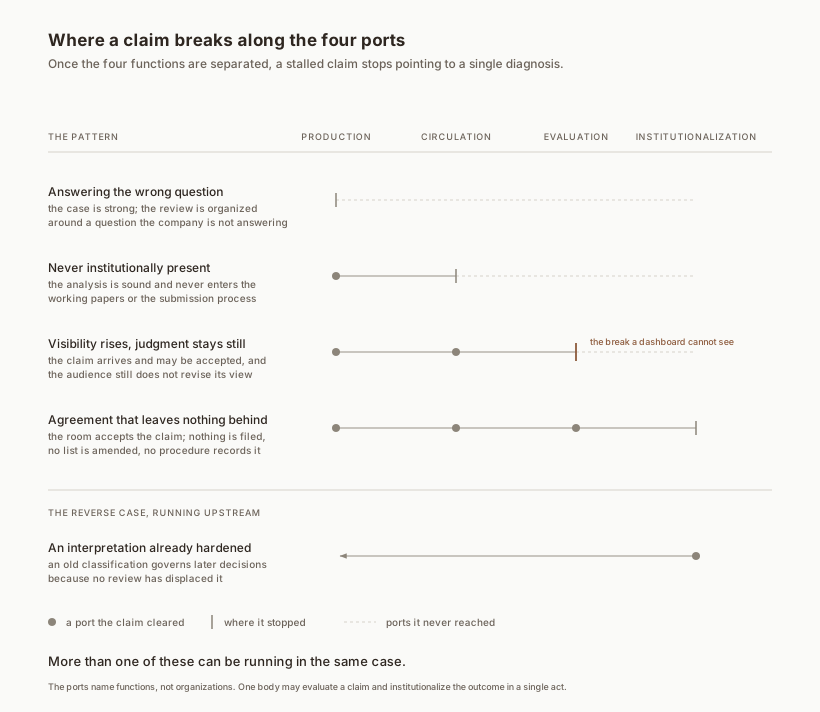
Once the functions are separated, a stalled claim no longer points to a single diagnosis.
A company may put forward a strong, well-supported case for the economic benefits of a transaction while the review is organized around security exposure, ownership and control, or institutional fit. The claim is visible and intelligible, but it answers a question the institution is not asking. More message refinement will not correct a mismatch in the frame governing the decision.
The claim may instead fit the governing question and still fail to enter the record on which judgment is based. The analysis exists and the position paper is sound, yet neither appears in the working papers, submission process, or procedure the deciding audience uses. It may not have been rejected at all; it may never have been institutionally present.
Visibility can rise while judgment stays still. Coverage accumulates, the claim reaches the relevant authority, and the evidence may even be accepted. Yet the audience does not revise how it regards the company, compares it with alternatives, or places it among recognized actors. This is the break that conventional dashboards are least equipped to see, because nearly every indicator they report may be moving in the right direction.
Agreement may also be genuine and temporary. The room accepts the claim, but nothing is filed, no list is amended, and no procedure records the judgment. When personnel change or the process resets, the agreement leaves little behind.
Then there is the reverse problem: an interpretation that has already hardened continues to operate after the assumptions beneath it have changed. An old classification or convention may govern later decisions simply because no review has displaced it. This is not a new claim failing to move from one port to the next. It is the persistence of an existing institutional form, and it can work for the company or against it.
When the same interpretation is repeatedly reproduced, relied upon, and embedded across the relevant functions, the result is a stable interpretive position. Stability says nothing about favorability. An adverse account of a company can be coherently framed, widely circulated, accepted by authoritative audiences, and written into procedure. That, too, is a stable interpretive position.
More than one of these patterns may appear in the same case, so surface symptoms cannot locate the break on their own. The reading must be inferred from observable evidence: what entered the record, which sources carried authority, whether the relevant judgment changed, and what acquired durable form.
Reading a break from the outside
Consider a specialty industrial-automation firm seeking formal recognition of its architecture within a regional standard. At the draft-review stage, the claim before the committee responsible for the conformity annex is narrow: the architecture meets the published technical criteria for inclusion among the recognized reference profiles. The case is a composite, constructed to show how a break can be located from public records rather than to report a specific advisory engagement.
The available record shows what happened to the claim. The company’s materials address the committee’s stated criteria on interoperability and safety and appear in the formal working-group record. A published assessment by a technical subgroup concludes that the architecture satisfies those criteria and is technically equivalent to the existing reference profiles.
That finding supports the conclusion that the responsible technical body considered the architecture technically eligible. Yet the draft conformity annex continues to list only the two incumbent designs. No public document explains the omission or provides a technical reason for excluding the architecture from the recognized category.
Taken together, the record supports a bounded inference. The claim addressed the stated criteria, entered the formal record, and received an affirmative technical assessment. Its absence from the annex therefore points most strongly to an institutionalization break. The firm was present in the technical discussion around the standard but absent from the text through which recognition acquired formal shape.
The evidence itself is ordinary: the documents cited by the annex, the subgroup’s published findings, and the revision history of the reference list. Together, they show where the claim appeared, what the technical body accepted, and what the draft annex recorded. They do not establish why the omission occurred. The cause may have been political, procedural, technical, or administrative; the public record does not show which. It supports a location for the break, not an explanation of the outcome or a prescription for what the firm should do next.
What this reading will not tell you
A four-port reading is deliberately limited. It can support a bounded inference about the most likely location of a break, but it does not establish why the outcome took the form it did. An authority may reopen a settled classification because the underlying facts changed, the risk environment shifted, or new evidence became available. Locating an interpretive break does not show that narrative dynamics caused the result, that the underlying judgment was mistaken, or that a different account would have changed it. Whether the situation presents a narrative problem at all is a prior question, examined in What Makes a Real Narrative Obstacle.
A reading also remains specific to one claim, audience, institutional arena, and date. Acceptance by one audience does not automatically transfer to another. Capital markets may embrace an account that a lead regulator has never accepted, with both positions persisting side by side. Treating “the market” as a single audience can therefore conceal the judgment governing the decision at issue.
The reading stops at location. Identifying the likely port of a breakdown narrows the problem, but it does not determine whether the issue is material, whether it is tractable, or whether any intervention is warranted. Those judgments belong to the next stage of analysis, which begins in Four Families of Narrative Intervention. For how this diagnostic layer sits alongside the advisers a company already has, see Narrative Architecture, Messaging, PR and IR.
The dashboard in the opening was not wrong. It showed that the company’s account was visible and how it was being described. What it could not show was whether a particular claim had entered the governing frame, the institutional record, the relevant judgment, or the rule that would outlast the moment. Those answers may diverge even for the same claim in the same quarter. The dashboard and the institutional outcome can therefore remain at odds without either observation being false. That is the distance a four-port reading is meant to locate.
Understand the method: Four Families of Narrative Intervention | How Institutional Readers Reconstruct a Cross-Border Company
See it applied: How Regulatory Friction Begins Before Formal Review
Evaluate fit: What an NPA Engagement Examines and Produces
Further reading
The four-port structure is a synthesis rather than an application of any single literature. The works below are the principal sources informing its treatment of framing, social judgment, discourse, legitimacy, and institutionalization.
-
Robert M. Entman, “Framing: Toward Clarification of a Fractured Paradigm,” Journal of Communication 43(4): 51-58 (1993).
-
Nelson Phillips, Thomas B. Lawrence, and Cynthia Hardy, “Discourse and Institutions,” Academy of Management Review 29(4): 635-652 (2004).
-
Alex Bitektine, “Toward a Theory of Social Judgments of Organizations: The Case of Legitimacy, Reputation, and Status,” Academy of Management Review 36(1): 151-179 (2011).
-
Alex Bitektine and Patrick Haack, “The ‘Macro’ and the ‘Micro’ of Legitimacy: Toward a Multilevel Theory of the Legitimacy Process,” Academy of Management Review 40(1): 49-75 (2015).
-
Tom R. Tyler, “The Psychology of Legitimacy: A Relational Perspective on Voluntary Deference to Authorities,” Personality and Social Psychology Review 1(4): 323-345 (1997).
-
Tom R. Tyler, “Psychological Perspectives on Legitimacy and Legitimation,” Annual Review of Psychology 57: 375-400 (2006).
-
Vivien A. Schmidt, “Discursive Institutionalism: The Explanatory Power of Ideas and Discourse,” Annual Review of Political Science 11: 303-326 (2008).
-
Alister Miskimmon, Ben O’Loughlin, and Laura Roselle, Strategic Narratives: Communication Power and the New World Order (Routledge, 2013).