Narrative Architecture, Messaging, PR and IR: Different Jobs at Different Moments
Bankers, counsel, investor relations and communications each do a different job well. The question their mandates omit, and when no separate layer is needed.
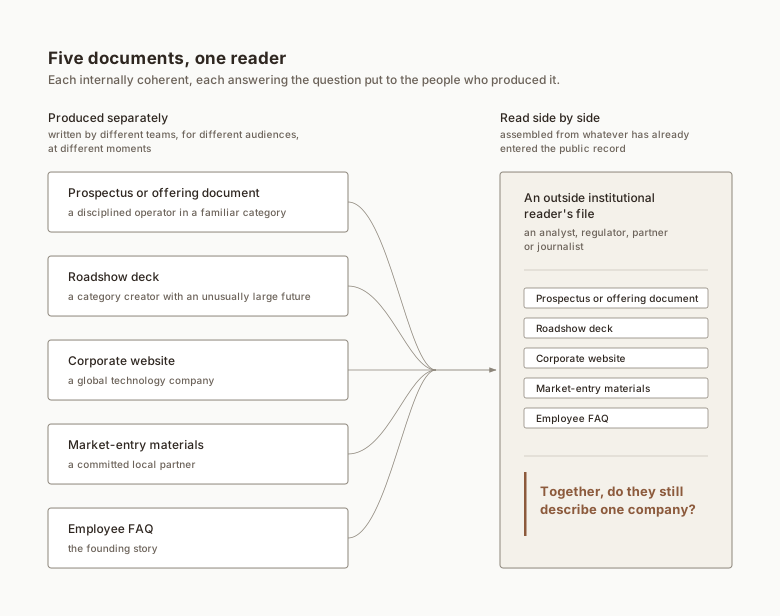
Collect the public record of almost any company preparing to cross a border. There is usually a prospectus or offering document, a roadshow deck, a corporate website, materials prepared for a new market, sometimes an employee FAQ explaining the company’s story to new hires. They are written by different teams, for different audiences, at different moments. None of that is unusual, and read one at a time, very little feels out of place.
Read side by side, they shift. The filing describes a disciplined operator in a familiar category. The roadshow presents a category creator with an unusually large future. The website introduces a global technology company. The market-entry materials speak as a committed local partner. The employee FAQ still tells the founding story. None of these accounts is necessarily inaccurate, and none implies that someone has done poor work; each answers the question put to the people responsible for producing it. What appears only when the documents are read together is that they no longer seem to describe exactly the same company.
Institutional readers rarely encounter a company one document at a time. An analyst, regulator, partner or journalist gradually assembles a file from whatever has already entered the public record. The comparison is usually informal, and nobody announces that it has begun; sooner or later, different versions of the company simply end up sitting beside one another. At that point the operative question stops being whether each document is correct and becomes whether together they still describe one company. Someone has to own that question, and it is worth being precise about who could.
A full bench
There is no vacant territory here. Corporate messaging, wherever it sits in the organization, builds the company a reusable account of itself: a language system that travels across executives and materials without being reinvented weekly. At its best it does something harder than making the company sound coherent; it helps the company discover where it is not. Public relations runs on two clocks, one continuous and one nearly instantaneous. Its trade is relationships and response, and the craft lies in knowing the difference between gaining attention and gaining acceptance, then feeding what audiences actually did back into management.
Investor relations is the most easily underestimated seat on the bench. Done seriously, it is a translator and a sensing function: it knows how investors model the company, notices where management’s account fails to match market assumptions, and remembers what the market remembers, quarter after quarter. Bankers make a transaction intelligible and executable in a specific capital market. They bring tested investor frames, comparable-company discipline, and live evidence of what is and is not clearing with buyers, and the equity story that results is a joint product of management, bank, counsel and IR; bankers themselves describe it that way. Counsel shapes the public account more than any communications plan does, deciding what must be disclosed, what may be said, when, and with what qualifications. The tests are accuracy, completeness, timing and defensibility, and good counsel explains where the boundary sits, why it is there, which routes remain open inside it, and refuses any account that outruns the evidentiary record.
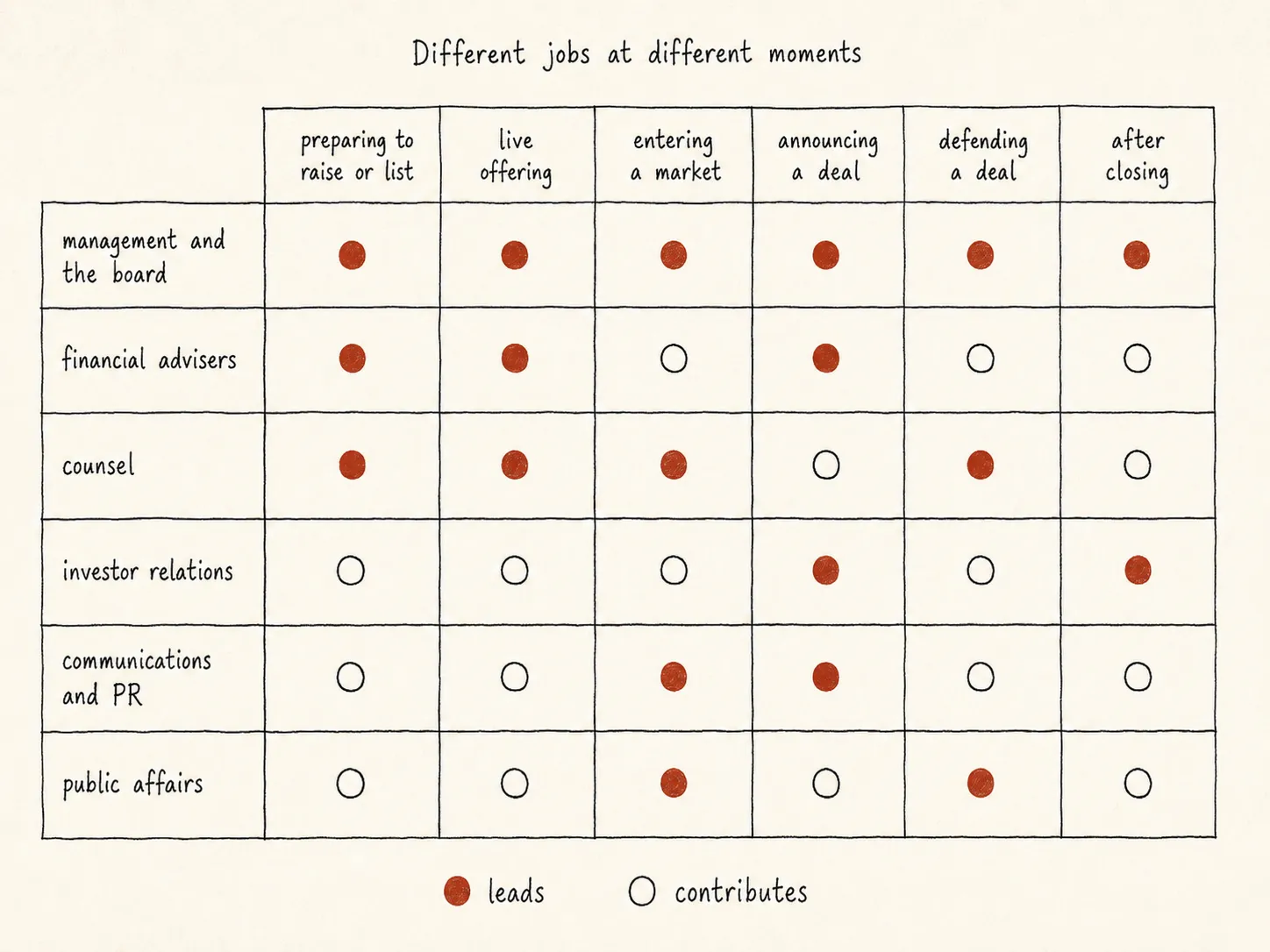
The division of labor also moves with the moment. In a listing, the banks lead valuation, investor targeting and the shape of the offer while counsel governs the disclosure process; IR leads the transition from a transaction story to a durable public-company relationship. In a market entry, the business leader owns the decision itself, counsel and public affairs lead where acceptance is institutional, and the communications team leads where acceptance is public. When a deal is announced, financial communications and IR move to the center. Who leads is rarely the confusion. What the leaders inherit is.
So the bench is full, and the people on it are good. That is what makes the divergence between the five documents interesting: it is produced by the structure of the mandates, at the hands of people doing strong work.
Where the seams run
Each adviser receives the company’s identity as an input. The banker asks how to make this company investable; counsel asks whether each statement can be supported; IR asks how the account holds up across quarters; PR asks how to put it to work with stakeholders. All four questions are the right questions, and none of them requires reopening the question they all inherit: what kind of company is this, and is it the same one in every room?
The functions also run on different clocks: a deal team’s sprint lasts weeks, counsel counts in filings and milestones, IR never quite leaves its quarterly cycle, and the press office has hours to answer. Under pressure, each clock produces the explanation it needs.
The trouble is that outside audiences keep what they are given. The comparable set chosen to price one financing shapes how the company is valued years later. A defensive line issued during one controversy becomes part of the permanent record. An account built to satisfy the nearest deadline quietly becomes the durable one.
And the documents never sit in the same room again. Prospectus, roadshow, website, regulatory submission, employee FAQ: each is internally coherent, each is separately owned, and there is usually no workflow whose job is to read them together the way an outside institutional reader will. Identity tends to harden in the first document that acquires formal approval authority, often a filing summary or a board deck. That is rarely where anyone consciously decided what the company is; it is simply where one version first became difficult to change.
Every adviser can be doing excellent work and still be carrying a different answer to the same question: what kind of company is this?
The decision without an owner
What is missing in the five-document company is a decision. Before each function converts the company’s account into its own materials, someone has to check whether the different institutional audiences are being asked to recognize the same company. Management then has to decide what must stay constant, what may legitimately vary by audience, and where the differences reflect a real strategic trade-off rather than a drafting accident. The claims, the evidence behind them, and the distinctions the company wants every audience to grasp: that shared object is the company’s narrative architecture.
Two boundaries hold the definition in place. First, in many companies this decision already has an owner. An empowered chief communications officer, a senior investor relations officer with cross-functional reach, a strategy team trusted by the chief executive and the general counsel: any of these can carry it, and where one does, there is no gap. Inserting a separate adviser into that system would add a version of the company rather than remove one.
Second, where nobody has been assigned the decision, the mandate that fills it should be temporary and bounded. Its findings are inputs for the advisers already at work: a settled set of claims, the evidence that supports them, the known points of divergence. It does not take over the roadshow, the filing, the investor program or the media plan, and once the account is settled, the work returns to the functions that own the relationships and carry the professional liabilities. What that examination involves in practice is described separately, in What an NPA Engagement Examines and Produces.
What stays with whom
Valuation, comparable selection, financing structure, bookbuilding, allocation, deal timing, and the judgment of whether a transaction clears at a given price and timetable stay with management and its financial advisers. What must be disclosed, what may be said and when, and the assessment of legal and regulatory risk stay with counsel; narrative work may examine how an audience is likely to read a position, but it offers no legal opinion and predicts no regulatory outcome, and where a narrative preference and a disclosure obligation conflict, the obligation wins.
The earnings process, guidance discipline, analyst and shareholder relationships, and the continuing feedback loop between company and market stay with investor relations. Media strategy, journalist relationships, spokesperson preparation, campaign and launch execution, crisis response and government engagement stay with communications, public relations and public affairs, the people who know how, when and through whom a message should travel. Strategy stays with management and the board: the choice among genuine trade-offs, the factual commitments, and the decision about which account of the company it is prepared to make true through action. No narrative process can make an unchosen strategy coherent.
When you do not need this
The clearest sign that you do not need this work is that your operating model already contains it. A mature company with an empowered communications chief, a senior investor relations officer, finance and legal teams that work as one, and advisers brought in before the public materials harden has little use for a separate narrative layer. The same holds when the problem is narrow: an earnings credibility issue belongs to IR, finance and counsel; a product launch belongs to the communications team; a regulatory submission belongs to counsel and the substantive experts.
Some obstacles are not interpretation problems at all: weak unit economics, a missing license, an unattractive price, a genuine competition concern. Rearranging the account will not move any of them. Narrative analysis can describe how such a problem is being read; it cannot become the reason the problem exists. The work is equally pointless when management has not yet made the strategic choices the account depends on. Applied to an unresolved strategy, it produces sophisticated ambiguity, which is worse than silence.
The criterion runs the other way. A separate engagement at this layer is justified only by an observable cross-audience problem: accounts in live workstreams that contradict one another, materially different classifications of the company between its home market and the markets that will judge it, a central claim that does not survive the public record, or standing uncertainty about who has the authority to reconcile any of this. That the company is cross-border does not qualify. That the event is important does not qualify either.
One company, in every room
Bankers make a transaction intelligible. Counsel makes the public record defensible. Investor relations carries the account through quarter after quarter of conversations with the market, and communications, public affairs and PR carry it everywhere else that people have to understand, evaluate or act on it. Each function is solving a different professional problem, and each is entitled to optimize for its own audience, timetable and responsibilities. That is exactly why the question in this article belongs to none of them automatically.
Return to the five documents from the beginning and nothing about them has changed. They are still accurate, still produced by capable people, still serving the audiences they were written for. What has changed is that they are no longer read one at a time. Someone outside the company now reads them together, and that reader does not see communications, investor relations, legal, finance and strategy as separate disciplines. They see one company, and assume that every public document describes the same thing. Sometimes the assumption holds.
When it does not, the gap is rarely an adviser’s failure. It usually appears because every adviser completed a different assignment exceptionally well, while nobody was ever asked to decide what had to remain recognizably the same across all of them. What the five-document company lacks was never a capability. It is a decision that, in some companies, nobody has ever been explicitly asked to make.
Understand the method · Narrative Problems Are Power Problems See it applied · Why Cross-Border IPOs Stumble: The Problem of Market Placement Evaluate fit · What an NPA Engagement Examines and Produces