Why Cross-Border IPOs Stumble: The Problem of Market Placement
Some cross-border listings price poorly not because the equity story is weak, but because the receiving market has no settled category in which to place the issuer.
When a cross-border listing stumbles, the word that eventually reaches the boardroom is failure. Yet the term conceals distinct operational outcomes: a transaction withdrawn after early soundings; an offering priced below the range; a listing delayed by approval or disclosure friction; or a completed offering that trades below its offer price for an extended period and attracts little research coverage.
Those outcomes do not share a common cause. A withdrawal can be a rational response to an illiquid order book; a below-range price may simply reflect a macro repricing during the roadshow.
Underwriters, accounting firms, and legal counsel already understand these mechanics. Their standard preparation work treats valuation discipline as legitimate and audited financials as the floor. When a domestic peer group reprices after a rate shock and the foreign issuer reprices with it, no additional explanation is needed.
Some cross-border IPOs stumble for a different reason. The company has the facts and a well-told equity story, yet the receiving market cannot place it in a stable category. The company brings its case; the market must decide what kind of entity it is considering. When there is no shelf for the company, information, comparable sets, coverage mandates, and pricing start to pull apart. In such cases, more explanation can make belief more expensive rather than less.
Two Jobs: Equity Story and Market Placement
The transaction workstream appropriately focuses on the equity story: how the company explains its strategic advantage, addressable market, unit economics, and the evidence for its target multiple. It is the issuer’s case for investment.
Market classification, or placement, is different. It is the receiving market’s way of sorting an issuer as it assesses risk and allocates capital.
These two jobs are constrained differently. The audience for the equity story is not a single market. It is a group of institutions, each with its own mandate and limits.
The sell-side analyst has a defined coverage mandate, usually bounded by sector, geography, or market capitalization. Models and client conversations are built around that remit. An issuer that combines software-like margins with heavy manufacturing capital requirements may not sit comfortably within any analyst’s explicit remit.
A long-only fund manager faces a different constraint. They must defend the position to an investment committee, which will assess more than standalone financial merit. The company must also fit the fund’s established risk parameters for the sector. The manager needs an explanation that can survive that conversation.
The lead bank needs a stable comparable set: one that can anchor valuation expectations, support a pricing model, and guide syndication to the right investors.
When a company has a stable shelf and the relevant actors broadly agree on what it is, the equity story can work as intended. The disagreements are largely financial: growth rates, margin assumptions, and discount rates.
When placement is unstable, the transaction’s ordinary machinery starts to strain. An analyst may use the nearest available shelf because a model still has to be built. A long-only manager may pass not because the revenue data are false, but because the hybrid business is difficult to defend in committee. The lead bank, seeing a fragmented order book, may lower the price to clear the deal.
Why Cross-Border Deals Can Amplify the Problem
Classification frictions also appear in domestic transactions, especially when an issuer straddles established sectors. Cross-border issuance can amplify them.
A domestic issuer often arrives in a market with a familiar regulatory grammar, a settled map of comparables, and well-understood governance expectations. The market already has a working architecture for processing the corporate structure.
A cross-border issuer adds institutional conditions to the question. The receiving market must assess core operations alongside home-jurisdiction law, cross-border data rules, and the enforceability of governance arrangements. The issuer is looking for more than an industry category. It needs a placement capable of holding its business capabilities and institutional conditions at the same time.
The tension sharpens when a foreign operating reality is translated into the domestic market’s taxonomy. Founder protections that are standard in the issuer’s home market may be read as execution risk in the receiving market. A corporate footprint designed for regional supply chains may be read as geopolitical exposure. When these added conditions destabilize placement, capital gravitates toward the most conservative available category.
The Problem in Motion
To see how this misalignment develops, consider a composite case, assembled from recurring transaction patterns rather than any single deal.
The issuer is a precision-measurement systems maker preparing to list outside its home market. It has defensible technology, instruments embedded in customers’ quality-control chains, and a founder-led executive team fluent in the underlying physics.
During early investor education, the market struggles to place the company. Investors ask questions that seek a bridge from the technology to familiar software or hardware economics. The founders respond with greater technical detail. The answers are accurate, yet each one adds to what the audience must hold. None of them builds a path from technical capability to durable revenue.
Without a clean comparable set, sell-side analysts place the company on the nearest available shelf: low-multiple industrial machinery. Long-only funds read the prospectus and meet management. They do not necessarily doubt the technology; they pass because the explanation is too convoluted to carry into an investment committee.
The lead bank sees a hesitant order book and suggests pricing at the bottom of the range.
In the boardroom, the company concludes that the new market does not understand, or will not pay for, deep technology.
A different question fits the evidence better: was the market ever given a stable placement in which to test the technology’s value? Each additional proof of technical depth made that test more expensive for the audience. The facts were never the problem; what was missing was a category to hold them.
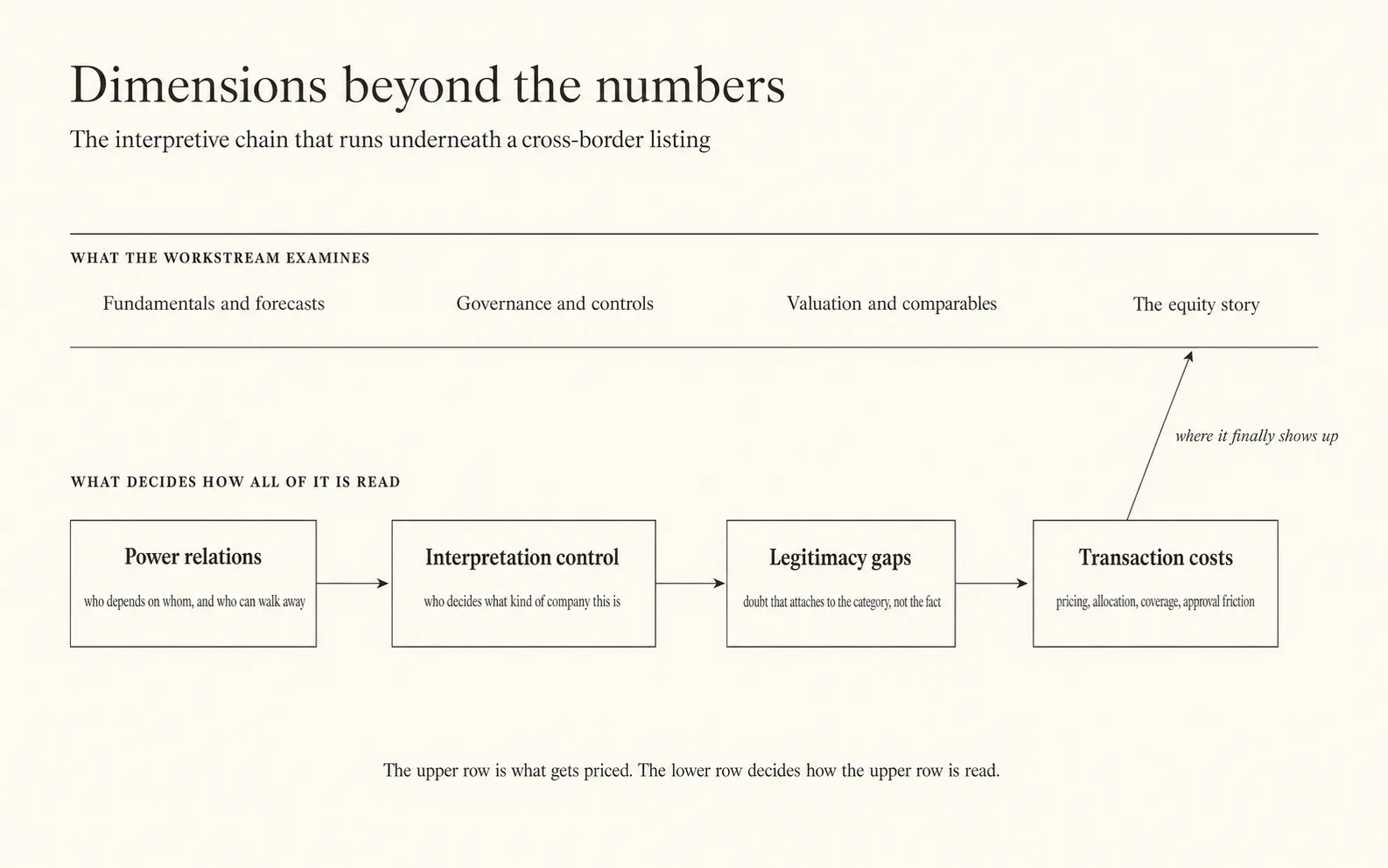
Underneath the composite runs a sequence. The familiar workstream, the part that gets priced, is fundamentals, governance, valuation, the equity story. What decides how that workstream is read sits below it: power relations, which set whose judgment the issuer depends on and who can walk away; and interpretation control, where the analyst picking the nearest shelf and the committee hearing the fund manager’s case are each, in that moment, deciding what kind of company this is. When that decision finds no stable place to land, doubt attaches to the company’s category rather than to any specific fact: a legitimacy gap. And what begins as a placement problem surfaces again inside the workstream, as transaction costs: pricing, allocation, coverage, approval friction.
Narrative Reading and Categorical Resistance
A narrative reading examines how a market classifies an issuer and how that classification affects transaction costs. Its job here is to identify when an issuer is facing categorical resistance.
Categorical resistance arises when doubt attaches to a company’s category rather than a specific behavior. A behavioral concern can often be corrected: an omitted disclosure may be supplied, and the factual question may then recede. Category-based resistance works differently. Unrelated evidence starts to be read with suspicion.
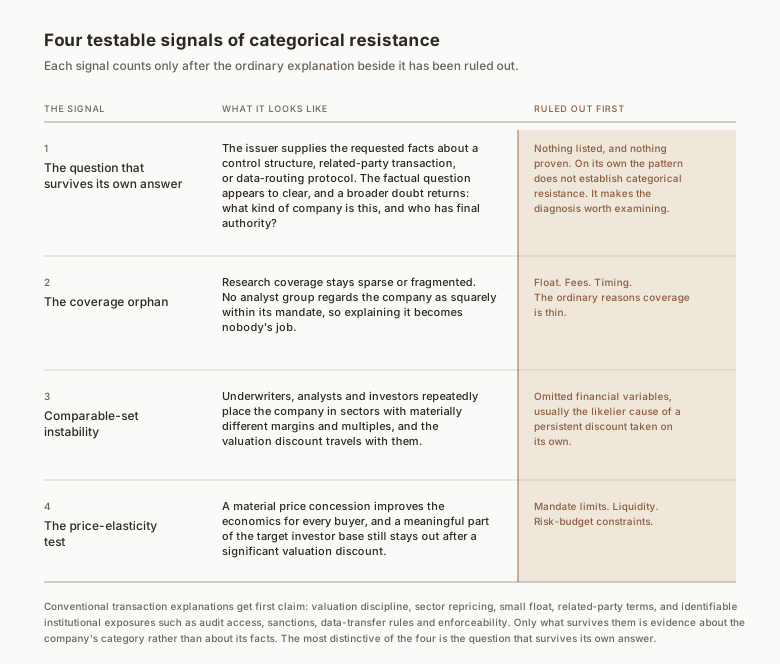
There are several testable signals. The most distinctive is the question that survives its own answer. An issuer supplies the requested facts about a control structure, related-party transaction, or data-routing protocol. The immediate factual question appears to clear, yet a broader doubt returns: What kind of company is this? Who has final authority? That pattern does not prove categorical resistance, but it makes the diagnosis worth examining.
Another is the coverage orphan: research coverage remains sparse or fragmented after ordinary explanations such as float, fees, and timing have been ruled out. No analyst group regards the company as squarely within its mandate, so explaining it becomes nobody’s job.
Comparable-set instability is a third signal. A persistent valuation discount alone is weak evidence: omitted financial variables are usually the more likely cause. The signal strengthens when the discount travels with unstable comparables. If underwriters, analysts, and investors repeatedly place the company in sectors with materially different margins and multiples, the market may be signaling uncertainty about where the asset belongs.
Price elasticity can offer another test. A material price concession improves the economics for all buyers. If a meaningful part of the target investor base still stays out after a significant valuation discount, and mandate, liquidity, and risk-budget constraints have been ruled out, the objection may not be reducible to price alone.
The Boundaries of the Diagnosis
The reading needs strict evidence boundaries. It should be considered only after conventional transaction explanations have been tested; those explanations get first claim.
If an issuer reprices with a well-defined peer group after a sector shock, the ordinary mechanics of the market may be enough to explain the result. If its valuation exceeds what growth and margins can support, and a lower price clears the book, the market has done its job. If investors pass because the public float is too small, formal risk budgets limit the purchase, or related-party terms alter the cash-flow rights, the constraints are structural and financial. They are not classification failures.
Country risk, too, should not be reduced to a narrative problem. Audit access, sanctions exposure, data-transfer rules, and contractual enforceability are institutional realities. A discount that reflects those exposures is a financial response, not by itself evidence of a classification failure.
A classification problem is worth considering only when the market’s categorization changes how it treats firm-level evidence after identifiable institutional exposures have been accounted for. That is a demanding standard. It keeps the diagnostic from becoming an excuse for weak fundamentals.
Where This Work Sits
This examination belongs early in the process, alongside structural readiness work. It asks who will form the judgment, which mandates shape it, where the company’s placement may fracture, and whether any material friction attaches to behavior or category.
The lead bank keeps valuation and syndicate structure, counsel keeps disclosure, and the auditors keep the financials; this reading works beside them, on the one question none of them is retained to answer. For how this layer integrates with conventional workflows, see the companion piece on narrative architecture, messaging, PR and IR.
Public evidence, including prospectus iterations, pricing adjustments, coverage initiation reports, and aftermarket trading patterns, can reveal sequences consistent with a classification failure. It rarely proves what a particular investor believed at a particular moment. The method does not require perfect psychological attribution. Its value lies in identifying a structural possibility: sometimes the market understands what the company says but has no stable shelf on which to place it.
Understand the method: Which power scenario are you in? | What makes a real narrative obstacle?
Evaluate fit: What an NPA engagement examines and produces.
Further reading
The reading in this article draws on several research traditions; the works below are the principal sources for its treatment of classification, categorical judgment, and the reception of foreign issuers, alongside the finance literature that disciplines any claim about IPO outcomes.
-
Paul J. DiMaggio and Walter W. Powell, “The Iron Cage Revisited: Institutional Isomorphism and Collective Rationality in Organizational Fields,” American Sociological Review 48(2): 147-160 (1983).
-
Ezra W. Zuckerman, “The Categorical Imperative: Securities Analysts and the Illegitimacy Discount,” American Journal of Sociology 104(5): 1398-1438 (1999). The mechanism is specific: firms that fail to attract coverage from the analysts specializing in their claimed industries trade at a discount. A later replication (Goldfarb and Yan, 2021) contests parts of the empirical result; the theoretical claim should be read accordingly.
-
Jean-Philippe Vergne, “Stigmatized Categories and Public Disapproval of Organizations: A Mixed-Methods Study of the Global Arms Industry, 1996-2007,” Academy of Management Journal 55(5): 1027-1052 (2012). Association with additional categories can redirect attention away from a stigmatized one; the effect depends on category saliency and tends to make evaluations less extreme in both directions.
-
R. Greg Bell, Igor Filatotchev, and Ruth V. Aguilera, “Corporate Governance and Investors’ Perceptions of Foreign IPO Value: An Institutional Perspective,” Academy of Management Journal 57(1): 301-320 (2014).
-
Kelly Nianyun Cai and Julia Zhu, “Cultural Distance and Foreign IPO Underpricing Variations,” Journal of Multinational Financial Management 29: 99-114 (2015).
-
Jay R. Ritter and Ivo Welch, “A Review of IPO Activity, Pricing, and Allocations,” Journal of Finance 57(4): 1795-1828 (2002).