Narrative Problems Are Power Problems
Some perception problems survive better messages, messengers and evidence. Why that happens, and how to tell those cases from the ones ordinary repairs still fix.
Somewhere in a conference room this quarter, a management team is having a familiar conversation. The numbers came in well. The story did not. The market still does not understand the model. The company is not receiving credit for a transformation that began three years ago and is now visible across the accounts. Eventually, someone gives the frustration a name: we have a perception problem.
The meeting usually moves toward sensible remedies. The deck could be sharper. The frame could be clearer. The company might need a more credible messenger, greater consistency across channels, or simply more repetition. Often, this is exactly right. Communications teams solve genuine problems this way every week.
But there is another kind of case, one in which the work is done properly and the judgment barely moves. The account becomes clearer. The evidence gets stronger. The delivery improves. The audience appears to understand what it has been told and may even accept most of it as true. Yet the same skeptical reading returns. Cross-border companies encounter this more often than most: different institutions carry different memories, categories, permissions, and thresholds for trust, and what looks at first like a failure of explanation may turn out to involve conditions that explanation does not control. The argument here is that some narrative problems cannot be found at the level of the message at all. Read at the wrong level, they will absorb unlimited amounts of good communication and give nothing back. The difficult part is knowing when that line has been crossed.
The reasonable repairs
Start by being fair to the conventional wisdom, because most of it is earned.
A message may be encoded too internally. Executives compress years of context into language that feels dense with meaning to them and arrives almost empty to an outsider. Chip Heath and Dan Heath described this as the curse of knowledge in Harvard Business Review in December 2006: once something is familiar, it becomes difficult to imagine what it looks like before the context is known. The frame may also be wrong: a company can make accurate claims while arranging them around its own categories rather than the concerns of the audience in front of it. Delivery can be thin: too little repetition, versions that drift between spokespeople, or channels that never reach the people who decide. A messenger may carry a discount because earlier promises were missed. And the evidence may be genuinely insufficient: a substantial body of research, reviewed by Paul Healy and Krishna Palepu in the Journal of Accounting and Economics in 2001, shows how disclosure can narrow information gaps between corporate insiders and the market. Unfamiliar companies do get overlooked. Comparability matters. Better proof does move prices.
These are not superficial defects. They are distinct failures in the communication system: the encoding, the frame, the channel, the source, or the proof. Each can leave a company poorly understood, and each gives the company something it can change. They also share two assumptions, usually unstated. First, if the inputs improve enough, the audience’s judgment should remain open to revision. Second, the company may not control the outcome, but it still controls at least one meaningful condition of it.
Those assumptions support a useful default: when a skeptical reading persists, conclude that the communication system is not yet sufficiently optimized, and run the sequence again. The default serves well until the improvements are real, materially different, and repeatedly acknowledged, but their effect stops accumulating.
The reading that survives the repair
Picture a company at the point where that inference starts to fail. It is a composite, assembled from patterns that recur across public situations rather than drawn from any single company.
An enterprise-technology firm has spent two years preparing to raise capital in a market across a border: different institutions, different memory, different defaults. Its operating metrics meet the standards its advisers set. Early conversations are interested but oddly difficult to advance, and the advisers keep meeting the same reading: interesting asset, but we cannot quite place it. The questions keep returning to the company’s origin, its ownership, and the obligations it may carry in its home jurisdiction. None of them is overtly hostile. They are placing questions: where decisions are made, how information moves, who can exercise influence, and what would happen if legal duties in two jurisdictions pointed in different directions. The conversation is courteous. The uncertainty remains.
The team responds competently. The presentation is rebuilt around the categories buyers use. Disclosure goes beyond the formal requirements. Governance changes are made. Respected local names join the board. A specialist firm examines sensitive functions and publishes conclusions that appear reassuring. Each round of work is real, expensive, and verifiable, and each round gets the company somewhere: professional readers become more comfortable with the accounts, particular questions disappear, and the company reaches meetings it might not otherwise have reached.
But the work does not accumulate cleanly. The next conversation begins further ahead and still ends in roughly the same place. Interest remains genuine. The questions remain thoughtful. The valuation conversation keeps re-anchoring well below the comparables. Stranger still, some of what reassures the professional readers plays differently with the institutional ones, and nobody in the room will say precisely why.
After the third round, the useful question changes shape. No single fact appears to be misunderstood. Belief is not the bottleneck: the buyers broadly accept the numbers. What remains unsettled is whether this company belongs in the category whose numbers are allowed to settle the matter. The account has been heard, understood, and substantially believed. It has not been allowed to govern the decision.
At that point, “perception problem” stops being an explanation. It names the outcome while leaving the cause untouched. It becomes the thing that needs explaining.
What has to be true before yes
Here the reading has to move levels.
A useful diagnosis now has to include the relationship around the message. NPA begins with a simple observation: strength and weakness are not fixed properties of a company. They describe a position between particular parties at a particular moment. The same firm can hold considerable leverage over its suppliers and very little over the institution controlling its market access. It may be weak at entry, when it needs recognition and has nothing to withhold, and strong three years later, when switching costs have grown teeth. The underlying questions are practical: who needs what from whom, what alternatives exist, who can walk away, and whose judgment can be imposed as a real cost.
Held against the meeting where the story keeps failing to land, this changes the inquiry. Most communication diagnoses assume that persuasion is still the bottleneck: the audience would move if it understood, believed, or trusted more. But understanding does not always produce acceptance, and acceptance does not always produce consequence. An investor may find a company’s account credible and still price the category rather than the company. A regulator may believe what a filing says and still be unable, under its mandate, to rely on the assurance being offered. A partner may accept that a risk has been reduced while remaining unwilling to become the institution that publicly bears it.
Between comprehension and consequence sit several questions that clearer prose cannot answer: whether this audience regards the company as the kind of actor entitled to make the claim, whether the person hearing the account can act on it, whether acting on it would create a cost elsewhere, and whether anything in the relationship requires the audience to give the company’s evidence decisive weight.
The diagnostic question therefore turns around. Not first: why was our account not accepted? First: what would have to be true in this relationship for acceptance to become available, and who controls that condition? Sometimes the answer is still better communication: the evidence may not be comparable, the relevant audience may never have seen it, or the company may be answering a question nobody is asking. In other cases, the condition sits beyond the message: a dependence that would have to weaken, a rule or mandate that would have to change, a permission that belongs to a body which has not granted it. The audience may not merely be unwilling to take the company at its word; it may not be in a position to do so safely.
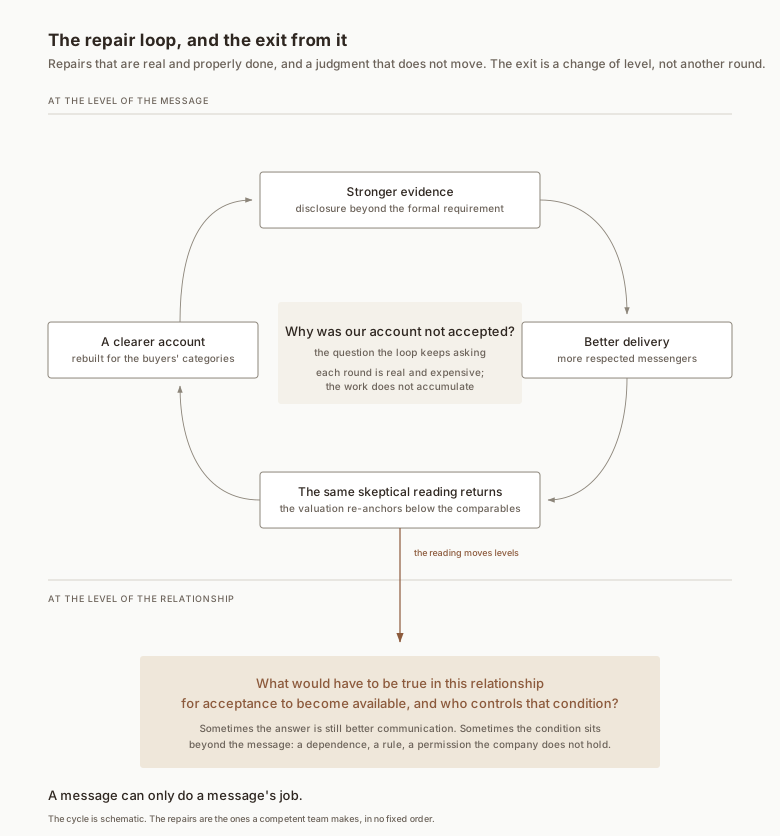
The composite firm was answering the questions its professional audiences were equipped to ask: are the numbers real, and is the business sound? The more consequential reading was turning on another question: should this kind of owner, from this kind of jurisdiction, be permitted to hold this kind of position here? The first question responds to proof. The second is shaped by the structure surrounding the proof.
That gap, between the question a company answers and the question an audience is actually deciding, is, in practice, the most common shape of a perception problem that survives good communications work. It cannot be seen from inside the message, because the message is answering its own question perfectly well: the company can keep improving its answer while the decision continues to be made elsewhere.
Reading the whole structure
Recognizing one such mismatch after several repair rounds is useful. Recognizing it earlier requires a more regular way of reading the situation. NPA reads a company through five layers, in order: power relations, interpretation control, obstacle discrimination, supporting infrastructure, and intervention logic.
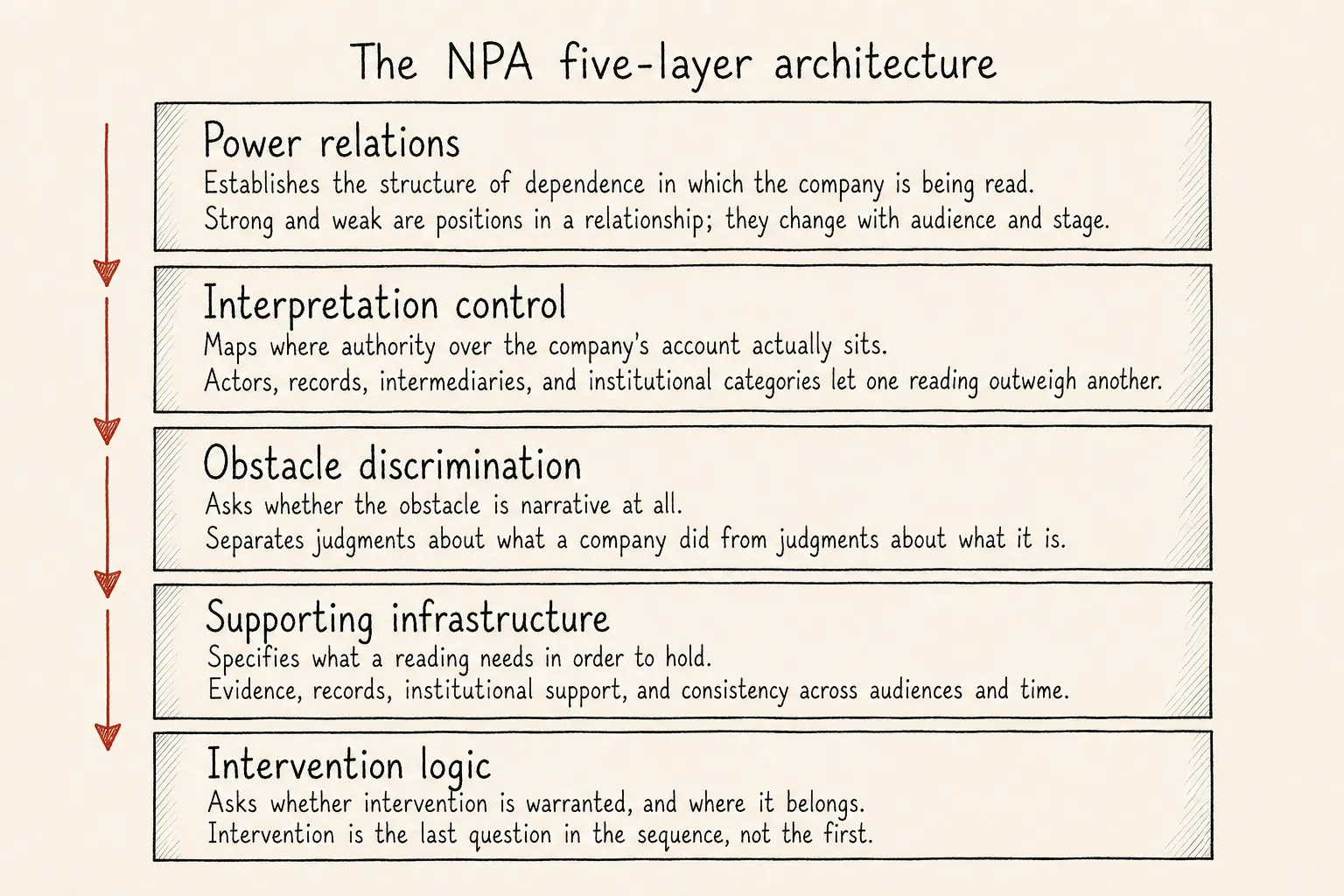
Power relations come first. Before asking what the company should say, the method examines who depends on whom in each audience relationship, what each side controls, what alternatives exist, and how those conditions change across the life of a transaction or market position. Everything downstream inherits from this layer, because the power structure decides whether a negative label can be enforced as a real cost, and who gets to do the interpreting.
Interpretation control follows the company’s account as it moves outward. A company publishes one set of materials, but institutional readers rarely receive them as a complete or orderly whole. They assemble a view from filings, prior coverage, third-party records, transaction documents, and the questions already present in their institution. How that reconstruction happens is explored in How Institutional Readers Reconstruct a Cross-Border Company.
Obstacle discrimination asks what kind of problem has actually appeared. Some negative readings are noise. Some are accurate descriptions of an operating weakness. Some are unfavorable but carry no practical consequence. A narrative obstacle exists only when the judgment has a structure, attaches to something that matters, and is held by an audience able to impose a cost.
Supporting infrastructure concerns what must exist around any account that needs to survive contact with more than one audience: where it must travel, in what order, through which materials and advisers, and how changes in reception will be observed. The method treats these as specifications for the organization and its existing advisers, not as a campaign plan.
Intervention logic comes last because a response should follow the diagnosis rather than precede it. A problem of evidence, a problem of access, and a problem rooted in an enforceable institutional judgment may all look like “perception” from the conference room. They do not call for more or less of the same remedy. The main intervention families are considered separately in Four Families of Narrative Intervention.
Power is therefore the starting layer, not the universal answer. The point of the structure is partly to prevent the method from explaining too much with its own favorite idea. Two distinctions are especially important.
The first is whether the judgment attaches to what the company has done or to what the company is understood to be. Conduct can change, and evidence of that change can accumulate. Origin, ownership category, or industry identity cannot be reversed by better behavior. They may be complicated by additional facts, but they cannot be treated as a missed communications task, and the difference is decisive for where effort should go.
The second is whether the condition that needs to change sits with the company or with the environment around it. A company that attributes a fixable operating or governance weakness to external prejudice has not discovered a structural narrative problem. It has avoided a repair that remains its own responsibility.
What this reading does not permit
Any method centered on power needs boundaries, particularly when it is used by the party that feels misread. The existence of a power imbalance does not make the stronger party wrong. A regulator may have sound reasons to apply a higher threshold. An investor may be rational to price uncertainty the company cannot remove. A market may be responding to weaknesses that management would prefer to describe as misunderstanding.
Nor does an external constraint release the company from work it can still do. Poor disclosure remains poor disclosure even when the audience is skeptical for other reasons. Governance changes should be judged first on whether they alter governance, not on whether they produce a more favorable story. Operational facts do not become narrative assets simply because they appear in a presentation.
The method also treats reassurance with care. A concession may reduce perceived risk, but it can also confirm the category the company hoped to escape. Adding local directors, commissioning an external review, or separating a sensitive function may be sensible. Each step still raises two questions: what changed in the underlying reality, and what did the act of reassurance quietly concede about the original concern?
Some constraints cannot be narrated away. That conclusion should not be reached casually, but refusing to reach it when the evidence supports it is not optimism. It is misallocation. The discipline lies in separating three things that are often bundled together: what the company can repair, what it can clarify, and what remains controlled by another party.
What the method believes
A method shows its character less in its diagrams than in its commitments. Seven run through this one.
Identity claims must be carried by organizational reality, because audiences verify, and a story the org chart contradicts costs more than silence. Durable narratives rest on layered fact rather than sustained performance: a disguise collapses the day the performance slips, while a complex truth survives having any one layer questioned. Every concession made to reassure an audience deserves the double audit described above, on risk and on admission; the board appointments and the specialist review were exactly this kind of concession, and both questions apply to them. Some constraints cannot be narrated away, and knowing which ones is itself high-value judgment, not defeat.
Defense has an opportunity cost: a company that spends its voice answering charges ends up defined as a defendant. Information vacuums never stay empty: whatever a company declines to explain, its audiences’ default frames will explain for it, and rarely in its favor. And the method has edges of its own: questions of deal structure, valuation, legal opinion, and geopolitical prediction belong to other professionals, a division of labor treated properly elsewhere.
When the message really is the problem
None of this retires the communications explanation. It bounds it. The messaging diagnosis is the right one more often than a power analyst would like to admit; most story problems remain communication problems.
Clarity matters when the audience faces a genuine information gap and has no entrenched reason to resist updating its view. Disclosure matters when credible evidence exists but has never been made accessible or comparable. Visibility, translation, and consistency have their own versions of the same condition: a company simply not seen, a strategy never converted into metrics an outsider can use, spokespeople offering materially different accounts. Sometimes the older reading is merely late: the company changed last year, while institutional memory changes more slowly. These are common problems, and the ordinary repairs work.
The harder cases tend to show a different pattern. The skeptical reading survives materially different messages, messengers, and evidence. It tracks what the company is, where it comes from, or who owns it more closely than it tracks changes in conduct. And the audiences holding that reading are the ones whose decisions carry formal or commercial consequence. No one sign is decisive on its own, but when those three signs appear together, another round of messaging is not rigor. It is the repair loop mistaking itself for progress. Shallow versus deep is the wrong axis here; the two cases are simply different problems that happen to produce the same complaint in the room.
The level of the problem
Return to the opening meeting. The frustration was real, and as a first description, “perception problem” earned its place. Something had gone wrong between the company’s operating reality and the judgment forming around it. Noticing that gap was right. Assuming where the cause must sit was the mistake.
The phrase naturally directs attention toward what the audience sees and therefore toward the people responsible for shaping that view. Sometimes that is exactly where the repair belongs. In other cases, the relationship, as currently constituted, does not have acceptance available in it, at any level of eloquence; it is being withheld by conditions the message does not control.
None of this counsels despair; it changes what gets examined before more work is commissioned. A message can only do a message’s job. Knowing precisely where that job ends, in each relationship that matters, is what keeps a company from spending years asking its story to move something the story was never holding; the practical question is what lies beyond that line, and whether the company has any leverage over the remaining condition.
The next question is narrower than “how powerful is the company.” It asks which relationship the company is in, with this audience, at this stage. The recurring situations are fewer than they first appear. That is where this series goes next.
Understand the method: Five Narrative Power Scenarios, next in this series. See it applied: The Identity Dimension of Blocked Cross-Border M&A. Evaluate fit: What an NPA Engagement Examines and Produces.