Why a Cross-Border Valuation Discount Can Persist After the Numbers Improve
Liquidity, disclosure, and governance explain most valuation gaps. This looks at what remains after all three are addressed and the discount still does not move.
Three years of work show up in the numbers. Revenue is compounding. Margins have crossed the threshold the board once set as the proof point. Reporting is cleaner than most domestic peers can claim. And the multiple has not moved.
At some point in the quarter, this becomes a meeting. Someone pulls up the comparables table, walks through the gap line by line, and asks the question that has been asked in some form at every such meeting for two years: what else do they want to see? The question sounds reasonable. It also carries an assumption worth noticing: that the discount is a grade, and better homework closes it.
That assumption fails in a particular class of cases. A persistent gap does not itself prove mispricing; it shows that something is still being priced. The work is to identify what that is. Often, the answer is fundamental and the discount is simply correct. But there are cases in which the standard explanations have been addressed and the gap remains.
The standard answers, taken seriously
Three explanations come up first in almost every version of this conversation: liquidity, disclosure, and governance. Each is real. Each explains actual discounts on actual companies. The point of walking through them is to find the edge of what each one covers.
Liquidity is the cleanest of the three because it is measurable. Investors pay less for what they cannot easily exit, and a security with wide spreads, low turnover, a small free float, or a thin holder base carries a discount that compensates for the cost and risk of trading it. When those conditions describe your security, liquidity is doing real work in the gap. But the explanation has an observable boundary. A company can have a liquid listing, years of steady volume, and a broad institutional register, and still trade well below its peer set. Liquidity lives in spreads and turnover, and when it cannot be found there, it should not be allowed to absorb the rest of the gap by default.
Disclosure works through forecastability. When analysts cannot see segment economics, cannot reconcile the accounting bridge, or wait longer than peers for the numbers, they compensate with conservative assumptions, and the conservatism compounds into the multiple. This too is real, and improving it has a real effect: forecast errors shrink, estimate dispersion narrows, models fill in. The boundary shows up in companies that have upgraded to the strictest reporting regime available and watched the gap persist anyway. Disclosure improves the accuracy of the cells in the model. It does not decide which model is open on the screen.
Governance is the deepest of the three because it goes to whose cash the cash flows are. Investors discount companies where control and economics diverge, where related parties sit close to the business, or where capital has a history of going somewhere other than back to shareholders. Two things need saying here. First, this discount is often rational, and it is rationally slow to close: markets price records, not policy documents, so even a genuine reform waits years for its evidence to accumulate. Second, there are companies well past that waiting period, with reformed structures, steady distributions, and a clean record, whose gap has stopped responding to any of it.
The three explanations share a shape. Each poses a question that standard valuation work knows how to test: whether the security can be traded, whether the information can be verified, and whether shareholders can claim the cash flows. A company can answer all three well, and keep answering them over years, while the discount remains. When it does, the gap has stopped being a harder version of the same question and become a different question altogether.
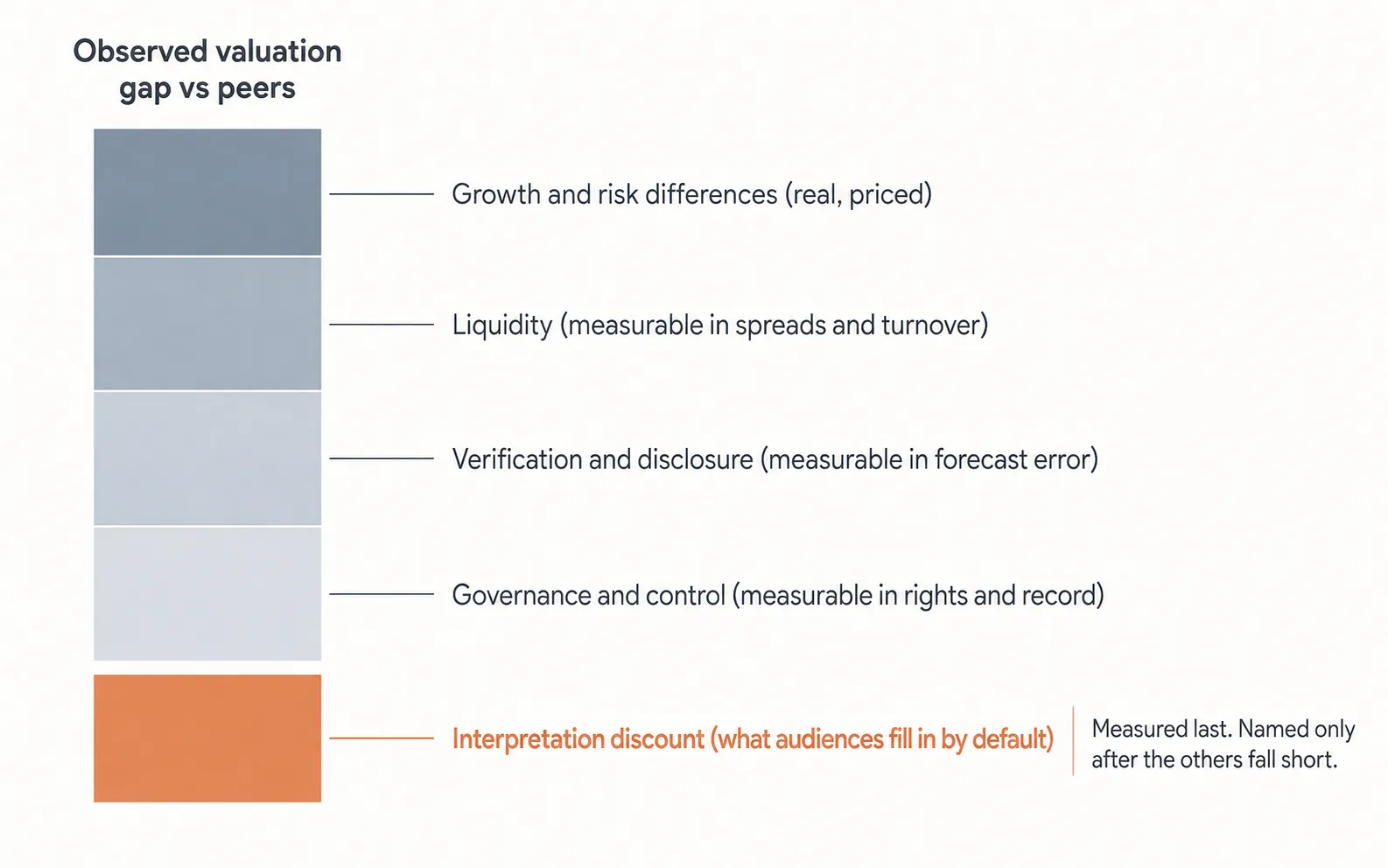
Conceptual schematic only. The blocks do not represent a quantitative attribution or an additive decomposition of the valuation gap.
Two companies
Two composite sketches make the difference visible. Both are assembled from patterns that recur across public markets; neither is a real company, and both will be recognizable.
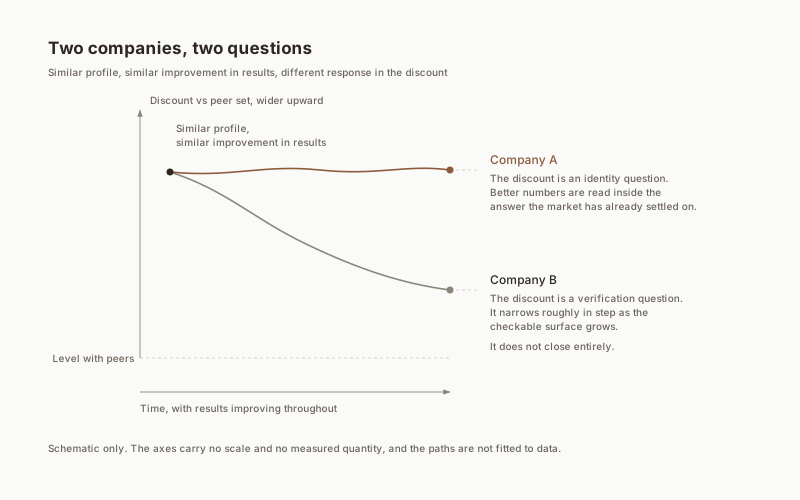
Company A listed abroad eight years ago. In its early years, a compliance failure at one subsidiary made the international press for a week. The company rebuilt: new controls, new auditors, a clean record since, and five consecutive years of improving results. Its multiple has stayed roughly where the incident left it. The pattern is visible in the coverage itself. Analyst notes still open with a paragraph about the incident, shorter each year, never absent. When results beat expectations, estimates rise and price targets follow the arithmetic. The cells in the model change. The peer set and the framing sentence at the top of the note do not. The company that had the problem is still, in every model that matters, the kind of company that had the problem.
Company B listed abroad in the same year, from a home market that made investors wary for a different reason. There was no incident. There was instead a verification problem: thin segment detail, key relationships documented in another language, an audit trail investors could not walk on their own. Its discount was wide too, for years. Then the checkable surface grew. Segment reporting filled out, an inspection regime settled into routine, and third-party data began tracking the operating claims closely enough to test them. As the numbers improved, the discount narrowed roughly in step. It did not close entirely, and nothing says it should have. But improvement moved it, year after year, in a way Company A never experienced.
Similar profile, similar effort, similar improvement, different result. The difference was the question each market was asking. Company B’s discount was a question about verification, and better numbers, once checkable, answered it directly. Company A’s discount was a question about identity, about what kind of company this is, and better numbers never addressed it, because the numbers were being read inside the answer the market had already settled on.
The estimates changed. The kind of company did not.
What fills the gap
An investor confronting an unfamiliar cross-border company still has to produce a valuation by Friday. When understanding is incomplete, something fills the gap: a country basket, a sector template, the nearest familiar comparable, the last memorable event in the category. The work cannot wait for perfect information. A gap in understanding does not stay empty; it fills with whatever framework the audience already carries.
That filling has a price, and the price deserves a name. Call it an interpretation discount: the cost a company pays when audiences fill the gaps in their understanding with their own default frameworks. For a cross-border company, those defaults are rarely generous, because they are built from what is most available: its home market’s reputation, its sector’s last scandal, and the failure cases that made the news. Company A pays an interpretation discount. Its audience’s default framework was set by one week eight years ago, and every result since has been furniture arranged inside that room.
This is a power fact before it is a communications fact. The account of what kind of company you are is produced somewhere, mostly outside your building: in coverage notes, in classification decisions, in the memory of the last similar company. You are one contributor to that account, and where your dependence on an audience is high and theirs on you is low, their version outweighs yours. That asymmetry, not any failure of effort, is why the meeting keeps circling. The company keeps answering the question it can answer, the numbers, while the discount is set by a question it has not located yet.
The idea needs two boundaries. First, an interpretation discount is a residual. Liquidity, disclosure, governance, and the durability of the improvement itself are all measurable, and they must be measured and found insufficient before what remains earns this name; a stubborn gap is sometimes just the correct price of real risk. An interpretation discount may leave a few observable traces: an unchanged opening frame in a coverage note after years of improving results; a peer set that persists despite a changed operating profile; investor questions that keep returning to a country, category, or old event; or language inherited when coverage changes hands. Second, recognizing the problem is not the same as solving it. What to do about an interpretation discount is a separate question, with a discipline of its own, and this note stops at the diagnosis.
Questions worth asking before the next meeting
If Company A’s pattern is familiar, the useful next step is a short set of observations, cheaper than a bigger deck and more likely to move the meeting.
Who controls the resource your valuation runs through? The mandate to own you, the coverage that prices you, the classification that assigns your peers: each sits with a specific audience. For each one, the useful fact is whether an alternative route exists or the relationship cannot be routed around.
Where does the working description of you live? Somewhere, a paragraph at the top of someone’s note is doing the work of saying what kind of company this is. Whose paragraph is it, and how much of it did you write?
Where does interpretation pass through a single point? Often it is one analyst’s model, inherited by whoever covers you next and rarely rebuilt from scratch. If that analyst left, or changed their mind, something else would have to carry the reading of your next set of results, and it is worth knowing what.
Is any of this moving? Coverage changes hands, classifications come up for review, holder bases turn over. Looking a year or two out, is the ground your valuation is read against getting firmer or thinner?
These are observations, not a scoring exercise, and they do not add up to a formula. What they establish is more useful than a score: where the account of your company gets written, and how much of it gets written by default.
Whether a given gap is fairly priced is a question for financial advisers. What may be said to the market, and when, belongs with securities counsel and investor relations. A narrower question comes first: whose working description of the company has become the market’s default? Where the work described here sits alongside those functions is mapped in Narrative Architecture, Messaging, PR and IR.
The comparables table will be back on the screen next quarter. Before asking what else they want to see, there is a prior question worth a full meeting of its own: who exactly is doing the seeing, and what are they using to fill in the parts they cannot see?
Understand the method: What Makes a Real Narrative Obstacle examines when a pattern like this is a genuine narrative obstacle and when it is something else wearing the language of one.
Evaluate fit: Why Cross-Border IPOs Stumble: The Problem of Market Placement reads the same mechanics in the setting where they bind hardest, a listing under way.
Further reading
- Robert C. Merton, “A Simple Model of Capital Market Equilibrium with Incomplete Information”, Journal of Finance 42:3 (1987). In the model, securities known to fewer investors may carry higher required returns; recognition itself is priced.
- Gur Huberman, “Familiarity Breeds Investment”, Review of Financial Studies 14:3 (2001). Investors systematically favor what they know, even when doing so produces concentrated portfolios.
- Lin Peng and Wei Xiong, “Investor Attention, Overconfidence and Category Learning”, Journal of Financial Economics 80:3 (2006). Attention-constrained investors may allocate more attention to market- and sector-level factors than to firm-specific information.