How Regulatory Friction Begins Before Formal Review
Banks slow, sellers hedge, and advisers narrow their scope before any authority opens a file. On why that early friction is not always a compliance problem.
Nothing formal has happened. There is no case number, no filing, and no review clock running in any jurisdiction. Yet the bank that welcomed the first meeting is now in its eleventh week of onboarding. Its questions have moved from entity documents to beneficial ownership, then to the company’s relationships in its home market. The seller’s advisers have quietly made your data room thinner than the one available to a competing bidder. The law firm you approached took weeks to clear client acceptance and has returned with a narrower scope than you requested. Nobody has said no. Nobody has given you a decision that can be appealed, corrected, or even quoted.
Executives leading international expansion or cross-border acquisitions often reach first for a sensible explanation: our compliance is not strong enough. Sometimes that is exactly right. A missing authorization, an unresolved sanctions concern, or an ownership record that does not reconcile is a real obstacle with a real remedy. But not every early obstruction has that shape. Before a formal process puts criteria on the record, banks, counterparties, advisers, officials, and commentators can form a provisional view of what kind of company they are dealing with. That view can delay, narrow, or reprice an otherwise viable transaction.
The distinction matters because the two problems demand different work. A stated requirement calls for evidence, remediation, and often counsel. A provisional audience judgment calls for a company to become more intelligible before that judgment hardens. Many hard cases contain both.
Friction starts in the operating system around a deal
The first signal often appears in financial plumbing. In 2014, the Financial Action Task Force warned that ending relationships with whole customer categories, rather than assessing risk case by case, was inconsistent with a risk-based approach.1 A slow onboarding usually has ordinary causes. What the warning documents is the structural fact behind the exceptional ones: a bank’s risk appetite can alter the commercial experience of a company long before a regulator makes any formal decision. The observable pattern is familiar: each answer produces another question, and the process remains open without a clear statement of what would close it.
The same uncertainty is priced upstream by sellers and counterparties. An OECD review of investment screening noted that prospective transactions may never be proposed when buyers or sellers expect screening-related delays, costs, or obstacles before a notification is made.2 In practice, closing certainty becomes part of price. A buyer expected to attract political attention can be treated as less attractive even when its headline offer is stronger. The seller is not deciding a regulatory case. It is deciding how much uncertainty it is willing to carry.
Advisers have their own gates. A law firm, accounting practice, insurer, lender, or communications adviser may run conflict, independence, client-acceptance, and reputational reviews that are separate from the question of legal permissibility. The decision weighs more than whether the firm can act; it weighs what the firm takes on by becoming associated with this company. That can produce a cautious scope, a slow internal escalation, or a quiet refusal to make an introduction. Each response may be defensible on its own. Taken together, they are information.
Public and political description can move faster still. Three days after Nippon Steel announced its proposed purchase of United States Steel, a White House statement said the deal deserved serious scrutiny.3 The parties’ voluntary notice to the Committee on Foreign Investment in the United States, or CFIUS, was not received until March 14, 2024.4 Whatever the gap meant for the eventual legal result, it made one thing visible: a transaction can acquire a political identity well before it acquires a procedural one.
Tell the two problems apart
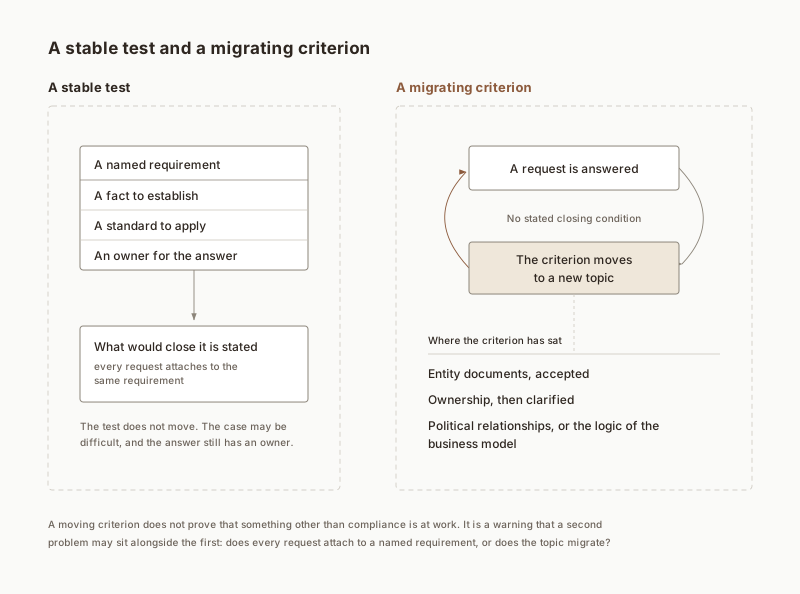
Start with the cases that have a stable test. If a bank cannot reconcile beneficial-ownership information with the documents provided, if a transaction needs a named authorization, or if a sanctions issue is implicated, the work begins with the specific requirement. Those cases may be difficult, but there is a fact to establish, a standard to apply, and an owner for the answer.
The more revealing pattern is criterion migration. Entity documents are accepted, then ownership becomes the focus. Ownership is clarified, then attention shifts to political relationships or the logic of the business model. A prospective adviser clears conflicts and sends the engagement to an internal risk committee; a seller says the price is compelling but starts asking how the deal will be received. No single instance proves that something other than compliance is at work. A hidden legal concern may still be present. But a moving criterion is a useful warning that the company may be facing a second problem alongside the first.
That problem is best understood as one of legitimacy and legibility. Legitimacy, in this setting, is acceptance granted by a particular audience under particular conditions; it lives on the audience’s side. An audience may be asking whether association serves its interests, whether the company fits its norms, or simply what sort of actor it is looking at. The last question is easy to underestimate. A company can be commercially credible and legally compliant, yet remain difficult for an unfamiliar institution to place in its mental map.
Under uncertainty, decision-makers rely on categories. Ownership, sector, home-market relationships, and business model become shorthand when company-specific evidence is thin. That is efficient, but it is coarse. Research on organizational legitimacy describes acceptance as an audience judgment, and research on stigma shows that negative associations can spill over to organizations that share a category without having committed the underlying act themselves.5 The practical implication concerns evidence rather than messaging: a company needs enough clear, verifiable, company-specific material that a relevant audience never has to let category do all the work.
Compliance and legibility are therefore complements, not substitutes. Compliance demonstrates that stated conditions have been met. Legibility helps an institution understand which conditions are relevant, what the company actually does, and why its structure is not merely a blank space to be filled with shorthand. When the gap is real, a complete compliance file may be necessary without being sufficient.
Visibility begins before the filing
A state can see a transaction well before formal review begins. CFIUS expressly encourages parties to consult with the committee and, where appropriate, submit a draft notice before a formal filing.6 Its annual report for calendar year 2024 makes the point more concretely. CFIUS identified and preliminarily considered thousands of potential non-notified transactions, further investigated 98, opened formal inquiries into 76, and requested filings for 12.7 The right reading of those figures is modest and still consequential: the period before a filing can be an active institutional space rather than a private one.
Other systems offer different versions of the same interval. Canada’s national-security guidelines strongly encourage early contact for specified investors and investments, and state that the Foreign Investment Review and Economic Security (FIRES) branch may contact a non-Canadian where it believes an application or notification has not been properly filed.8 United Kingdom guidance provides for voluntary notifications outside the mandatory regime and expressly invites general enquiries or informal discussion about future acquisitions and specific notifications.9 The two regimes differ in mechanics; both make room for engagement before a standard review process is underway.
Spain shows a more bounded model. Its foreign-investment rules allow a voluntary, confidential pre-investment consultation on whether a proposed investment is subject to authorization; the response is binding on the consulted administration in relation to the applicant.10 That is valuable procedural clarity, not a universal endorsement of the investor. China’s foreign-investment security-review measures also permit parties to consult the working-mechanism office before making a declaration.11 The legal effects vary. The common lesson is narrower: a company without a formal case may still be under observation, classification, and institutional contact.
When separate signals become one pattern
The timeline below is an illustrative composite, assembled to show how weak signals can accumulate across institutions before a company has an official process to point to; it is neither a case history nor an empirical average.
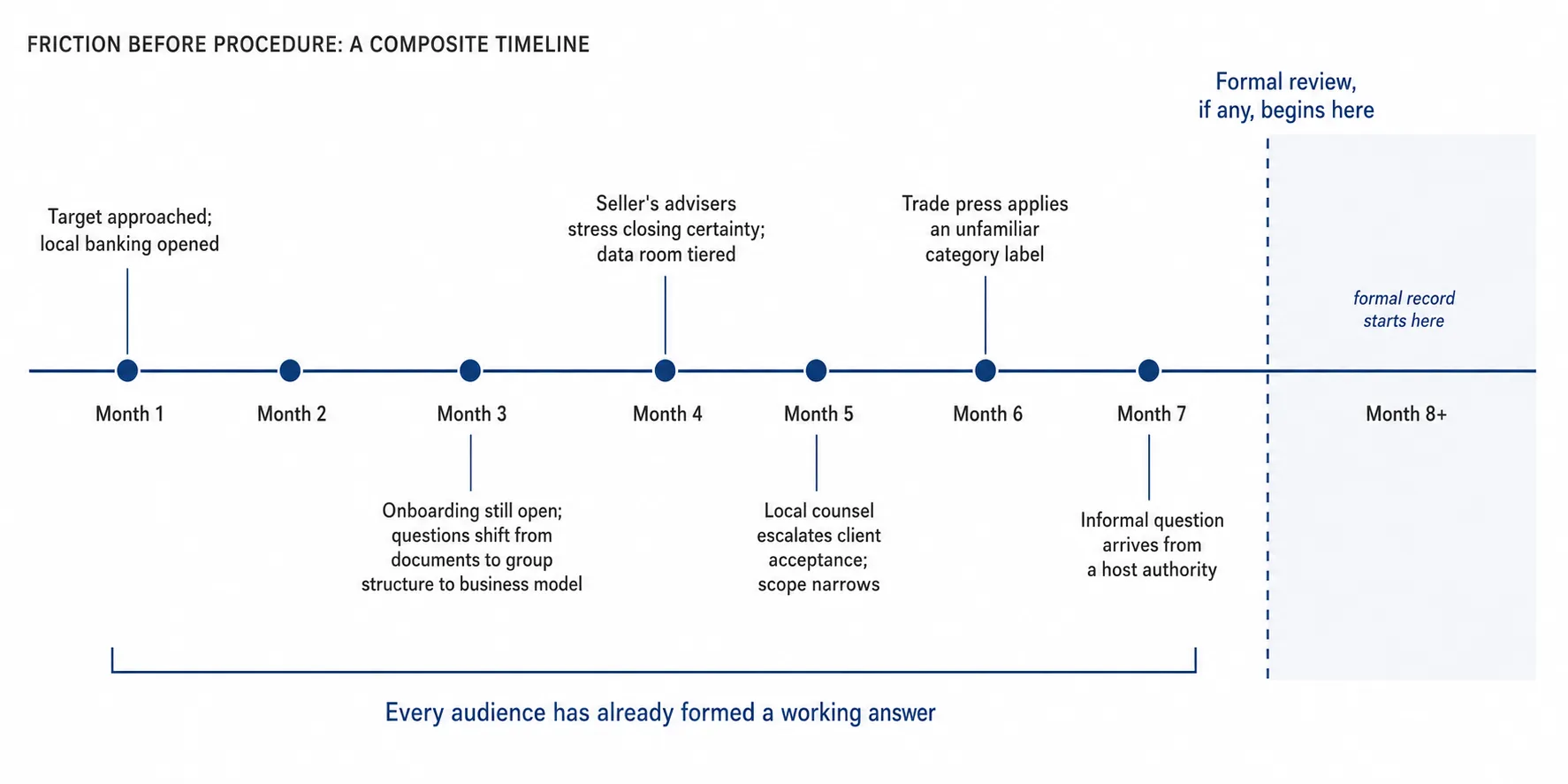
The timeline runs across institutions rather than through a procedure. A slow bank review, a seller’s concern about closing certainty, an adviser’s internal escalation, and a journalist’s category label are separate events, and when they recur around the same company they can make a provisional classification part of the deal before any authority has opened a file. The first repeat signal is often more important than the first isolated delay.
That is why each event deserves a second look before being filed as someone else’s idiosyncratic process. Ordinary friction needs no grand theory; what deserves attention is the moment when independent audiences, each with a different exposure, start solving the same uncertainty with the same shortcut.
Diagnose before you respond
Before prescribing a fix, build a short friction log. It should capture four things:
- The audience and the changed behavior. Which institution slowed, narrowed, escalated, or withdrew? A bank, seller, adviser, and government office do not carry the same risk or make the same decision.
- What that audience knew at the time. Had it seen company-specific evidence, or was the initial judgment available from nationality, ownership, sector, or business model alone?
- Whether the criterion stays stable. Does every request attach to a named requirement, or does the topic migrate from documents to ownership to political association?
- Where the pattern concentrates. Is friction strongest among parties that know the company least well, while parties with fuller information behave differently?
The answers change the response. A named procedural gap needs an accountable owner, a defined evidence package, and a clear route through the relevant legal or compliance process. A legibility problem calls for a concise, factual account tailored to the audience’s actual concern: who controls the company, how governance works, what the local operating footprint is, which activities are sensitive, what evidence supports the answers, and where uncertainty genuinely remains. The objective is not to make the company sound benign. It is to make it possible to evaluate the company as itself.
Hybrid cases need both workstreams at once. The legal, compliance, deal, operating, and public-affairs teams should work from a shared, verified fact base, with clear responsibility for what must be resolved before approaching a counterparty, bank, or authority. Counsel should lead on legal requirements and formal engagement. The wider team should not try to message away a legal problem, and counsel should not be asked to solve an audience-classification problem with a filing alone.
Informal concern is often just caution, workload, or poor process, and nothing here treats it as hidden regulatory power. The argument is for a more accurate diagnosis. Compliance answers a stated requirement. Before the requirement has fully surfaced, the practical task is to make sure the relevant institution can form its view on facts rather than shorthand.
A formal review begins when a file is opened. Regulatory friction begins when someone has to decide how much risk to accept in a company they have not yet formally reviewed. Companies that understand the difference keep compliance doing its own work, and make it harder for uncertainty to become the reason a viable transaction quietly stops moving.
Understand the method: What Makes a Real Narrative Obstacle examines when a pattern like this is a genuine narrative obstacle and when it is something else wearing the language of one.
Where this work sits: how it relates to counsel, compliance, communications, and government affairs is mapped in Narrative Architecture, Messaging, PR and IR.
Evaluate fit: Passing the Wrong Examination reads the same dynamics across a full market entry; The Identity Dimension of Blocked Cross-Border M&A reads them inside a contested acquisition.
Sources and notes
Further reading
- Suchman, M. C. (1995). “Managing Legitimacy: Strategic and Institutional Approaches.” Academy of Management Review, 20(3), 571-610.
- Kostova, T., and Zaheer, S. (1999). “Organizational Legitimacy under Conditions of Complexity: The Case of the Multinational Enterprise.” Academy of Management Review, 24(1), 64-81.
- Tirole, J. (1996). “A Theory of Collective Reputations (with Applications to the Persistence of Corruption and to Firm Quality).” Review of Economic Studies, 63(1), 1-22.
- Jonsson, S., Greve, H. R., and Fujiwara-Greve, M. (2009). “Undeserved Loss: The Spread of Legitimacy Loss to Innocent Organizations in Response to Reported Corporate Deviance.” Administrative Science Quarterly, 54(2), 195-228.
Footnotes
-
Financial Action Task Force, “FATF clarifies risk-based approach: case-by-case, not wholesale de-risking” (23 October 2014). ↩
-
OECD, The Relationship between FDI Screening and Merger Control Reviews (2022). ↩
-
The White House, “Statement from National Economic Advisor Lael Brainard on the U.S. Steel Announcement” (21 December 2023), archived by The American Presidency Project. ↩
-
Federal Register, “Regarding the Proposed Acquisition of United States Steel Corporation” (20 June 2025). The order records CFIUS’s receipt of the parties’ voluntary notice on 14 March 2024. ↩
-
Mark C. Suchman, “Managing Legitimacy: Strategic and Institutional Approaches” (1995); Tatiana Kostova and Srilata Zaheer, “Organizational Legitimacy under Conditions of Complexity” (1999); Stefan Jonsson, Henrich R. Greve, and Masaki Fujiwara-Greve, “Undeserved Loss” (2009). ↩
-
U.S. Department of the Treasury, “Voluntary Notice Filing Instructions: Part 800”. ↩
-
U.S. Department of the Treasury, Annual Report to Congress for CY 2024. ↩
-
Government of Canada, Guidelines on the National Security Review of Investments. ↩
-
Government of the United Kingdom, National Security and Investment Act: Guidance on Acquisitions. ↩
-
Ministry of Commerce of the People’s Republic of China, Measures for the Security Review of Foreign Investment. ↩