What Makes a Real Narrative Obstacle
Negative perception names an outcome, not a diagnosis. Separating the label, the doubt and the power to act on either, and what that separation will not settle.
A company answers the question it was never asked. Its market access is under attack over who owns it, and it responds with proof of how it operates: where sensitive information sits, who audits it, how decisions are insulated from the parent. The measures are real and expensive. They change nothing. Whatever the audience was grading, it was not the operations.
The mirror image is just as common. A company loses a license, declares the decision hostile to foreign newcomers, and mobilizes its customers in protest. The regulator’s file reads differently: misleading submissions, processes that lag the local standard, responsibilities nobody inside the company owned. Both boards would describe their situation in the same words: negative perception in a foreign market.
The phrase covers too much. Negative perception names an outcome, not a diagnosis. It tells you that the company is being judged unfavorably; it says little about how the judgment formed, what kind of doubt it contains, or whether anyone can act on it. A mark on what the company is, a failure to meet local standards, and a counterparty pressing for better terms may all produce the same complaint inside a boardroom. They do not run on the same machinery.
Money spent on the wrong one is not partially effective. It is spent on a different problem.
So the question boards eventually ask, “is this worth serious investment?”, has an earlier question underneath it: what kind of problem is this? The prior question is the one worth settling first, and settling it tells a board what it is looking at, not yet what to do.
Three observations, kept apart
Three things that ordinary language merges must be observed separately: a label, a doubt, and the power to act on either. Each can exist without the others. Most analytical error in this territory begins when the presence of one is taken as proof of the rest.
The label
Stigma becomes visible when some feature of the company is marked and begins to organize judgment. The firm enters the room as “the state-tied one,” “the data company,” or “the brand that cuts corners.” The description no longer functions as a neutral identifier. It carries expectations that arrive before the company’s own evidence does.
Stigma builds in an observable sequence: labeling, stereotyping, separation, status loss, and discrimination under power. The elements come from Bruce Link and Jo Phelan; in their original account they converge rather than march in order, and power is constitutive throughout. Reading them as the five-step stigma sequence is this method’s adaptation, kept because in organizational life the elements surface at different times, and much of the practical value lies in seeing how much of the structure has already assembled. Each gives the analyst a distinct thing to look for: whether a feature has been named; whether the name carries a settled bundle of negative assumptions; whether the company has been sorted into an out-group, where facts that would reassure in an ordinary case no longer transfer; whether standing is being lost; and whether cold receptions have begun to appear as actual exclusions.
Two labels that sound equally hostile may still require different readings. Behavioral stigma attaches to an incident or practice. Existential stigma attaches to what the company is understood to be: its origin, ownership, industry, or institutional affiliation. The distinction is made by the audience’s attribution.
A handled incident may remain an event. Repeated, moralized, or treated as revealing character, it can harden into a judgment about the kind of company involved. An ownership structure may be altered while the category attached to it survives. What matters is whether the audience treats the marked feature as limited and remediable, or as durable evidence of the company’s nature.
Not all stigma is alike: its structure varies along six observable dimensions, from perceived danger to attributed origin.
- Perceived danger. The degree of threat the audience believes the company poses to its interests, identity, or institutional responsibilities.
- Course. Whether the marking is building, stable, or fading.
- Concealability. How visible the marked feature is, and how far that visibility can be managed.
- Interactional friction. The additional burden that falls on those dealing with the company: enhanced account reviews, questionnaires peers never receive, an internal memo required before a partner can sign.
- Aesthetic reaction. The immediate comfort, unease, or aversion the feature produces before an argument has begun.
- Attributed origin. Whether the audience regards the mark as the result of a choice, an avoidable failure, or something intrinsic to the company.
Edward Jones and his co-authors developed these dimensions for marked persons. Their use here is an organizational adaptation. The value of the transfer lies in the fact that each dimension remains observable in the treatment of firms, which is why this method holds them as the six structural dimensions of stigma.
The doubt
A company can be doubted pragmatically, morally, or cognitively, and in several institutional environments at once. Satisfying formal requirements settles none of them.
Pragmatic doubt arises when the audience no longer believes that dealing with the company serves its interests. Moral doubt concerns whether the company’s conduct, affiliations, or way of operating fits the audience’s norms. Cognitive doubt appears when the audience lacks a settled category for the firm. It cannot complete the sentence “this is a…”, and what cannot be classified cannot be routinely approved. Together the three form the legitimacy gap typology this method works with.
Legitimacy is conferred by an audience. Compliance may contribute to that judgment, but it does not determine whether recognition follows. A company may have adapted and still not be recognized as adapted. An audience may continue to apply a category that no longer fits. Recognition may also be withheld because doing so serves another interest.
Cross-border companies encounter several institutional orders at once: those of the home market, the host market, supranational bodies, and their own internal constituencies. The expectations of these environments may reinforce one another, but they can also conflict. A posture that reassures a home regulator may be precisely what unsettles a host-market audience. An ownership relationship read as stability at home may be read as capture abroad.
“The company has a legitimacy problem” is therefore an unfinished sentence. Doubted how, by whom, and under which institutional order?
The channel of enforcement
A label can remain a cultural fact. A doubt can remain an unfavorable judgment. They become a business constraint when an identifiable audience can convert its view into a decision.
Four questions locate that power: whether the audience can restrict a resource, deny access, or impose an institutional penalty; whether it has a reason to do so; through what mechanism the judgment can travel, a licensing process, a listing rule, a procurement standard, a credit committee, a contractual covenant; and what it would cost the company to resist, substitute, or route around that mechanism.
The final question matters because enforcement power is relational. The same restriction can end a dependent entrant’s year and barely register for a diversified incumbent.
Power is already present in stigma. Without it, labels do not acquire the same capacity to separate, lower status, or exclude. The third variable asks something narrower: whether a particular audience has an activated channel it can use in relation to this company, this object, and this decision. Background power allows a mark to matter. Enforcement power turns the judgment into a commercial or institutional consequence.
Who depends on whom is a separate part of the analysis, mapped in Five Narrative Power Scenarios. Here the question is whether someone can act.
The test
A narrative obstacle is only real when three variables hold at once: stigma, a legitimacy gap, and the power to enforce the judgment. This is the three-variable test, and the diagnostic work lies in verifying that the three actually converge. Each variable condenses an established literature, credited in the reading list; the requirement that all three converge at one audience is this method’s own.
The variables must be indexed to the same audience, concerning the same object, at the same time. A journalist’s label, a regulator’s doubt, and a bank’s leverage do not compose a single obstacle merely because all three can be found somewhere in the market. Without a traceable path between them, they remain three separate relationships.
Co-presence, connection, and causation are different claims. Finding all three variables establishes co-presence. Showing that they belong to the same relationship establishes connection. Proving that this relationship caused a particular commercial loss requires a further body of evidence. The test needs the first two to identify a posture. It does not, by itself, settle the third.
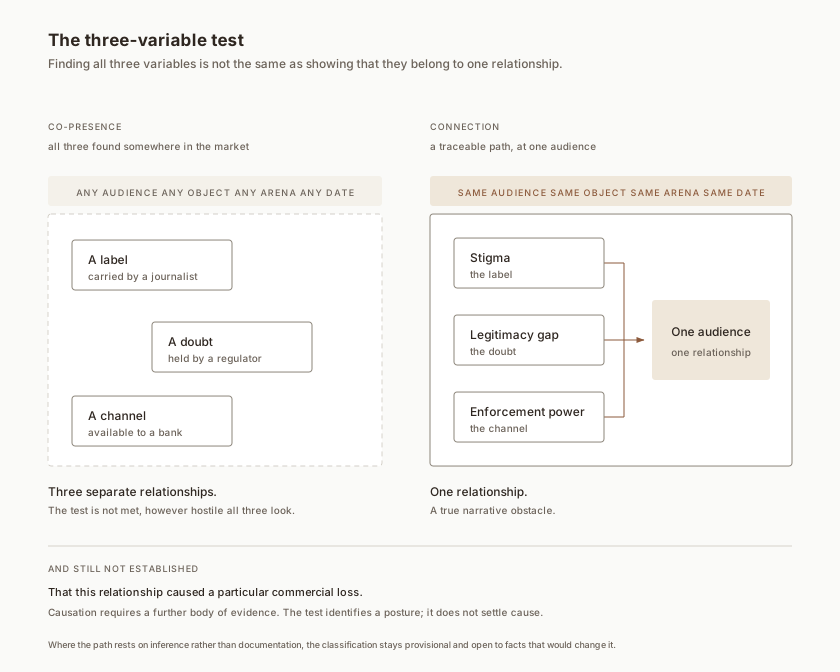
A traceable path may rest on direct documentation or on grounded inference. Internal classifications, review questions that repeat the marked category, decision records, and consistent treatment across comparable cases can strengthen the connection. Evidence of an independent commercial rationale may weaken it. Where the path depends on inference, the classification should remain provisional and open to facts that would change it.
The object of analysis matters just as much as the audience. A parent company, its local subsidiary, and a specific product can occupy different postures on the same day. The arena matters too: a firm may be accepted in commercial contracting and doubted in public procurement. When an assessment produces a counterintuitive answer, the first step is to check its indexing.
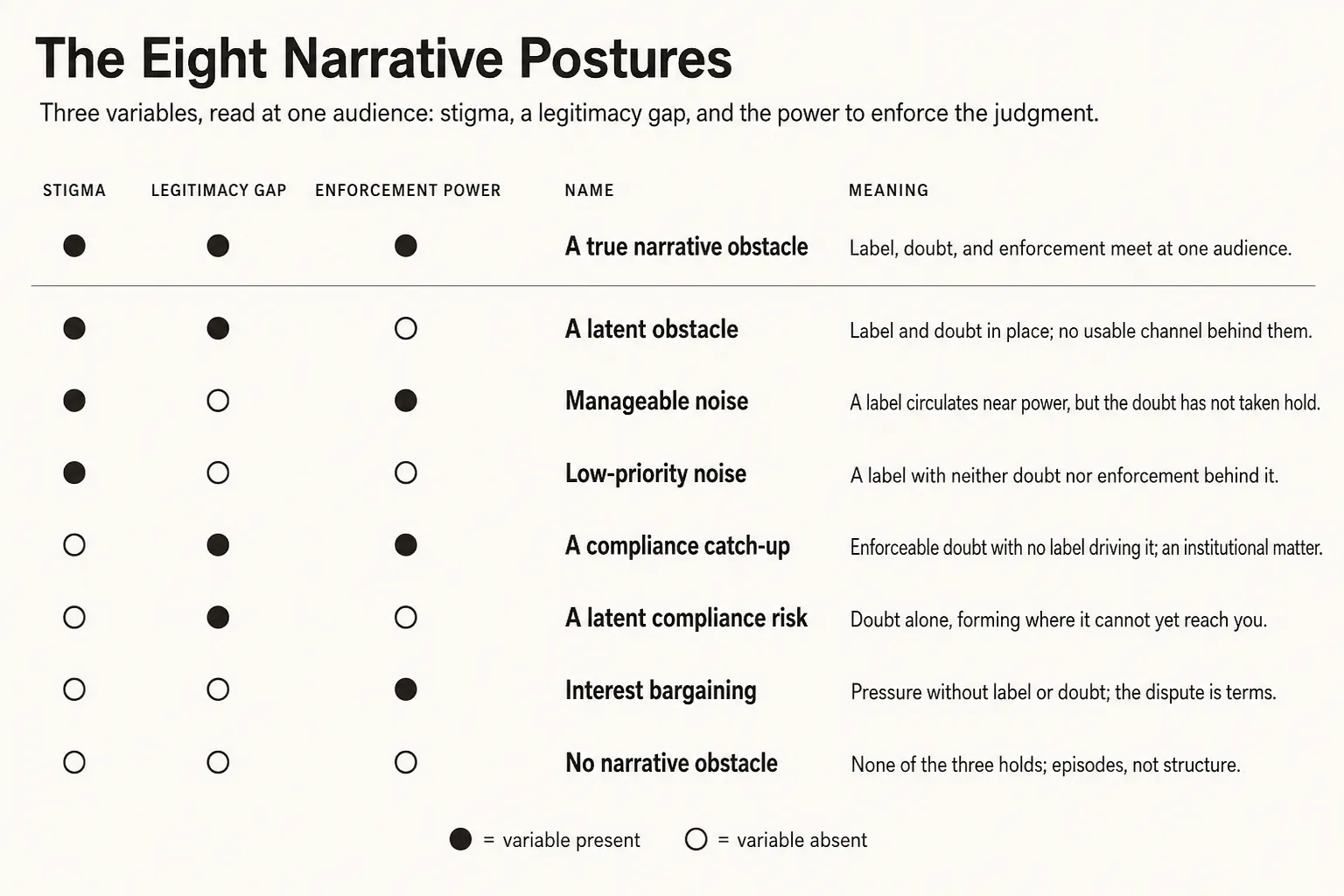
Combining the three variables yields eight distinct postures a company can be in, and only some of them are true narrative obstacles.
-
A true narrative obstacle. Label, doubt, and enforcement converge at one audience. A marked feature of the company has become material to a judgment that the audience can act upon.
-
A latent obstacle. Label and doubt are present, but the audience lacks a usable channel for imposing consequences.
-
Manageable noise. A label circulates around an audience that possesses power, but the underlying doubt has not taken hold. Those able to act still regard the company as a proper participant.
-
Low-priority noise. A label exists without a corresponding doubt or enforcement channel.
-
A compliance catch-up. Enforceable doubt exists without a stigmatizing label. The company’s adaptation may trail the institution’s expectations, or the adaptation may have occurred without yet being recognized. The immediate work lies in the institutional requirement and the evidence around it.
-
A latent compliance risk. Doubt is forming, but it has not reached an audience or channel capable of affecting the company.
-
Interest bargaining. Enforcement pressure exists without a label or legitimacy gap. The vocabulary may be moral, while the dispute itself concerns price, terms, access, or control.
-
No narrative obstacle. None of the three variables holds. The underlying issue may still matter, but this test supplies no basis for treating it as a narrative obstacle.
One seam deserves particular care. Exclusion cannot stand in for evidence of doubt. An authority may refuse, delay, or restrict a company for reasons unrelated to its identity or standing. The analyst still needs to show that the marked feature bears on the audience’s judgment of propriety. Otherwise, enforcement is being used as proof of the legitimacy gap, which is precisely the inference the test is meant to prevent.
The eight narrative postures are states, not verdicts on cause, and they move. Enforcement can give institutional weight to a label. A label left standing can gradually foster doubt. A procedural failure repeated in public may become evidence of character. A change in government, policy, or market structure can remove an enforcement channel while the label remains.
Every reading is dated. That is a reason to repeat the assessment when the relationship changes, not a reason to abandon the distinction.
Three readings
The following situations are synthesized for illustration. None is a disguised client record. Each reads the same three variables at a specified audience and stops at the posture the evidence can support.
First. An industrial technology company from a smaller market operates in a large host economy. At home, the state-linked fund among its shareholders is routine and may even be read as a mark of stability. In the host market, local media spend two years introducing the company as “state-tied.” The description begins to precede it into commercial discussions.
Over the same period, host banks escalate account reviews, allow credit lines to expire, and send questionnaires that local peers do not receive. The sequence is suggestive, but timing alone does not show that the banks are acting on the public label. The classification turns on the banks’ own treatment of the ownership feature.
In this case, the enhanced reviews repeatedly ask whether the fund can influence appointments, data access, and strategic decisions. Ordinary operational safeguards are treated as insufficient because the shareholding itself is taken as evidence of possible capture. Read at the banks, the label is existential, the doubt is moral, and the channel is active. Media coverage may have helped the category travel, but the test does not need to prove that the media caused the banks’ judgment. The obstacle sits in the relationship between the company and the banks.
Three variables, one audience, one object: a true narrative obstacle.
Second. A business services firm enters a market whose data rules look familiar from a distance. It applies its home-standard consent flows and retention practices. The host authority expects more detailed documentation, clearer internal ownership, and a different sequence of procedural approvals.
The company’s first license application returns with granular questions, and management initially reads the scrutiny as hostility toward a foreign entrant. Yet no public label is circulating. Competitors from the same home country operate without unusual attention. The authority’s concerns remain tied to the application, and it has an obvious channel through which to act.
There is enforceable doubt, but no evidence that the firm has been marked as a particular kind of undesirable company. The gap may lie in adaptation or in the authority’s recognition of adaptation; the next evidence must distinguish the two. At the point described here, the posture is a compliance catch-up.
Third. A consumer hardware maker handled a product recall slowly three years ago. In trade media and host-market forums, the episode has hardened into shorthand: the brand that cuts corners. The label carries genuine moral doubt among the commentators and communities that continue to use it.
Yet the safety authority closed its file years ago. Retailers continue to order according to sales velocity. No procurement standard, contractual covenant, or review procedure has incorporated the label. Those are separate audiences, and their decisions cannot simply be added to the commentators’ judgment.
At the audience where the label and doubt are present, no enforcement channel exists. The posture is a latent obstacle. It may become active if a retailer, insurer, regulator, or procurement body later adopts the category, but that connection has not yet formed.
What the test will not tell you
The test earns its keep partly through what it refuses to decide.
It does not price the investment. A confirmed obstacle may be economically minor, entrenched in law, or too costly to change. A latent posture may be commercially urgent because an enforcement channel is about to open. Materiality, tractability, reversibility, and opportunity cost belong to the commercial appraisal that follows the diagnosis.
Nor does the test settle cause. A label, a legitimacy gap, and an adverse decision may coexist because narrative dynamics produced the consequence. They may also coexist because an authority acted for independent reasons and a public interpretation grew around the action. The posture describes the relationship as it stands. Causal attribution requires additional work, and resolving the posture does not guarantee that the commercial outcome will reverse.
Bargaining can imitate stigma. Counterparties with leverage often borrow the vocabulary of moral failing, reputational concern, or institutional propriety while seeking better terms. A useful counterfactual is whether materially improved terms would dissolve the objection. When they would, the company is probably negotiating interest, however normative the language sounds.
Every posture is indexed to an audience, object, arena, and date. It is never a general property of “the company.” Change any of those coordinates and the reading may change with them.
Two practical boundaries remain. When there is no label and no legitimacy gap, only dissatisfied customers, weak demand, or a poorly adapted product, this test is the wrong instrument. It does not replace product, operational, or market work. Nor does it displace the adjacent professions. Matters belonging to counsel, bankers, communicators, and public-affairs advisers remain theirs, as set out in Narrative Architecture, Messaging, PR and IR.
The phrase “negative perception” becomes useful only after it is taken apart: who has marked the company, what form of recognition is being withheld, who can turn that judgment into a decision, and whether those answers belong to the same relationship.
Until those questions are joined, the company does not yet know whether it faces a narrative obstacle, an institutional adaptation problem, a negotiation, or noise. The value of the test lies in refusing to let those problems share a name.
Where this sits
The power relations on which the third variable depends are mapped in Five Narrative Power Scenarios. How interpretation is controlled once a situation has been read, and by whom, is the subject of Who Controls Interpretation. For the place of this analysis within an engagement, see What an NPA Engagement Examines and Produces.
Reading list
The theory this article draws on, with notes on where the present use departs from the originals.
-
Link, Bruce G., and Jo C. Phelan (2001). “Conceptualizing Stigma.” Annual Review of Sociology 27: 363-385. The five elements of stigma. In the original they converge rather than form an ordered sequence, and power is constitutive of stigma throughout.
-
Link, Bruce G., and Jo Phelan (2014). “Stigma Power.” Social Science & Medicine 103: 24-32. Stigma as a resource used to keep its targets down, in, or away. The four-part reading of an activated enforcement channel is an elaboration used here.
-
Jones, Edward E., Amerigo Farina, Albert H. Hastorf, Hazel Markus, Dale T. Miller, and Robert A. Scott (1984). Social Stigma: The Psychology of Marked Relationships. New York: W. H. Freeman. The six dimensions were developed for persons; their organizational use in this article is an adaptation.
-
Suchman, Mark C. (1995). “Managing Legitimacy: Strategic and Institutional Approaches.” Academy of Management Review 20(3): 571-610. The pragmatic, moral, and cognitive forms of legitimacy, understood as audience-conferred perception rather than objective compliance.
-
Kostova, Tatiana, and Srilata Zaheer (1999). “Organizational Legitimacy Under Conditions of Complexity: The Case of the Multinational Enterprise.” Academy of Management Review 24(1): 64-81. Legitimacy complexity across institutional environments. The four-way distinction among home, host, supranational, and internal environments is the working scheme used here.
-
Devers, Cynthia E., Todd Dewett, Yuri Mishina, and Carrie A. Belsito (2009). “A General Theory of Organizational Stigma.” Organization Science 20(1): 154-171. Organizational stigma as a discrediting label formally distinct from legitimacy. The behavioral and existential categories used here are adjacent to, but not identical with, their conduct and tribal categories.
Continue: Who Controls Interpretation (next in the method sequence) | See it applied: Why a Cross-Border Valuation Discount Can Persist After the Numbers Improve | Evaluate fit: What an NPA Engagement Examines and Produces