Radiant World's $870 Million Table
Radiant World's table shows where US$870 million of receivables finance sat, but not why. Read with the court record, it moves the question from the product to the debtor side of each invoice.
When the receivable is disputed, the lender is left holding the trader.
Prepared from publicly available information as of 25 September 2026.
A friend who works in trade finance asked me whether the US$870 million Radiant World owes to the lenders that financed its receivables shows that something is wrong with the product. The first reading does point that way, and the reporting encourages it. Bloomberg’s report on Radiant’s creditor table put the split at its centre: “It shows that Radiant’s lenders under traditional commodity trade finance and repo facilities have been repaid, while its lenders under receivables financing facilities are still owed substantial amounts of money.” BCR Publishing, on 22 September, read it the same way: “Its most significant feature for trade financiers is the split between funding structures.” General news coverage told it instead as one trader’s story, under headlines such as “Singapore Court Strips Control of Radiant World From Founder”, carried by Insurance Journal on 24 September, and a Reuters report the next day that the judge had tasked interim managers with “probing suspected fraud”.
I read what was public as of 25 September 2026: the press reports, the reasons the High Court of Singapore published that day, and the parties’ own statements. I write on one assumption: over the coming months, credit committees will be reviewing traders that depend on receivables finance, and those traders and their finance heads will be answering the questions this case raises. For them the useful question is narrower than my friend’s. It is how lenders will reread such traders now that Radiant’s Singapore entity is in the hands of interim judicial managers. The evidence sits in three documents, and it moves the answer away from the product and toward the other party to every invoice, the debtor.
The table
Radiant World, founded by Indian national Pinkesh Nahar, trades iron ore through an operating entity in Singapore. The table came out of a legal filing, an affidavit Nahar signed in Mumbai on 16 September, and it lists six creditors that financed Radiant’s receivables, the sums its buyers owed it on invoices.
| Receivables creditor | Total limit (US$ million) | Utilised (US$ million) |
|---|---|---|
| Jefferies | 745 | 352.64 |
| Intesa | 340 | 238.26 |
| Deutsche Bank | 150 | 102.59 |
| Mizuho | 100 | 97.28 |
| Mariner | 50 | 48.57 |
| Incomlend | 35 | 30.72 |
| Total | 1,420 | 870.06 |
Jefferies and Intesa account for US$590.90 million of the total, about two-thirds. Of the 19 non-receivables facilities listed, only one shows a balance: a KBC letter of credit facility with US$18 million outstanding. The table covers Radiant World Corporation Pte Ltd, the main Singapore operating entity. It does not cover facilities for related companies such as Sapphire Minmetals and Quanterra International, and it does not include non-financial creditors.
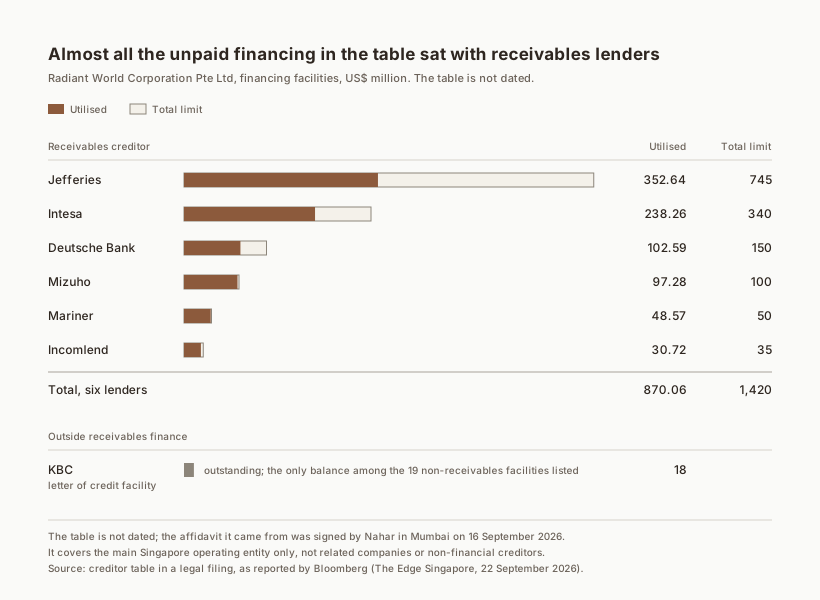
Figure 1. The creditor table shows where Radiant’s unpaid financing sat: US$870.06 million utilised across six receivables lenders, against one non-receivables balance of US$18 million at KBC. It does not show when, because the table is undated.
Read as Bloomberg read it, the table supports one conclusion firmly: at the moment it captures, almost all of the unpaid financing the table lists sat with receivables lenders. What it cannot say is why, and the first obstacle is that the moment itself is missing. As Bloomberg noted, “The spreadsheet is not dated, though the affidavit was signed by Nahar in Mumbai on Sept 16.” By then the lenders had been acting for weeks. According to the court’s record, Deutsche Bank set off US$11,251,782.29 from Radiant’s accounts on 5 August, and Reuters, citing Bloomberg, reported that Deutsche Bank and KBC “froze some of Radiant’s Singapore bank accounts”. An undated balance taken from the middle of that sequence records, in part, which lenders had already moved and how far.
KBC makes the same point from the other side of the split. Its letter of credit line is the one non-receivables facility still carrying a balance; Nahar said it was being settled, and a KBC spokesperson told Bloomberg the bank had “no exposure to Radiant at all”. Even on the side of the table that looks clean, whether a line shows a balance depends on how far settlement had gone by a date the table does not give.
How much of the split comes from the structure of the facilities and how much from timing, the table cannot separate. It tells a credit officer where Radiant’s financing was stuck. Taken as a verdict on receivables finance, it is being asked to carry more than it holds, and the first answer to my friend’s question starts to loosen here.
The affidavit
Nahar’s affidavit reads the same numbers another way. Of the financing facilities outstanding, he said, only the US$18 million due to KBC was “due directly from Radiant”. The remainder sat under receivables financing facilities, whereby payment is due from Radiant World’s customers rather than the company itself. Put plainly, Radiant’s position is that it sold invoices to these lenders, and the money is owed by the buyers named on them.
The lenders acted on the opposite view. According to the court’s record, Deutsche Bank issued its first repurchase notice on 5 August, calling on Radiant to buy receivables back, and set off money in Radiant’s accounts the same day; a second notice followed on 7 August, and on 21 August a statutory demand, the formal demand for payment, for US$102,592,409.03. Mizuho demanded repurchase on 12 August for payment by 14 August and served a statutory demand for US$97,281,235.05 on 17 August. Intesa served its statutory demand on 14 August. The judicial management case in which the court has now ruled is Mizuho’s. Each of these steps is a claim on Radiant, the trader.
Between them, the two sides describe the two ways a receivables lender expects to be repaid. The ordinary route is the buyer paying the invoice. The fallback is recourse: if the invoice goes wrong, the trader takes it back and pays. Radiant points to the first route. The lenders, once the invoices were in question, took the second. The full security package behind these facilities is not public; the protection visible in the public record is recourse to the trader, and it is the one the lenders in the court’s record reached for. For the finance head of a trader that uses these facilities, the point is concrete: when the receivable is disputed, the lender comes back to the company.
Recourse is worth what the trader is worth, and Radiant’s case for its own worth was its receivables. Nahar argued the company was solvent on the basis of US$1.07 billion of assets, including US$36 million of inventories, US$27 million of cash and US$1.007 billion of trade receivables. Lawyers for Jefferies, at a hearing in London, argued that “the core of the claim” was that Radiant World had “falsified documents in relation to supposed receivables”, and that “The court cannot rely on the veracity of that figure.” That is a lawyer’s allegation, and Radiant denies wrongdoing. The Singapore court’s reasons record the 8 September management accounts as claiming current assets of US$1,069.98 million, of which trade receivables were US$1,006.99 million, and the court gave those accounts very little weight. Radiant met the recourse claims with receivables, the same kind of asset the lenders were disputing. The affidavit puts distance between the trader and the debts; its own solvency case closes that distance.
The court’s reasons
On 24 September, in Mizuho Bank, Ltd v Radiant World Corp Pte Ltd [2026] SGHC 200, Kristy Tan J appointed three interim judicial managers from KPMG Services Pte Ltd, pending the hearing of the judicial management application, and tasked them with investigating. In reasons published on 25 September, the court found that Radiant had not raised a sufficient triable issue on the Mizuho debt, and that Deutsche Bank’s statutory demand could found a prima facie presumption of insolvency. These are preliminary findings in an interim proceeding, not a judgment on the fraud allegations or on Radiant’s counterclaims. What the reasons add is the detail of three lenders’ files: what each bank required, what Radiant supplied, and what the buyers named on the invoices said.
According to the court’s record, Mizuho signed a master receivables purchase agreement with Radiant on 11 June 2026, and on 18 June paid US$95,514,771 for five receivables said to arise from sales to Glencore. The agreement required a signed, dated notice of assignment to Glencore, the document telling the buyer that the receivable had passed to the bank, together with evidence of delivery or email confirmation satisfactory to the bank. Radiant forwarded emails presented as confirmations from Glencore. Glencore, per the court’s record, denied sending or receiving those emails and denied receiving or agreeing to the assignment. Mizuho asked for evidence that notice of assignment had been sent in June; Radiant did not provide it. Glencore also told Mizuho that the invoices in its system corresponding to the contract numbers had been paid between 30 April and 3 June, by letter of credit or telegraphic transfer. That is Glencore’s account, and whether Radiant’s documents correspond to those transactions is disputed. On that account, though, the invoices had been paid before Mizuho paid for the receivables.
Deutsche Bank’s agreement, according to the same record, is older: a receivables purchase agreement dating from 19 October 2021, last amended on 28 April 2026. Between 12 and 31 March 2026 the bank bought seven receivables with a face value of US$115.308 million for US$113.844 million, with stated maturities in August and September 2026. In one of the disputes the court recorded, Glencore said the genuine invoice’s US$17,113,791.31 had been paid on 6 March into Radiant’s account at Deutsche Bank, and that there had been no notice of assignment of the proceeds. Vitol told the bank that the relevant contracts were not signed or authorised by the named Vitol personnel and that the purported confirmations were not genuine.
The court’s record shows that Intesa’s agreement is dated 27 June 2024 and was amended on 1 October 2025. In April 2026, after Radiant proposed buying back some invoices, Intesa contacted the buyers to check. Its statutory demand of 14 August, for US$126,150,717.52 plus interest, covers purported transactions under three Cargill invoices, three Vitol invoices and one Glencore invoice. Radiant produced an internal email saying that an Intesa employee and a Vitol contact had confirmed via WhatsApp. Intesa’s response was that Vitol’s senior staff said the contact had no authority to give such confirmation. The full WhatsApp exchange is not in the record.
Incomlend, the smallest line in the table, makes a similar allegation in its own lawsuit. It has sued Radiant World and Nahar in Singapore seeking more than US$34 million, alleging that Radiant used Glencore invoices that had already been paid, and false contracts, to raise US$31.7 million, and it says it is acting on behalf of the relevant funder on its platform.
Set side by side, these files turn on three questions about each receivable: whether the debt is still owed, whether the assignment reached the debtor, and whether whoever confirmed it had the authority to do so. Glencore’s accounts of invoices already paid, and Incomlend’s allegation, go to the first; DaDepo compressed that one into a headline on 18 September, “The Invoice Exists. The Receivable May Not”. The June notice Radiant did not evidence to Mizuho, and the absence of any notice of assignment of the Deutsche Bank proceeds, go to the second. The Vitol contact on WhatsApp goes to the third, and so do Glencore’s denial that it sent the confirmation emails and Vitol’s statement that its named personnel did not sign or authorise the contracts. Radiant’s documents assert an answer to each question. The answer that decides the asset comes from the debtor. For a credit officer weighing the next trader, that is the location that matters: the facts that determine whether a receivable is worth anything sit on the debtor’s side of the trade.
The same few names fill that side of these disputes. Glencore appears in Mizuho’s file, in Deutsche Bank’s, on one of Intesa’s invoices and in Incomlend’s claim. Vitol appears in Deutsche Bank’s file and in Intesa’s. Cargill appears in Intesa’s, where the statutory demand covers three Cargill invoices beside three from Vitol and one from Glencore. On 31 July, Reuters, citing Bloomberg, reported that “Vitol Group and Cargill have stopped trading with Radiant World”, and cited a person familiar with the matter as saying Glencore was not entering into any new business with Radiant. Radiant called the reports “inaccurate and unsubstantiated”. The repurchase notices, set-off and statutory demands described above all came in August, after those reports.
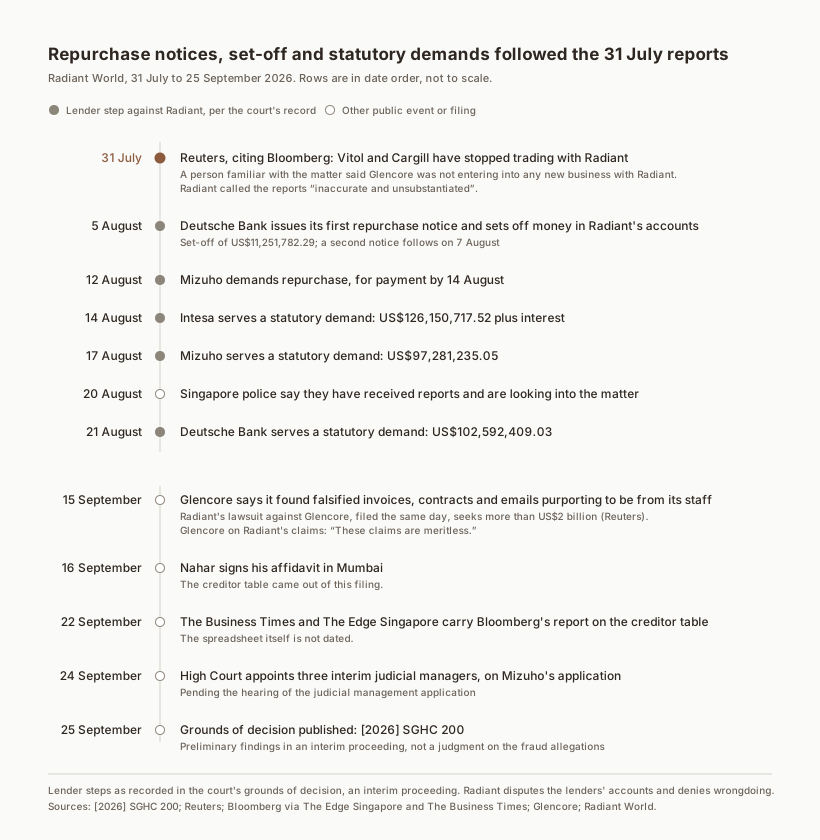
Figure 2. The repurchase notices, set-off and statutory demands in the court’s record all came in August, after the 31 July reports that Vitol and Cargill had stopped trading with Radiant. The undated table surfaced only in September.
A receivables facility looks like two protections that stand apart: if the buyer does not pay, the lender goes to the trader. Recourse, though, is a claim on a trader, and a trader pays out of its trade. In the disputes the court recorded, the debtors who disowned the paper were Glencore and Vitol, and they, with Cargill, are the counterparties reported to have stopped trading with Radiant or to be entering into no new business with it. Whatever passed between Radiant and these companies put the asset route in dispute and also weakened the recourse route, and the lenders turned to recourse in the weeks after the reports. The two routes had one source. This is an inference, and I draw it from the overlap of names and dates in the public record. It shows the two routes weakening together; it cannot say by how much.
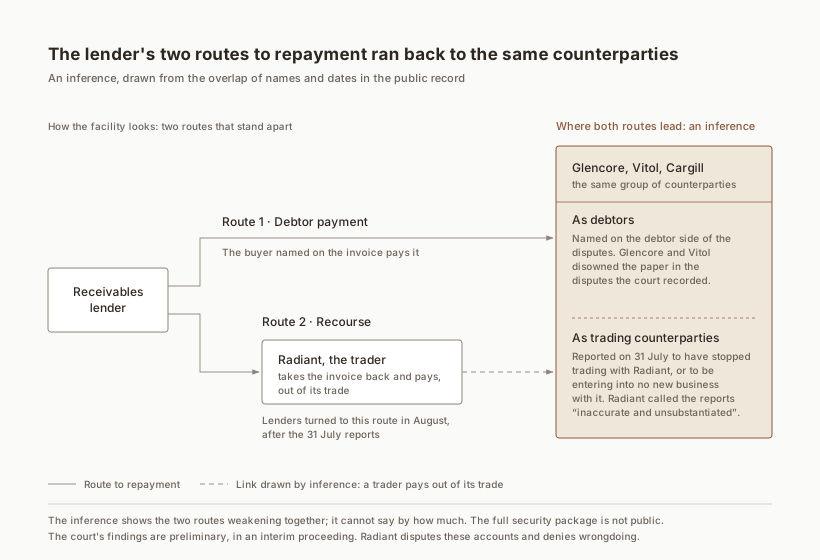
Figure 3. A receivables facility looks like two separate protections, the debtor’s payment and recourse to the trader. At Radiant, both ran back to Glencore, Vitol and Cargill. This is an inference from the overlap of names and dates in the public record, and it cannot say by how much the two routes weakened.
All of this is one party’s claim or evidence recorded in an interim proceeding, and Radiant disputes it. Its website statement calls the matter a “commercial dispute arising out of a genuine and longstanding trading relationship” and denies wrongdoing. Reuters reported that Radiant’s lawsuit against Glencore, filed on 15 September, seeks more than US$2 billion; Glencore’s response to Radiant’s claims was “These claims are meritless.” The court’s findings are preliminary, and the disputes it sets out cover receivables in three lenders’ files, not every receivable behind the US$870 million. A full hearing could change the facts of any single receivable. It would not move those facts off the debtor’s side, and that is why the finding holds within these limits.
Back to the question
Is this, then, simply a fraud case? The objection deserves its full weight. Lawyers for Jefferies allege falsified documents. On 15 September Glencore said it had found falsified invoices and contracts and emails purporting to be from its staff. On 20 August Singapore police said they had received reports and were looking into the matter. Allianz and Zurich said they had no “material exposure” to Radiant. John Saunders, writing on 26 August, made the product’s case directly: “Receivables finance is a strategic tool, not a distress signal.” And no structure is proof against deception. On 30 January 2026 Reuters reported that Trafigura had won its London lawsuit against Prateek Gupta, a case in which cargoes that were supposed to contain high-grade nickel contained low-value or even worthless materials; the judgment is Trafigura v Gupta and others [2026] EWHC 159 (Comm). That case turned on cargo. On this view, receivables finance was only where the alleged fraud landed, and a fraud case says little about the product it passed through.
I accept the facts in that objection and not the inference drawn from them, and the answer does not depend on whether the fraud allegations are proved. Allianz and Zurich’s statements tell us who is not carrying a material share of this exposure; they say nothing about where the next one would be caught. Saunders is right that using receivables finance is no distress signal, and nothing in the record points lenders at the product label. What the nickel case shows is that every kind of trade has a point where the paper has to meet something outside it. In the nickel case that point was the cargo. In receivables finance it is the debtor. One independent confirmation, obtained from the debtor and given by someone with authority to bind it, answers all three questions at once: the debtor itself says the debt is still owed, acknowledges the assignment, and does so through a person entitled to say it. That dependence does not disappear with one trader. The next trader’s receivables will also be owed by debtors, and the facts that decide them will also sit on the debtor’s side, whether or not anything at Radiant was forged.
The 2020 precedent shows what a rereading looks like when it happens. According to a Bloomberg report of 23 August 2020, European banks were then reassessing commodity trade finance against a string of collapses, scandals and losses, among them Hin Leong, which collapsed in April 2020. Some left. On 13 August 2020 ABN AMRO announced that “Trade & Commodity Finance activities will be discontinued completely”, and Societe Generale tightened risk controls and exited part of its Asian business with the closure of its Singapore office. Others tightened procedure: ING’s chief executive said, “We are reintroducing the strict structures.” BNP Paribas was reviewing its business. The Radiant record, as of 25 September, holds one trader, and within the public sources searched, no lender, insurer or trade finance fund had publicly announced a change to limits, pricing or verification requirements for other traders attributable to this case. GTR’s warning that the case “could harm the availability of invoice financing” remains, on that record, a forecast.
If lenders do reread traders that depend on receivables finance, the record points to the procedural kind of change, made on the debtor side. It starts with confirmation from the debtor itself, given by someone with authority to give it. The Association of Banks in Singapore’s Code of Best Practices for commodity financing, dated November 2020 and developed by a working group of 28 banks with the support of MAS, Enterprise Singapore and ACRA, already points there: its §4.3 says lenders should seek to have the assignment of receivables notified to the debtor, and its Appendix 4 gives debtor confirmation among its examples of controls, as best practice rather than a legal requirement for every transaction. The Intesa file shows why the authority behind a confirmation matters as much as the confirmation. A confirmation also loses force if the debtor then pays the trader, which is why lenders will look at whether the payment route is one the trader cannot redirect: in the Deutsche Bank dispute, the money Glencore says it paid went into Radiant’s own account, and a lender whose debtor pays the trader is back to relying on the trader. Registry checks sit alongside both. ABS launched the Trade Finance Registry on 23 June 2023; participating banks register new trade finance transactions so that duplicate financing of the same underlying trade can be identified, and transactions at or above a threshold must be queried. On 12 February 2025 ABS and SGTraDex announced a real-time bill of lading genuineness check, and the announcement said the registry’s duplicate-financing check had been supported by 40 key trade finance banks, with more than 18,000 queries. These tools are built for paper financed twice and bills of lading that are not genuine. A duplicate check or a document genuineness check does not by itself show that a debt is still owed and has been assigned, and the public record does not say whether any of the Radiant transactions were registered in the Trade Finance Registry. For the finance head of a trader that relies on these facilities, every one of these questions is about its buyers.
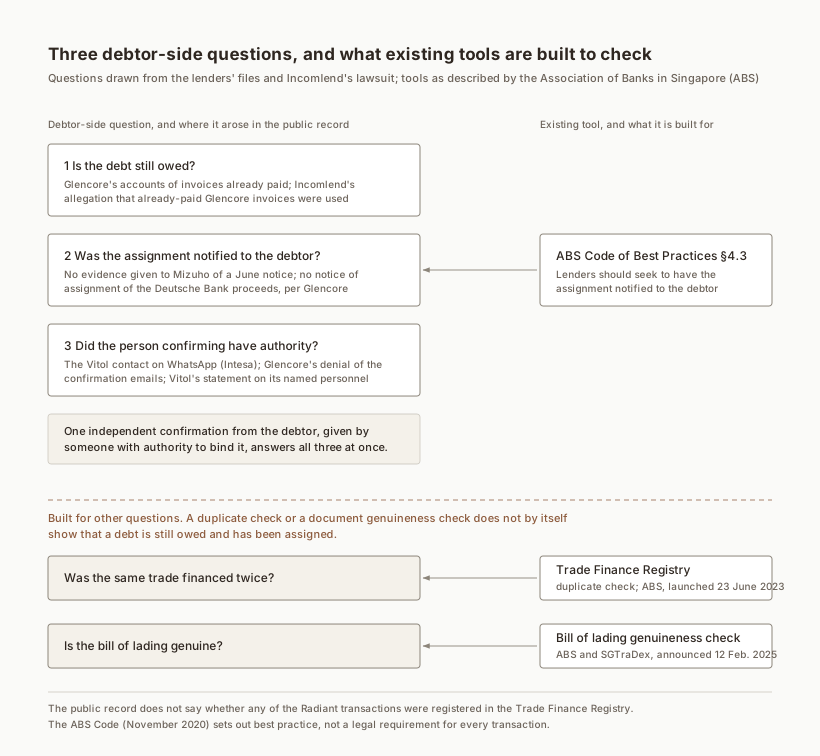
Figure 4. The ABS Code’s §4.3 points at the second question, notice of assignment to the debtor. The registry’s duplicate check and the bill of lading genuineness check are built for paper financed twice and documents that are not genuine. Neither shows by itself that a debt is still owed and has been assigned.
A reader will want to know whether a company in Radiant’s position could earn a kinder reading by telling its story better. The strongest version of that story is already on file. Nahar’s affidavit says the money is due from Radiant World’s customers rather than the company itself, and that argument reaches exactly as far as the customers will confirm it. In the court’s record, the customers are the ones disowning the paper: Glencore denied sending the confirmation emails or receiving the assignment, and Vitol said the contracts were not signed or authorised by its named personnel and that the purported confirmations were not genuine. The narrative problem and the credit problem meet at the same point, the debtor’s word, and no framing goes around it.
The room for narrative lies with the traders that come next, and for them the moment of rereading is not abstract. It is the next renewal, the next new limit, the next annual review, and when it comes the first reading a lender reaches for will be the one Radiant has just supplied. That makes the order of events matter. Someone will write the account of a trader’s debtor side, and if the trader does not write it first, the lender will. A trader that sets it out before it is asked, naming which debtors will confirm directly through someone with authority, whether collections come through a route it cannot redirect, and whether its financing is registered and checked for duplicates, negotiates inside a frame it has drawn itself. A trader that waits answers inside Radiant’s. I expect the gap between the two to show up in specific places: a limit trimmed at renewal, pricing that moves up, a longer list of diligence questions, a renewal that drags.
The natural mistake, and the easiest one to make, is to defend the product by arguing that receivables finance is safe in itself. That is a defence of a category, and it holds the conversation in the wrong frame. Once the discussion is about the product, the trader and Radiant belong to the same category, and the lender’s question becomes how far the trader can prove itself different from a company now in the hands of interim judicial managers. The argument that works moves the question from which product the trader uses to who its debtors are and whether they can be verified independently. It is the same point this piece has drawn from the court’s record, turned around to face the trader: the facts that decide a receivable sit on the debtor’s side, so the case a trader can make for itself sits there too.
So my answer to my friend is that the product did not fail at Radiant. A way of reading it did: the habit of counting the debtor’s payment and recourse to the trader as two independent protections. The table will be quoted for a long time, and all it can carry is where the balances sat. The reading that replaces the old one will be settled over the coming months in credit files, one renewal at a time, and the measure the record gives it is whether the debtor side of each invoice can be verified independently, by someone with authority to answer. This judgment rests on one trader, on allegations Radiant denies and on findings the court made at an interim stage. Within those limits, I hold to it. At Radiant, the lender’s two routes to repayment ran back to the same counterparties, and the next reading of every trader like it will begin with the debtors on the other side of its invoices.
Sources
- [S1] High Court of Singapore, Mizuho Bank, Ltd v Radiant World Corp Pte Ltd [2026] SGHC 200, grounds of decision published 25 September 2026 (order made 24 September 2026). https://www.elitigation.sg/gd/s/2026_SGHC_200 (accessed 26 September 2026)
- [S2] The Edge Singapore (Bloomberg), report on Radiant World’s creditor table, 22 September 2026; carries the creditor table and affidavit details. https://www.theedgesingapore.com/amp/news/news/radiant-world-table-shows-six-lenders-us870-mil-exposure (accessed 26 September 2026)
- [S3] The Business Times (Bloomberg), “Radiant World table shows six lenders with US$870 million exposure”, 22 September 2026. https://www.businesstimes.com.sg/international/global/radiant-world-table-shows-six-lenders-us870-million-exposure (accessed 26 September 2026)
- [S4] Bloomberg Tax (Bloomberg), “Radiant World Table Shows Six Lenders With $870 Million Exposure”, 21 September 2026; original report, paywalled. https://news.bloombergtax.com/financial-accounting/radiant-world-table-shows-six-lenders-with-870-million-exposure (accessed 26 September 2026)
- [S5] Reuters, report that Vitol, Cargill and Glencore cut ties with Radiant World, citing Bloomberg, 31 July 2026. https://www.reuters.com/business/finance/vitol-cargill-glencore-cut-ties-with-radiant-world-bloomberg-news-reports-2026-07-31/ (accessed 26 September 2026)
- [S6] Radiant World, “Radiant World Response to Media Report”, 31 July 2026. https://radiant-world.com/uncategorized/radiant-world-response-to-media-report/ (accessed 26 September 2026)
- [S7] Radiant World, “Statement from Radiant World”, company website, undated. https://radiant-world.com/ (accessed 26 September 2026)
- [S8] Reuters, “Singapore police say they are looking into iron ore trader Radiant World”, 20 August 2026. https://www.reuters.com/world/asia-pacific/singapore-police-say-they-are-looking-into-iron-ore-trader-radiant-world-2026-08-20/ (accessed 26 September 2026)
- [S9] Reuters, report that Mizuho Bank filed a case against Radiant World in Singapore, 28 August 2026. https://www.reuters.com/world/asia-pacific/mizuho-bank-files-case-against-radiant-world-singapore-2026-08-28/ (accessed 26 September 2026)
- [S10] Reuters, “What is Radiant World and why is it in the news?”, 28 August 2026. https://www.reuters.com/business/what-is-radiant-world-why-is-it-news-2026-08-28/ (accessed 26 September 2026)
- [S11] Glencore, statement on past business activities involving Radiant World, 15 September 2026. https://www.glencore.com/media-and-insights/news/update-on-past-business-activities-involving-radiant-world- (accessed 26 September 2026)
- [S12] Reuters, report on Radiant World’s lawsuit against Glencore seeking more than US$2 billion, 16 September 2026. https://www.reuters.com/sustainability/boards-policy-regulation/radiant-world-seeks-2-billion-glencore-lawsuit-2026-09-16/ (accessed 26 September 2026)
- [S13] Reuters, report that a Singapore High Court judge tasked interim managers with probing suspected fraud, 25 September 2026. https://www.reuters.com/world/asia-pacific/singapore-high-court-judge-tasks-interim-managers-with-probing-suspected-fraud-2026-09-25/ (accessed 26 September 2026)
- [S14] Insurance Journal (Bloomberg), “Singapore Court Strips Control of Radiant World From Founder”, 24 September 2026. https://www.insurancejournal.com/news/international/2026/09/24/886741.htm (accessed 26 September 2026)
- [S15] Bloomberg Law (Bloomberg), report on Incomlend’s lawsuit alleging fake Glencore contracts, 3 September 2026; paywalled preview. https://news.bloomberglaw.com/bankruptcy-law/radiant-world-sent-lender-fake-glencore-contracts-lawsuit-says (accessed 26 September 2026)
- [S16] The Business Times (Bloomberg), report that Radiant World and its founder were sued in Singapore, 28 August 2026. https://www.businesstimes.com.sg/companies-markets/radiant-world-and-its-founder-sued-singapore-us34-million (accessed 26 September 2026)
- [S17] Global Trade Review, report on Mizuho’s claims concerning Glencore emails, including Incomlend’s position, 15 September 2026. https://www.gtreview.com/news/asia/mizuho-claims-radiant-world-faked-glencore-emails/ (accessed 26 September 2026)
- [S18] BCR Publishing, “Radiant World discloses US$870m exposure to six receivables finance lenders”, 22 September 2026. https://bcrpub.com/news/radiant-world-discloses-us870m-exposure-to-six-receivables-finance-lenders/ (accessed 26 September 2026)
- [S19] Global Trade Review, report on the allegations, creditors and next steps in the Radiant World case, 23 September 2026. https://www.gtreview.com/news/global/radiant-world-the-allegations-creditors-and-what-happens-next/ (accessed 26 September 2026)
- [S20] DaDepo Insights, “The Invoice Exists. The Receivable May Not”, 18 September 2026. https://dadepo.com/Insights/invoice-exists-receivable-may-not-radiant-world-trade-finance-asset-identity (accessed 26 September 2026)
- [S21] John Saunders, article on designing fraud out of trade finance, LinkedIn, 26 August 2026. https://www.linkedin.com/pulse/part-3-designing-fraud-out-john-saunders-4vr6c (accessed 26 September 2026)
- [S22] Insurance Journal (Bloomberg), “Allianz, Zurich Say They Have No ‘Material Exposure’ to Radiant”, 11 September 2026. https://amp.insurancejournal.com/news/international/2026/09/11/884749.htm (accessed 26 September 2026)
- [S23] finews.asia, report on ABN AMRO’s corporate bank overhaul, 13 August 2020. https://www.finews.asia/finance/32487-abn-amro-overhauls-corporate-bank-robert-swaak (accessed 26 September 2026)
- [S24] Gulf Times (Bloomberg), report on European banks retreating from commodity trade finance, 23 August 2020. https://www.gulf-times.com/story/671304/europes-banks-fall-out-of-love-with-commodity-traders (accessed 26 September 2026)
- [S25] The Association of Banks in Singapore, Code of Best Practices – Commodity Financing, November 2020. https://abs.org.sg/docs/library/code-of-best-practices-commodity-financing.pdf (accessed 26 September 2026)
- [S26] The Association of Banks in Singapore, announcement of the Trade Finance Registry launch, 23 June 2023. https://www.abs.org.sg/docs/library/abs-launches-trade-finance-registry-to-counter-trade-finance-fraud_v3.pdf (accessed 26 September 2026)
- [S27] The Association of Banks in Singapore, Trade Finance Registry FAQs. https://www.abs.org.sg/docs/library/tfr-faqs-12sep23.pdf (accessed 26 September 2026)
- [S28] The Association of Banks in Singapore and SGTraDex, announcement of the real-time bill of lading genuineness check, 12 February 2025. https://www.abs.org.sg/docs/library/trade-finance-registry-and-sgtradex-further-strengthen-trade-finance-risk-mitigation-with-real-time-bill-of-lading-genuineness-check.pdf (accessed 26 September 2026)
- [S29] Reuters, report that Trafigura won its nickel fraud lawsuit against businessman Gupta, 30 January 2026. https://www.reuters.com/world/china/trafigura-says-it-won-600-million-nickel-fraud-lawsuit-against-businessman-gupta-2026-01-30/ (accessed 26 September 2026)
- [S30] Courts and Tribunals Judiciary (England and Wales), Trafigura v Gupta and others [2026] EWHC 159 (Comm), 30 January 2026. https://www.judiciary.uk/judgments/trafigura-v-gupta-and-others/ (accessed 26 September 2026)