Passing the Wrong Examination
Expansion can stall while demand holds: a permit sits, a partner goes quiet, a trade body describes the company in terms it would not use. On the other judgment in play.
Why global expansion can stall even when the offer succeeds.
You did everything the playbook asked. The market study was right. Demand is real, the product wins its comparisons, and the pricing has been stress-tested twice.
And yet, the license renewal that should have been routine is in its fourth month. A partner who spent a quarter negotiating terms has gone quiet without rejecting anything. A trade association you never thought of as an audience has begun describing your company in public in words you would not use about yourself.
When expansion stalls like this, the instinct is to reopen the entry plan and hunt for the error. But often, there is no error to find. The plan answered the questions it was built to answer: where to enter, how to enter, how to compete. The stall comes from a question the plan never asked, because it treated the answer as settled: whether the institutions and audiences of the host market will actually authorize this particular company to operate among them.
You are facing two different examinations. One judges the offer: is this product worth buying at this price through this channel? The other judges the actor: who controls this company, whose interests does it serve, does it respect how things are governed here, and can an association with it be publicly defended?
A company can pass the first examination completely and still fail the second. Most expansion playbooks are instruments for passing the first. This is the diagnostic question at the heart of Narrative Power Analysis (NPA).
The distinction is rarely a clean fork: a company can have an offer problem and an actor problem at once. The practical question is which judgment is binding at the current bottleneck.
Who is actually judging you
The first step is to stop imagining a single judge. There is no unified “market” forming one opinion of a foreign entrant. There are only specific audiences, and they are not reading the same company.
A restaurant owner evaluating your equipment is judging usefulness: does it work, what does it cost to run, will someone fix it when it breaks? A distributor weighing a partnership is judging something else entirely: whether depending on you is safe, and whether an association with you can be defended to peers if it sours. A licensing office is judging control and consequence: what this company’s presence does to the system it is responsible for. A local newspaper is judging belonging: whose interests this company serves, and whether its presence threatens something the community values.
Each audience holds a different resource. One signs purchase orders. One controls distribution. One grants and withholds permission. One shapes what everyone else believes.
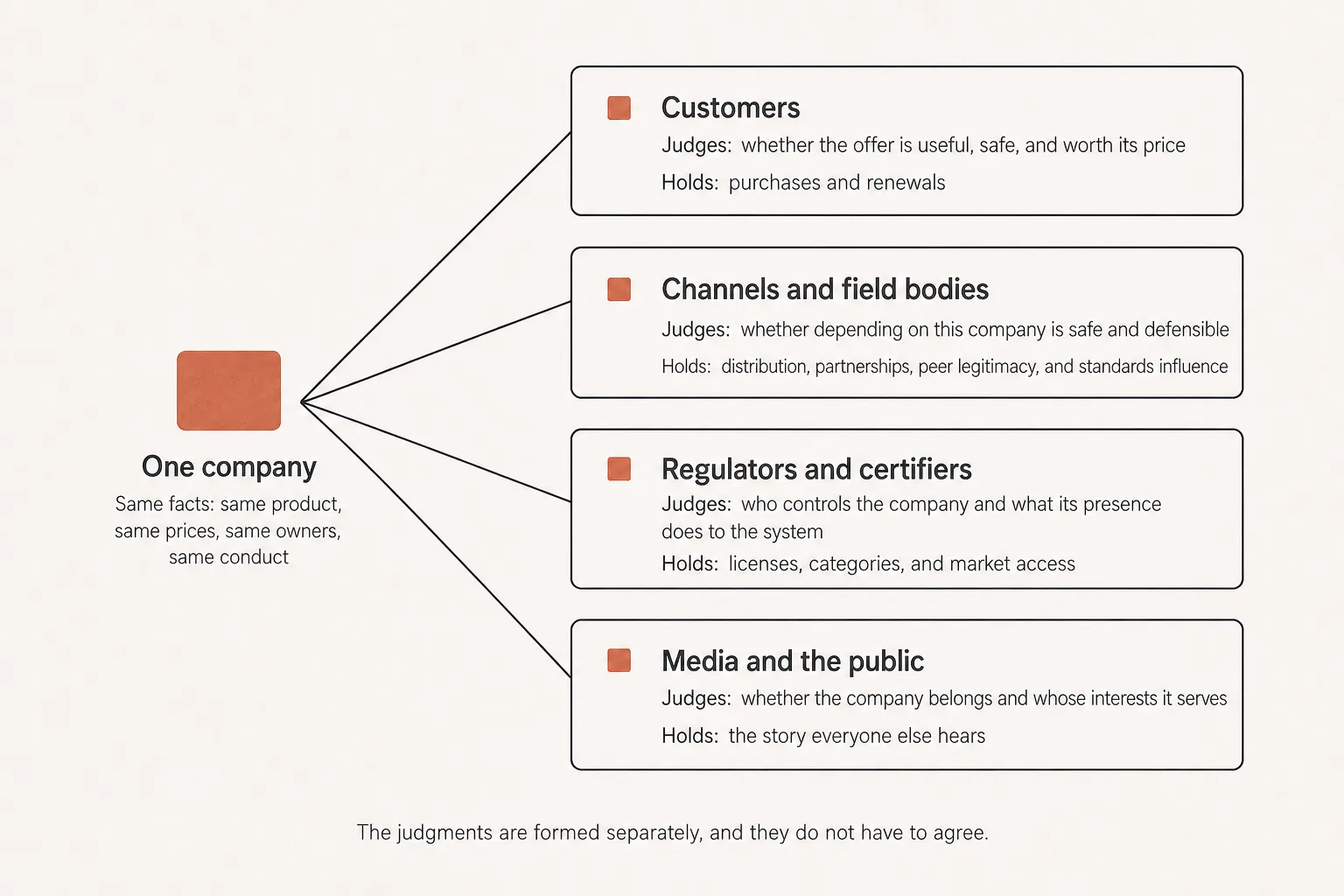
This matters because the same fact routinely means radically different things to different audiences at the same moment. A low price is a good deal to a buyer and evidence of predation to a threatened incumbent channel. A local hire signals commitment to one audience and window-dressing to another. A large investment reassures the audience that wanted jobs, but alarms the audience that counts dependencies. Nothing about the fact changes. What changes is the question it is being used to answer.
Acceptance in a host market is not a single score. It is a set of separate accounts, each held with a different audience, governed by different rules, and convertible into different consequences. A company can be solvent in three of those accounts and quietly bankrupt in the fourth. That fourth account may be the one that controls market access. Friction with regulators, for instance, often begins there long before anything formal happens. How Regulatory Friction Begins Before Formal Review examines that earlier phase.
“Our reputation in the market” is a phrase with no referent. What exists is individual relationships: this company, judged by this audience, for this purpose, with this power to act on the judgment.
A company that did everything the playbook asked
The case that follows is a composite; no single company sits behind it. Consider a maker of commercial kitchen refrigeration expanding abroad.
The entry plan is flawless. The units are efficient and cheap to run, and demand is real: restaurant owners who trial them immediately reorder. The company enters exactly the way it sells at home, where the industry runs on direct sales and independent service contractors. It prices aggressively, sells straight to kitchens, and signs regional contractors for maintenance.
But in the host market, the trade is built differently. Commercial kitchen equipment moves through dealer networks that also certify installations and stock parts. The dealers anchor the trade association. The association advises the municipal offices that certify food-service equipment. None of this is written down as a barrier to entry, because it is not one. It is simply how the trade governs itself.
Within the first year, the accounts diverge. Buyers keep buying. Dealers decline to touch the machines. The association starts raising safety and installation questions in public, in general terms, without naming anyone. The certification review for the company’s import category slows, then stalls. It is never rejected. It is simply parked.
The company reads all this as protectionist noise. It responds with hard evidence about the machine: independent test reports, an extended warranty, and, eventually, a price cut.
Every move makes it worse.
The test reports answer a question no one asked. The price cut confirms to the channel exactly what kind of company undercuts its way in. The direct-sales model, defended in every meeting as more efficient, is heard as a declaration that the company has no intention of participating in how this trade runs itself. Late in the second year, the company builds a local service center, a real investment at real cost. But announced under pressure, it is read as a tactic.
Each audience was judging a different object. The buyers judged the machine, and the machine won. The dealers judged the business model, and what it implied for them. The association judged the actor: whether this company respects the way the local trade governs itself. The certification office faced a quieter, harder problem: classification. What, exactly, was this thing? A foreign direct-seller with contractor service fit no existing slot. When an institution is asked to certify something it cannot classify, it does not refuse. It waits.
The company spent two years answering questions about the machine. The machine was never the question.
Two sets of demands that do not merge
The natural conclusion from a story like that is “we just need to become more local.” It is half right, and the wrong half is expensive.
Suppose the refrigeration maker does the obvious thing: joins the dealer system, licenses local assembly, and restructures distribution until it looks identical to a domestic firm. Its host-market accounts improve. But the company does not stop being watched from home.
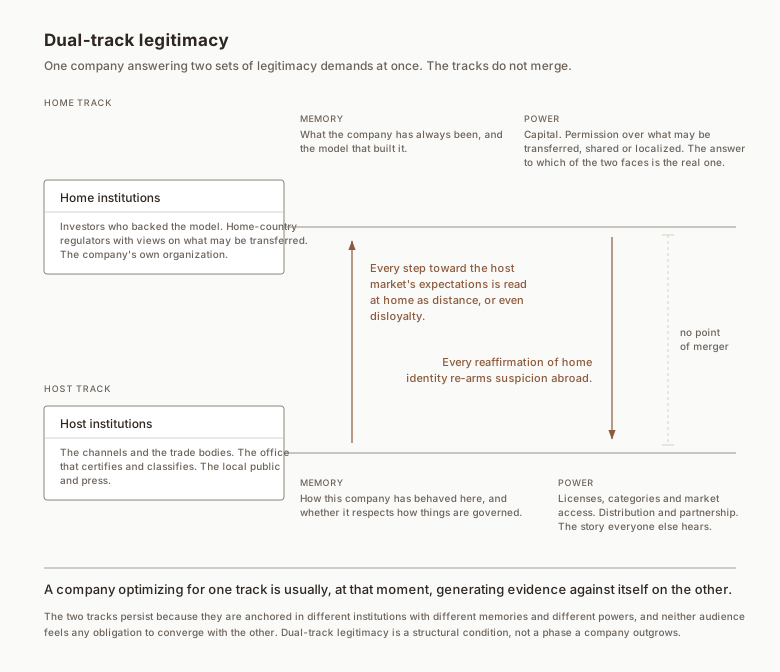
Home-market investors ask why the model that built the company is being dismantled abroad. In some industries, home-country regulators have their own views about what may be transferred, shared, or localized. Even the company’s own organization begins to ask which of its two faces is the real one. For companies from politically visible home countries, the pull is sharper still. Every step toward the host market’s expectations can be read at home as distance, or even disloyalty. Conversely, every reaffirmation of home identity re-arms suspicion abroad. The home track holds powers of its own: capital, the terms on which technology and operations may be transferred or localized, and the company’s own answer to which of its two faces is real.
A company expanding abroad answers two sets of legitimacy demands at once: home and host. The tracks do not merge.
Call it dual-track legitimacy: a structural condition, not a phase a company outgrows. The two tracks persist because they are anchored in different institutions with different memories and different powers, and neither audience feels any obligation to converge with the other. A company optimizing for one track is usually, at that very moment, generating evidence against itself on the other.
Two things follow from taking this structure seriously.
The first is that adaptation has layers. There is a core of fact that cannot change with geography: what the company is, who owns it, where it comes from, what it has done. Around that core sit layers that can legitimately adapt: the cultural register it speaks in, the benefits it emphasizes, the proof it offers each audience.
Companies get into trouble in both directions. Some refuse to adapt the adaptable layers and are heard as arrogant. Others try to adapt the factual core and get caught. Once caught, a foreignness problem becomes an honesty problem. The distinction sounds obvious in a meeting room, but under pressure, with different advisors owning different layers, it is missed constantly.
The second is that multiple identities are inevitable. A company operating across borders holds multiple identities whether it manages them or not, because different audiences read it differently. They do not have to perfectly align before the company can act. The first task is to identify precisely where they diverge: which audience holds which version of the company, and where one version contradicts another. Divergence that is mapped is a manageable condition. Divergence that is discovered by journalists is a crisis.
One more property of these judgments changes planning horizons. Acceptance is accumulated, not acquired. There is no moment at which a market has “approved” you and the file closes. There are only accounts that build slowly, respond to different kinds of evidence, and can be drawn down abruptly.
Doubt comes in more than one kind: an audience can doubt that you are useful, that you are right, or that it can place you in a category at all. Each doubt requires different evidence. Judging which doubt you face, and whether it is a real obstacle at all, is its own discipline (What Makes a Real Narrative Obstacle).
Why the usual fixes slide off
The trouble begins when this kind of stall is divided inside the company.
The stall arrives as a symptom: lagging sales, a stalled license, a partner gone quiet, hostile coverage. Each internal function translates the symptom into its own vocabulary. To the product organization, it becomes a localization gap. To marketing, a brand-relevance problem. To communications, a reputation issue. To government affairs, regulatory risk.
Each translation is locally reasonable, and each comes with a familiar playbook and a budget line. What gets lost in translation is that these are often different appearances of a single judgment about the actor, formed by specific audiences.
The work usually splits across four functions: brand, cross-cultural, communications, and public affairs. None of these functions is careless; with no one owning the seam between them, the gap is structural. How that division of labor works, and where its edges are, is mapped in Narrative Architecture, Messaging, PR and IR.
First, there is a timing mismatch. By the time a symptom reaches any of the four clusters, the decisions that audiences actually read as evidence (entry mode, ownership structure, partner selection, data arrangements, the operating model) have often become expensive, politically difficult, or operationally disruptive to reopen. Communications can explain an ownership structure; it cannot make an unacceptable one acceptable. A brand campaign can clarify identity, but it cannot substitute for the verifiable, costly, hard-to-reverse commitments that institutional audiences treat as the only real signal.
Second, there is the seam itself. Who determines which audience’s judgment is binding? Who decides what that audience actually believes the company is? Who checks if the fixes proposed by four different functions are even compatible across the home and host tracks? That determination belongs to no cluster in particular. So by default, it is made by no one.
Reading the problem before choosing the work
For a stalled expansion, the place to begin is observable evidence: three questions, run across each audience separately.
- What are the objections actually about? Complaints about price, features, availability, and service point to the offer. Market-entry playbooks are designed to address them. But questions about control, origin, intentions, respect, and belonging, especially when they persist after your factual record improves, point to a judgment about the actor.
- Does demand hold while access deteriorates? When customers keep buying while institutions hesitate, licenses stall, or partners hedge, that divergence is a strong diagnostic signal. Offer problems often damage demand and access together; actor problems often damage access selectively, even while demand holds.
- What kind of change would the doubting audience accept? If a clearer message would genuinely settle the matter, your problem lives in communication. But when an audience demands a structural commitment too costly to reverse (a different owner, a governance change, a local partner with real authority), the judgment is about the actor. A message can clarify a commitment; it cannot create one.
Answer these, and a stalled expansion usually stops looking like an unreadable fog and starts looking like a map. You will see which audience’s judgment has become binding, and what evidence that specific audience demands.
The same few patterns recur often enough to be recognizable on sight: home assumptions imported wholesale; attempts to shed your origin that read as concealment; trust that will not transfer from one audience to its neighbor; expansion speed outrunning the pace of acceptance; the dual tracks pulling the company in opposite directions.
This is where NPA enters. It does not run the campaign or negotiate the license. It produces a decision map: the audience whose judgment is binding, the inference about the company that must change, and the evidence that audience can treat as real. The interventions themselves remain the province of your internal teams. But now, they are working from a shared map instead of four private translations.
And sometimes, the reading tells you exactly the opposite of what this article focuses on. If the objections really are about price and features, if local institutions are slow for everyone and not just for you, and if the doubt dissolves when your product facts improve, then you do not have an actor problem. Treating an ordinary competitive grind as an identity drama wastes money. Worse, it insults audiences who were only ever asking for a better offer.
The first decision
The direct-sales model may or may not have been the wrong commercial choice. The mistake was failing to ask what it signaled to the audiences that controlled access.
The deeper risk is spending two years winning the argument with buyers while the institution that controls access waits for a different commitment.
The market can want you, and the system around it can still decline to authorize you. Before deciding whether to push, restructure, or wait, identify whose judgment is binding.
Further reading. The concepts carried in this article rest on established research literatures.
- On origin acting as inference or summary in audience evaluation: C. Min Han, “Country Image: Halo or Summary Construct?” Journal of Marketing Research 26, no. 2 (1989).
- On the additional costs of operating as a foreign firm: Srilata Zaheer, “Overcoming the Liability of Foreignness,” Academy of Management Journal 38, no. 2 (1995).
- On the forms legitimacy takes: Mark C. Suchman, “Managing Legitimacy: Strategic and Institutional Approaches,” Academy of Management Review 20, no. 3 (1995).
- On subsidiaries answering two institutional environments at once: Tatiana Kostova and Kendall Roth, “Adoption of an Organizational Practice by Subsidiaries of Multinational Corporations,” Academy of Management Journal 45, no. 1 (2002).
- On organizations under multiple, conflicting institutional prescriptions: Royston Greenwood et al., “Institutional Complexity and Organizational Responses,” Academy of Management Annals 5, no. 1 (2011).
- On tensions that require ongoing management rather than resolution: Wendy K. Smith and Marianne W. Lewis, “Toward a Theory of Paradox,” Academy of Management Review 36, no. 2 (2011).
Understand the method: Five Narrative Power Scenarios | What Makes a Real Narrative Obstacle
Method note: What an NPA Engagement Examines and Produces