Five Narrative Power Scenarios
A company holds a different position with each audience. Three lenses for reading one relationship at one moment, and the recurring shapes of dependence they show.
“Position” sounds singular. In cross-border business, it rarely is.
A company has one position with investors, another with regulators, another with commercial partners, and another with the institutions and commentators that shape how it is understood. These relationships can coexist around the same company, in the same market, at the same moment, without operating on the same terms.
This is why a board can ask a seemingly simple question: how exposed are we in our largest foreign market? The CFO points to the latest financing round. It was oversubscribed, and two sovereign funds asked to participate. The general counsel points to the operating license. Renewal is eleven months away, and the decision is discretionary. The country manager points to the local partner. The relationship has never been closer, and the minister attended the plant opening.
Each answer may be correct. The disagreement is not necessarily about the facts. It is about which relationship those facts describe.
A financing position can strengthen while a regulatory position weakens. A partnership can deepen while the company’s public classification becomes more difficult. Commercial value can rise while institutional exposure grows. When these relationships are compressed into one adjective, whether strong, stable, or exposed, the adjective often describes the mood in the room more accurately than the company’s situation.
The first task is to read the relationships separately: what each side needs, how the balance has changed, what the relationship runs through. Only then does the question of response become useful. A response designed for the wrong relationship is how companies end up solving an investor problem they do not have while a licensing problem they do have remains unattended. The relationship has to be read before it can be managed.
Power is a property of the relationship
Start with the general counsel’s view. What would “strong” mean here?
The licensing authority controls something the company cannot operate without: permission to remain in the market. The company controls nothing the authority needs at a comparable level, and there is no second authority to approach. It has spent four years and built a headquarters to qualify for this market. The investment cannot simply be moved elsewhere.
Strength here belongs to the relationship, and to nothing else: who depends on whom, for what, and with what alternatives.
Power in a cross-border relationship can be read through three lenses: resource dependence, stage-specific bargaining position, and control of network nodes. The first asks who needs what from whom and how easily either side could replace it; the second asks where the relationship is in its life and how previous commitments have changed the balance; the third asks what the relationship runs through, and who controls that.
None of the three is new; each condenses a research tradition developed over decades. Together, they offer a way to reconstruct a company’s standing with one audience, on one issue, at one moment, without taking the answer from company size, brand, or self-image. A large company can be structurally dependent on a small authority. A new entrant can become difficult to replace. A company with strong direct relationships can still be exposed if a third institution controls the channel through which those relationships operate. The question is always the same: what is the actual structure of dependence around this relationship?
The first lens: who needs whom
Resource dependence is the bluntest of the three lenses and the one most often skipped. The question worth asking is whether the company controls anything that matters to the audience, and what either side could realistically do if the relationship ended; that the audience matters to the company is never in doubt.
Four questions do most of the work:
- Does the audience control something the company cannot operate without, such as access, capital, approval, supply, or a channel through which it can be heard?
- Could the company obtain the same thing elsewhere, within the time available and at a cost it could actually bear?
- What has already been committed to the relationship that cannot be recovered or moved?
- What would walking away cost each side?
The second question deserves the most suspicion. Alternatives look plentiful on a slide and scarce in practice. A substitute supplier that would take three years to qualify is not an alternative inside an eighteen-month window. A listing venue that would accept the company only at half the valuation may be an exit, but it is not a comparable option. An alternative that cannot be funded, approved, and executed within the relevant window does not reduce dependence. It merely decorates it.
The second lens: how the relationship changes
The first lens gives a snapshot. The second asks whether it is still current.
Bargaining position changes over the life of a cross-border commitment, often around visible events. A plant is completed. Technology is transferred. A license approaches renewal. Debt is refinanced. A political sponsor leaves office. A second credible investor enters the market.
Before such a moment, one side may be trying to win the relationship. After it, the balance may quietly change. A company that was courted at entry may find itself taking instructions at renewal. No one needs to announce the shift.
The useful questions concern movement: whether what the company brought into the relationship was scarce, and whether it still is; how much of what it has built could be redeployed if the relationship ended; whether the surrounding policy environment is moving toward the company or away from it; and who else can now offer the audience what only this company could offer at the beginning.
Position does not erode on a schedule, and it does not only erode. A host that once had many suitors can come to depend on the company that stayed, for employment, revenue, infrastructure, or a capability it cannot rebuild. The only reading that can safely be assumed to be out of date is the entry-day reading.
The third lens: what the relationship runs through
The first two lenses look at the pair itself: the company and the audience. The third looks at the wiring around them.
Some relationships appear balanced when viewed directly, but become uneven once the surrounding system is visible. One side may control a point through which necessary flows must pass: a payment rail, a clearing system, a certification body, a component produced in only one jurisdiction, or a data channel that one authority can read or close.
Control of such a point creates a different kind of leverage. It does not require the counterpart’s consent. It is also easy to miss when the relationship is measured only by what each side buys from the other.
“Chokepoint” is a precise term. A node counts only when the flow through it is necessary and no practical route around it exists. A prominent critic is not a chokepoint. A regulator that can close the only clearing channel for a company’s receivables is.
The questions run along the wiring: whether either side controls a point through which money, goods, data, or approval must pass; whether there is a bottleneck neither side controls, and who sits closer to it; who can define, publish, or withhold the information on which the relationship depends; and, if the node closed, what route around it would actually be available and how long it would take to establish.
Control of a node creates leverage, not trust. An audience that cannot route around a company may still distrust it. A regulator that controls access may still struggle to persuade others that its decisions are predictable. This lens reads the structure of constraint. What the audience makes of the company inside that structure belongs to a different layer of the method.
The five scenarios
Taken together, the three lenses do not produce a score. Depending on who depends on whom, a company sits in one of five recognizable power scenarios, and the same company can sit in different ones for different audiences. Four are basic arrangements of dependence; the fifth is a recurrent mismatch between formal position and actual control.
These are not rankings. The first four differ in where the binding constraint sits: with the company, with the audience, with both, or outside the pair. The fifth is a warning that applies to all four. The examples below are schematic rather than complete case histories.
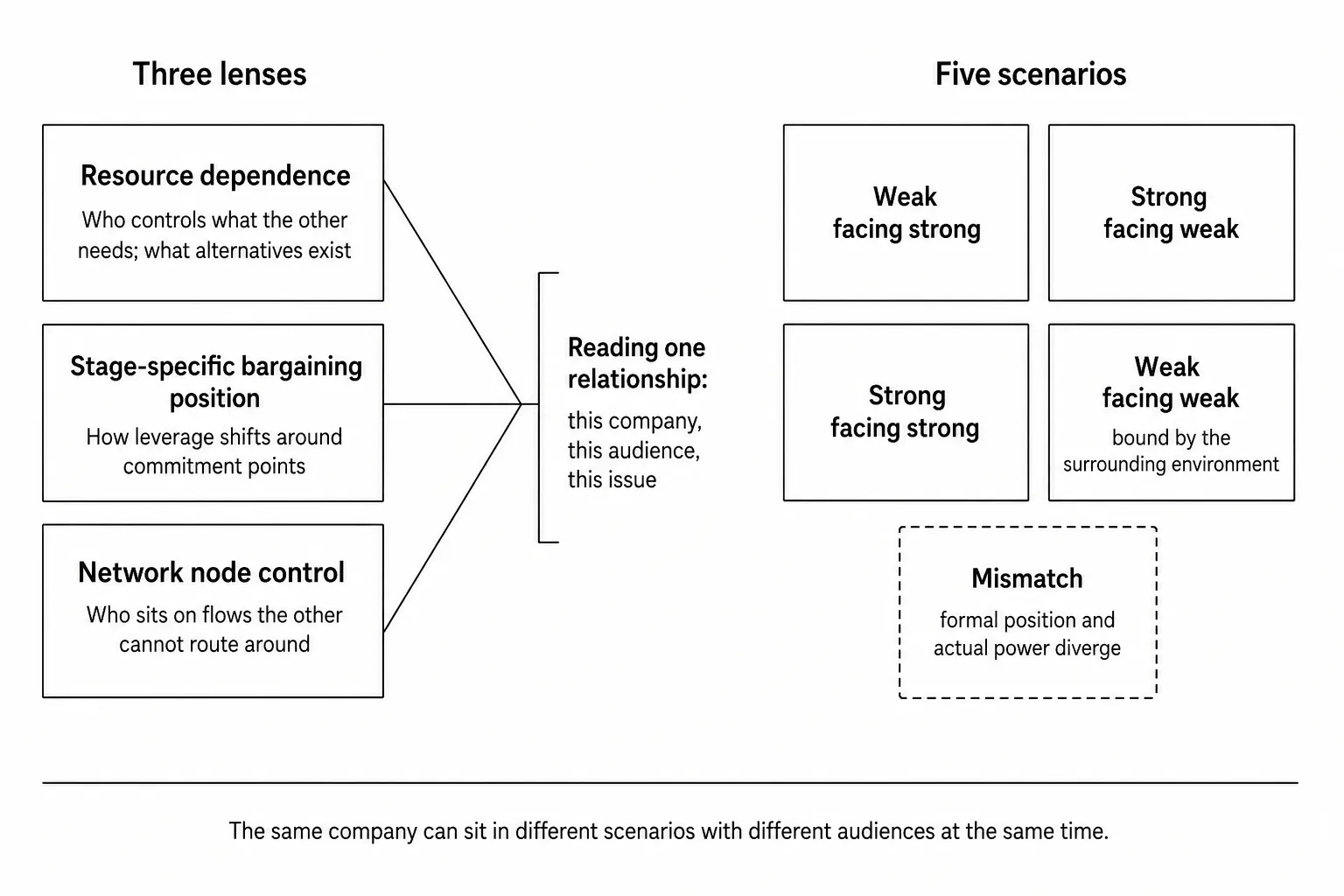
Weak facing strong. The audience controls something the company must have. The company controls nothing of comparable weight, alternatives are thin, and the balance is not improving. This is the classic shape of entry: the company is asking to be admitted by an audience that does not need to admit it.
A company can be large, successful, and valuable to the market without holding meaningful bargaining power in a particular relationship. Consider a payments company that had operated in its second market for five years when an acknowledged compliance failure placed its license renewal under scrutiny. The structure was plain. The authority controlled market access, there was no equivalent license to apply for, the local platform had taken four years to build, and exit would strand the company’s largest customer base.
The question was whether the company could continue to operate cleanly. The company described itself as a market leader. In this relationship, it was a supplicant with a hearing date.
Strong facing weak. Here, the dependence runs in the other direction. The audience needs something the company controls and cannot readily replace.
Few companies read this position correctly from the inside. Size and purchasing power are easy proxies for dependence, and often poor ones. A precision-components manufacturer discovered that its largest foreign buyer would need longer to qualify a substitute than its committed production schedule allowed. The manufacturer had assumed that the buyer held the power because buyers usually do. The underlying dependence ran toward the manufacturer, and the buyer understood it first.
The buyer’s procurement committee was not debating price alone. It was debating whether it was comfortable being so dependent on a company from that country. No delivery statistic could answer that question.
Strong facing strong. Both sides control something the other needs. Each can impose meaningful costs, and neither can simply walk away.
Two companies spent a year assembling a joint venture. One controlled the distribution network in its home region; the other controlled the process technology. Each also needed regulatory approval. Diligence raised questions about conduct on both sides, but neither party could replace the other within the window that made the venture worth pursuing.
Mutual dependence did not remove the doubts. It gave both sides a reason to remain at the table while addressing them.
Weak facing weak. Sometimes neither side controls what binds the relationship. The constraint sits outside the pair, in an industry standard, a certification body, a market convention, a regulatory classification, or an information channel that neither party owns.
Two mid-sized companies formed an alliance that neither strictly needed. Each had alternatives, and little had been sunk into the relationship. What neither controlled was the industry’s certification consortium and the trade press around it. Together, they had effectively decided what category the foreign company belonged to.
The consortium’s taxonomy had no place for its hybrid model, while the trade press continued to file it under a business the company had left years earlier. The bilateral relationship was functioning. The consequential judgment was being formed in a room neither partner sat in, and a wrong classification there cost more than anything the two companies could do to each other.
Improving the relationship between the partners would not solve a constraint that sat outside it.
A separate problem arises when the visible indicators point to the wrong structure.
The mismatch case. The formally small player may operate the node through which everyone routes. A heavily scrutinized company may hold an asset its scrutinizer urgently needs. A majority owner may control the shares without controlling the operations, licenses, or people.
Size, ownership percentage, nationality, institutional rank, and public prominence are all proxies for power. Any of them can be wrong in either direction. When the proxies and the underlying structure disagree, the structure deserves priority. Until the relationship has been examined on its own terms, its position remains unread.
One company, several scenarios, several clocks
The board meeting at the beginning was not confused because anyone lacked information. It was confused because the company occupied at least three scenarios at once, while the meeting had one word for all of them.
With investors, its position was strong and strengthening. With the licensing authority, it faced discretionary renewal from a position of full dependence. With its local partner, it sat inside a mutual dependence that neither side had fully priced.
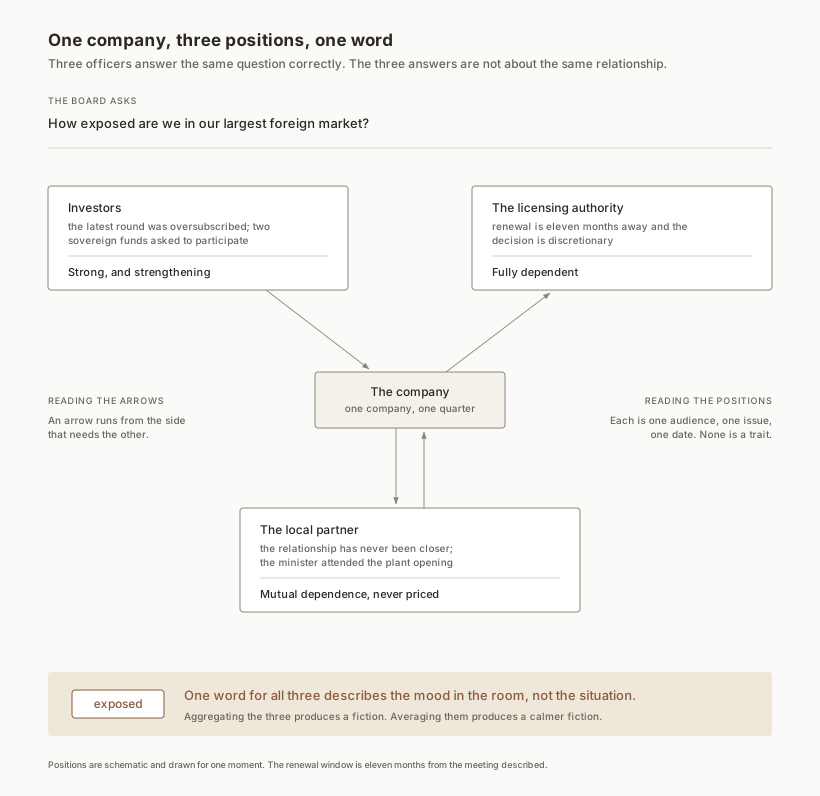
Aggregating these positions produces a fiction. Averaging them produces a more dangerous one, because the average is calm.
A scenario is a dated reading of one relationship, around one issue, with one audience, never a trait of the company. Each relationship also moves on its own clock. A capital position can strengthen in the same quarter that a regulatory position weakens. Success on the fast clock can quietly raise the stakes on the slow one.
The audience has to be named before the position means anything. “We are strong” is not a reading. “We are strong with the bondholders and weak with the ministry, and the ministry’s clock runs faster” is a reading. It is also the kind of distinction that changes what a board does next.
Where this reading stops
A relationship reading is useful only when the outcome actually depends on the structure of the relationship.
Some situations do not. If a rule is determinate and immediately enforceable, the relationship with its enforcer is not the variable; compliance is. If the problem is a failed product, a safety incident, or a broken process, the work begins with causal investigation. No analysis of dependence substitutes for fixing the thing itself. The same is true of arm’s-length exchanges with abundant substitutes and little committed to the relationship. There may be no power structure to read.
Evidence creates the harder boundary. When the available facts cannot distinguish structural dependence from assumption, the right output is a statement of what remains unknown and what evidence would resolve it, rather than a scenario. The most common abuse is to assign a scenario only after the outcome is known and use it to explain what has already happened.
The scenarios do not prescribe a response. They do one job: identify the relationship before an intervention is designed. Before that comes another question, whether the obstacle in front of the company is real at all. That is the subject of the next note, What Makes a Real Narrative Obstacle.
Most of the observations are ordinary. Legal teams know approval rights, finance teams know capital options, operations teams know supply dependencies, and commercial teams know customers and partners; the surrounding advisory work has its own jobs and its own moments. The difficulty is that these observations sit in separate rooms, answering separate questions. What is rare is the assembled reading: one relationship, three lenses, a date, and a named audience.
Bringing them together produces a more precise answer to a narrower question: where does the company stand with this audience, on this issue, today? Most companies have every input to that reading somewhere in the building. Few have the reading.
This note is part of a series on narrative power analysis. For why narrative problems are power problems in the first place, start with the opening note. To see what an engagement built on this method examines and produces, see what an NPA engagement examines.
Further reading
-
Richard M. Emerson, “Power-Dependence Relations,” American Sociological Review, Vol. 27, No. 1, 1962, pp. 31-41. The foundational statement that power belongs to a relationship rather than an actor. Dependence, and therefore power, is shaped by the importance of what flows between the parties and the alternatives available to each.
-
Tiziana Casciaro and Mikolaj Jan Piskorski, “Power Imbalance, Mutual Dependence, and Constraint Absorption: A Closer Look at Resource Dependence Theory,” Administrative Science Quarterly, Vol. 50, No. 2, 2005, pp. 167-199. An account of why “balanced” can describe two very different conditions: relationships in which neither side needs much, and relationships in which both sides are deeply dependent.
-
Raymond Vernon, Sovereignty at Bay: The Multinational Spread of U.S. Enterprises, Basic Books, 1971. The original account of how a foreign investor’s bargaining position can change after assets have been committed.
-
Ravi Ramamurti, “The Obsolescing ‘Bargaining Model’? MNC-Host Developing Country Relations Revisited,” Journal of International Business Studies, Vol. 32, No. 1, 2001, pp. 23-39. A revision of the original bargaining model, showing how company-host relationships operate inside a wider structure of home governments, treaties, and multilateral rules.
-
Henry Farrell and Abraham L. Newman, “Weaponized Interdependence: How Global Economic Networks Shape State Coercion,” International Security, Vol. 44, No. 1, 2019, pp. 42-79. An account of how networks concentrate around hubs, and how control of a hub can become power over the parties routed through it.
-
Jeff Frooman, “Stakeholder Influence Strategies,” Academy of Management Review, Vol. 24, No. 2, 1999, pp. 191-205. The closest existing map to the four recurring scenarios, sorting firm-stakeholder relationships by the direction and intensity of dependence.