One Mark in GIFT City's Export-Credit Column: Where IndiGo's Credendo Deal Was Booked and Why It Was Insured
IndiGo's Credendo deal showed an export-credit-insured aircraft financing can be booked through GIFT City. The one reason on record for insuring it points to Belgium; its terms were not disclosed.
Prepared from publicly available information as of 16 October 2026.
Reading the aviation-finance news from 13 October 2026, I found GIFT City at the centre of a transaction whose insurer was speaking about Belgium. Citi and Credendo jointly announced the successful completion of a USD 328 million financing for eight Airbus aircraft for IndiGo, six A321s and two A320s. Citi lent, Credendo insured, and the transaction ran through IndiGo’s IFSC subsidiary. The release described two firsts. By the next day, the coverage had picked them up and was calling the deal a milestone. The Citi and IndiGo executives quoted in the release spoke of “ECA-backed international liquidity” and a “competitive source of liquidity”. Together, those accounts gave the transaction a clear public meaning: GIFT IFSC was bringing export-credit-backed liquidity to Indian aviation finance.
Credendo’s own explanation began elsewhere. In the release, its Group Deputy CEO called the deal Credendo’s first aircraft financing and the first step in a broader plan to expand its support for the Belgian aeronautics industry. GIFT had accommodated the financing; the reason Credendo gave for entering aircraft finance was rooted in its home industry. I could see why the firsts were newsworthy. What I could not take from the public record was an underwriting reason or a set of insurance terms that another Indian airline could use. Where a financing can be booked is one decision. Why an agency agrees to carry the risk, and on what terms, is another. The October deal demonstrated the first once. For the next borrower, the public record offers no answer to the second.
That matters for people who had no part in the transaction: credit and structuring staff at banks financing Indian airlines, export credit agency underwriters and aircraft lessors. Their first view of “GIFT plus export credit” may be formed at least partly from the announcement and the reporting around it. If so, the next mandate could begin with the GIFT story already established, while the reason and terms for insuring a different borrower’s risk remain to be worked out.
The release
The release itself is exact about roles. It names Citi as Sole Mandated Arranger, ECA Coordinator and Sole Lender, and says the financing is supported by credit insurance from Credendo. It says the transaction was executed through IndiGo’s IFSC subsidiary, InterGlobe Aviation Financial Services IFSC Private Limited, without saying whether that subsidiary is the borrower, the lessor or the owner of the aircraft, which is the first thing a structurer at another bank would want to know. Two firsts appear in the release’s own text, as joint statements of Citi and Credendo, outside any spokesperson’s quote. One is the “first-ever Credendo-insured aviation financing globally”, a first within Credendo’s own book. The other is the “first ECA-backed aircraft financing through a GIFT IFSC leasing structure”, which holds only with all three of its qualifiers in place: export credit backing, aircraft financing and a GIFT IFSC leasing structure. The deals that came before it show what the qualifiers exclude. Then come the absences. The release discloses no tenor, no insurance cover percentage, no insured risk categories, no interest rate and no premium. An underwriter reading it for a precedent learns that the combination was completed and nothing about the terms on which it was completed. The deal cannot serve anyone as a terms precedent.
How the release became a milestone
For a non-participant, the coverage may be the first account of the deal. Business Standard, in a report by Subrata Panda on the day, introduced the two firsts with “The two lenders described it as”, where the release has one lender and one insurer. For an export credit underwriter, the line between lending and insuring is the substance of the deal. The Economic Times, carrying a PTI report, gave the firsts “according to a statement”, among them “the maiden ECA-backed aircraft financing structured through the GIFT IFSC”. Mint, in a report by Subhana Shaikh, attributed both firsts to what “Citigroup said in a statement on Tuesday” and placed the deal against the backdrop that “GIFT City’s aircraft-leasing ecosystem attracts some of India’s biggest business and airline groups.” On 14 October, AviTrader described the deal as “establishing a significant milestone for India’s aviation finance sector.” Each report carried the firsts on the authority of the statement.
The frame came from inside the release. K Balasubramanian, Citi’s India CEO and Banking Head and Indian Subcontinent Sub-Cluster Head, connected the deal to India’s GIFT policy, Citi’s cross-border aviation and export credit financing capabilities, Credendo’s insurance and IndiGo’s IFSC platform, and spoke of “ECA-backed international liquidity”. Riyaz Peermohamed, IndiGo’s Chief Aircraft Acquisition & Financing Officer, said the partnership provided a “competitive source of liquidity” for IndiGo’s growing Airbus fleet and showed GIFT IFSC’s potential to bring together international banks and export credit agencies. “Competitive” is IndiGo’s own assessment; the release compares no prices. Credendo’s statement points elsewhere, to Belgium. BCR Publishing wrote down what the release left out: “The exact insurance coverage, borrowing costs, repayment schedule and maturity were not disclosed.” BCR also gave the general case for the instrument, that export credit insurance can help lenders “manage part of the credit risk” and may “provide longer-term funding”, an account of what such cover does in general with no term of this deal behind it. In the sources reviewed through 16 October 2026, no rating action, law-firm note or independent lessor commentary specific to this deal was found. The reading available to a non-participant was framed by two of the parties and carried by the press, with no pricing voice in it.
GIFT before Credendo
A credit officer who sets the deal against GIFT’s history finds a venue already in regular use. On 29 September 2023, Air India announced that its wholly owned GIFT IFSC subsidiary, AI Fleet Services (AIFS), had facilitated the finance lease of its first Airbus A350-900, with HSBC. On 23 August 2024, Airfinance Global reported, in an exclusive by Olivier Bonnassies, that IndiGo had financed a new A321neo delivery through a commercial loan supported by Itasca insurance in GIFT City, under a mandate covering four new A321neo deliveries, with Crédit Agricole CIB providing the senior debt. On 15 October 2025, Standard Chartered and Bank of India announced a USD 215 million, seven-year amortising term loan to AI Fleet Services IFSC Limited for six Boeing 777-300ER aircraft to be leased to Air India. On 6 March 2026, Clifford Chance said it had advised SMBC on a JOLCO (Japanese Operating Lease with Call Option) for IndiGo covering “two Airbus A320neo family aircraft”, with SMBC as debt arranger and lender and SMFL arranging the equity.
IndiGo’s subsidiary grew quickly into the role. IndiGo’s Annual Report 2025–26 dates its incorporation to 12 October 2023. The Annual Report 2024–25 records an IFSCA captive finance company licence on 26 June 2024, the start of operations on 15 July 2024, and 33 aircraft leased to IndiGo during FY2025. During FY2025–26 the subsidiary leased 45 aircraft to the parent, and at 31 March 2026 it owned “78 aircraft and 2 landing gears”. IndiGo reported that in FY2025–26 it “allocated USD 820 million” for aircraft purchases through its GIFT City entity. Credendo arrived at a venue IndiGo had already built out.
The announcements and reports on the four earlier GIFT deals disclosed no export credit support. The 2024 IndiGo deal came closest, because it was insured. Airfinance Global reported that CA-CIB had confirmed the transaction was supported by an aviation non-payment insurance policy through Itasca, which acted as insurer agent. The report does not say whether the policy is private or commercial, and it uses no export-credit terms. The instrument it names corresponds to what Boeing’s Commercial Aircraft Finance Market Outlook 2026 counts as “Credit Enhanced” funding, commercial credit enhancement such as commercial non-payment insurance and guarantees, which Boeing tallies separately from export credit. GIFT had carried IndiGo risk backed by aviation non-payment insurance two years before Credendo. Export credit on an aircraft flown by an Indian airline was not new either: on 31 March 2015, CALC announced it had completed its first export-credit-supported financing, for an Airbus A320 leased to Air India, guaranteed by UKEF on behalf of the European export credit agencies.
Table 1 sets the six transactions in order, as each announcement or report discloses them. Every GIFT row shows a bank loan or lease, and the 2024 row shows aviation non-payment insurance. The export-credit column shows disclosed support twice, the UKEF guarantee in 2015 and Credendo’s insurance in October 2026, and reads not disclosed for the four GIFT deals in between. October filled one cell, disclosed export credit insurance on a GIFT leasing structure, which is exactly the ground the release’s three-qualifier first marks out. Without the export-credit qualifier, the claim would run into GIFT aircraft financings from 2023 on; without the GIFT qualifier, into the 2015 guarantee.
Table 1. Six aircraft financings for Indian airlines, as disclosed
| Announced | Airline | Lender or lessor | Risk support, as disclosed | Aircraft | Structure | Through a GIFT IFSC entity | Export credit support | Source |
|---|---|---|---|---|---|---|---|---|
| 31 March 2015 | Air India | CALC (lessor) | Guarantee from UKEF on behalf of the European export credit agencies | 1 Airbus A320 | Financing guaranteed by UKEF | Not stated | Disclosed: UKEF guarantee | CALC press release |
| 29 September 2023 | Air India | HSBC | Not disclosed | 1 Airbus A350-900 | Finance lease, facilitated by AI Fleet Services | Yes: AI Fleet Services | Not disclosed | Air India press release |
| 23 August 2024 | IndiGo | Crédit Agricole CIB (senior debt) | Aviation non-payment insurance through Itasca, as insurer agent | 1 A321neo financed; mandate for 4 | Commercial loan | Yes: IndiGo’s GIFT leasing company | Not disclosed | Airfinance Global |
| 15 October 2025 | Air India | Standard Chartered and Bank of India | Not disclosed | 6 Boeing 777-300ER | USD 215 million seven-year amortising term loan | Yes: AI Fleet Services IFSC Limited, as borrower | Not disclosed | Standard Chartered and Bank of India |
| 6 March 2026 | IndiGo | SMBC (debt arranger and lender); SMFL (equity) | Not disclosed | 2 Airbus A320neo family | JOLCO | Yes: executed through GIFT City | Not disclosed | Clifford Chance |
| 13 October 2026 | IndiGo | Citi (sole lender) | Credit insurance from Credendo | 8 Airbus: 6 A321, 2 A320 | USD 328 million financing | Yes: InterGlobe Aviation Financial Services IFSC | Disclosed: Credendo | Citi and Credendo joint release |
Not disclosed means the announcement or report cited does not state it.
Each of the four GIFT deals since August 2024 was made public as a first of some kind, and the announcements and reports reviewed contain at least nine separate statements calling one of these deals a first. Airfinance Global called IndiGo’s 2024 deal “the first of its kind through a dedicated aircraft leasing company, wholly owned by Indigo and incorporated in the International Financial Services Centre (IFSC) of GIFT City” and “the first insurance-guaranteed exposure for Indigo Airlines”. The 2025 announcement called the Air India loan the “first commercial aircraft finance transaction to be structured with a GIFT City borrower”, and PD Singh, quoted in it, the “first ever commercial aviation financing at GIFT City”. Clifford Chance called the SMBC deal the “first ever JOLCO structure to be executed in India through GIFT City”. October added two more, in the joint release itself. Two of the nine are press restatements of that release; the rest were made on their own account by the parties, the banks, the law firm or the reporter. The qualifiers are what let these claims stand side by side, and they are where the information sits: each first marks a new combination of lender, structure and risk support passing through the same venue.
Credendo’s reason
An underwriter at another export credit agency, asked whether the deal is a template, will look for the reason Credendo took the risk. The record holds one reason, and it comes from Credendo. In the joint release, Frank Vanwingh, Credendo’s Group Deputy CEO and Vice Chairman of the Executive Committee, said this was Credendo’s first aircraft financing and the first step in a broader plan to expand its support for the Belgian aeronautics industry. An article Credendo published the same day ties these financings to “Belgian suppliers in Airbus’ global supply chain” and states: “The contemplated transactions are asset-based financings, underwritten by a dedicated Specialised Finance team within Credendo.” The release adds that Airbus worked closely with the parties in developing the solution and supported the process, while giving it no lending, insuring or arranging role. The reason on record runs from Belgian industry, through the Airbus supply chain, to Credendo’s first aviation deal, though neither the Belgian content of these eight aircraft nor the underwriting calculation behind the cover is public. GIFT does not figure in it as a reason. That reason belongs to Credendo. It does not pass to another agency, and it does not yet show how Credendo would view another borrower.
Three layers on a lender’s desk
A bank weighing the next Indian airline deal through GIFT with export credit cover works through three layers: the borrower’s credit, the insurance, and the recovery of the aircraft if the borrower fails. The October announcement adds one data point, to the insurance layer: for this borrower and these aircraft, one export credit agency was willing to insure. On credit and on recovery it adds nothing.
The credit in question is IndiGo’s, and it is one of the conditions any repeat of the deal would need. IndiGo’s 1 May 2026 disclosure to the National Stock Exchange of India attaches Moody’s periodic review of 30 April 2026, which discusses IndiGo’s Baa3 issuer rating and states: “This publication does not announce a credit rating action.” The disclosure’s cover lists the rating as Baa3 with a stable outlook. By late September, two other agencies had IndiGo on watch. ICRA’s rationale of 23 September 2026, issued for a change in limits and giving no reason for the watch, carries a long-term rating of “[ICRA]AA; Rating Watch with Negative Implications” and a short-term rating of “[ICRA]A1+”. Crisil Ratings, on 25 September, placed the bank facilities at “Crisil AA-/Watch Developing” and “Crisil A1+/Watch Developing” following “the escalation of the conflict in West Asia”, citing jet fuel prices, exchange rates, cancellations and rerouting. The three are written in different rating notations and rate the issuer or its bank facilities; none rates this financing. Whatever made this deal insurable included its borrower, and ICRA’s and Crisil’s documents, dated 20 and 18 days before the announcement, show that borrower’s credit on watch. The next borrower brings its own credit.
The insurance layer is where the deal adds its data point, and the rules around that layer show how much is left open. Official support for new aircraft falls under the Aircraft Sector Understanding, Annex III of the OECD Arrangement on Officially Supported Export Credits (TAD/PG(2026)1, version dated 26 January 2026), which sets ceilings on support against the net price, minimum down payments, a maximum repayment term and a floor under the premium. Table 2 sets the terms a lender would price beside what the Understanding sets and what the joint release discloses; on every line, the release is silent or records only that the transaction was executed through the subsidiary.
Table 2. What the OECD rules set and what the joint release discloses, term by term
| Term | What the OECD Aircraft Sector Understanding sets | What the joint release discloses |
|---|---|---|
| Legal role of IndiGo’s IFSC subsidiary | Not covered by the provisions cited | Executed through the subsidiary; whether it is borrower, lessor or owner is not stated |
| Repayment term | Generally 12 years at most; up to 15 by exception, with prior notification and a 35% surcharge on the minimum premium | Not stated |
| Insurance cover | Not covered by the provisions cited (the 80% and 85% ceilings apply to support against the net price) | No percentage appears |
| Insured risks | Not covered by the provisions cited | Not stated |
| Interest rate | Not covered by the provisions cited | Not stated |
| Premium | No less than the minimum premium set in Appendix II | Not stated |
| Down payment | At least 20% of the net price for risk category 1, at least 15% for categories 2 to 8 | No percentage appears |
| Cape Town premium discount | Up to 10% off the minimum premium for qualifying transactions in listed states; India’s implementation is “Not Confirmed” on the list last updated 22 April 2025 | No premium information for this deal |
The release search covered its full three-page text; the rules column cites Annex III of TAD/PG(2026)1.
Lessors read the recovery layer first, and India’s recent record there runs through Go First. On 10 May 2023, the National Company Law Tribunal admitted Go Airlines (Go First) into insolvency and declared a moratorium under Section 14 of the Insolvency and Bankruptcy Code. On 3 October 2023, the Ministry of Corporate Affairs issued notification S.O.4321(E), excluding transactions in aircraft objects under the Cape Town Convention and its Aircraft Protocol from the Section 14(1) moratorium. On 26 April 2024, the Delhi High Court, in a batch of petitions led by Accipiter Investments Aircraft 2 v Union of India, directed the aviation regulator, the DGCA, to process lessors’ deregistration applications forthwith and in any case within five working days, and held that the October 2023 notification applies retrospectively. In the court’s own account, India’s Cape Town compliance score “has fallen from 3.5 to 2 out of 5”. On 1 May 2024, a PTI report carried by The Indian Express gave the regulator’s position through an unnamed official: “A senior official at the regulator on Wednesday confirmed that all the 54 aircraft of the airline have been deregistered.” Deregistration is a step short of getting an aircraft back or out of the country. On 20 January 2025, the NCLT ordered Go Airlines into liquidation; the order records that the committee of creditors had voted for liquidation on 23 July 2024 with 100% of the voting share.
The law then moved. The Protection of Interests in Aircraft Objects Act, 2025 (Act No. 17 of 2025) received presidential assent on 16 April 2025 and was published the same day, and the Ministry of Civil Aviation’s Annual Report 2025–26 states that it came into force on 1 May 2025. The Aviation Working Group’s White Paper No. 1, dated 24 April 2025, welcomed the Act and said it strengthened the primary legislative basis for the Cape Town Convention in India and its priority over conflicting laws. On 9 May 2025, Airfinance Global reported, in a piece by Dominic Lalk, that the AWG had raised India’s compliance score to “71.5 points from 61”, which the report placed in the medium band (60–74), and that “Several pieces of delegated legislation in the form of rules and regulations are awaited, which could improve India’s score further.” That 71.5 is a figure reported in May 2025, not a current score. Rules followed: the Protection of Interests in Aircraft Objects Rules, 2026 were notified on 30 January 2026 (G.S.R.77(E)). The AWG’s CTC Compliance Index methodology of May 2026 scores countries from 20 to 100 on six variables, each scored 1 to 5; variable A measures legal implementation, variable B covers reported judicial and administrative precedent and enforcement experience advised by experts, and the two together carry half the base weighting. India’s statute and rules are now in place. The Rules were notified 256 days before the October announcement; in the sources reviewed, no enforcement case under them is recorded, and enforcement experience is what variable B measures.
The OECD rules connect this record to the price of cover. The Understanding allows a reduction of the minimum premium, which “shall not exceed 10% of the applicable minimum premium rate”, for qualifying asset-backed transactions involving states on the OECD’s Cape Town list, under conditions that include registration in the International Registry. The OECD’s “Prevailing List of States qualifying for the Cape Town Discount”, linked from its aircraft-specific rules page, is marked “Last updated: 22 April 2025”. That date falls six days after the Act received assent and nine days before it came into force, so the list holds no assessment of the new law. India appears on it with implementation status “Not Confirmed”, and the column “Qualify for CTC Discount” is not marked for India. Whether this deal received any discount cannot be known from the record. Figure 1 lays these events on one timeline from May 2023 to October 2026: the new statute and its rules arrive in 2025 and 2026, and the OECD list was last updated before the statute took effect. To the recovery layer, the October deal adds only its own date.
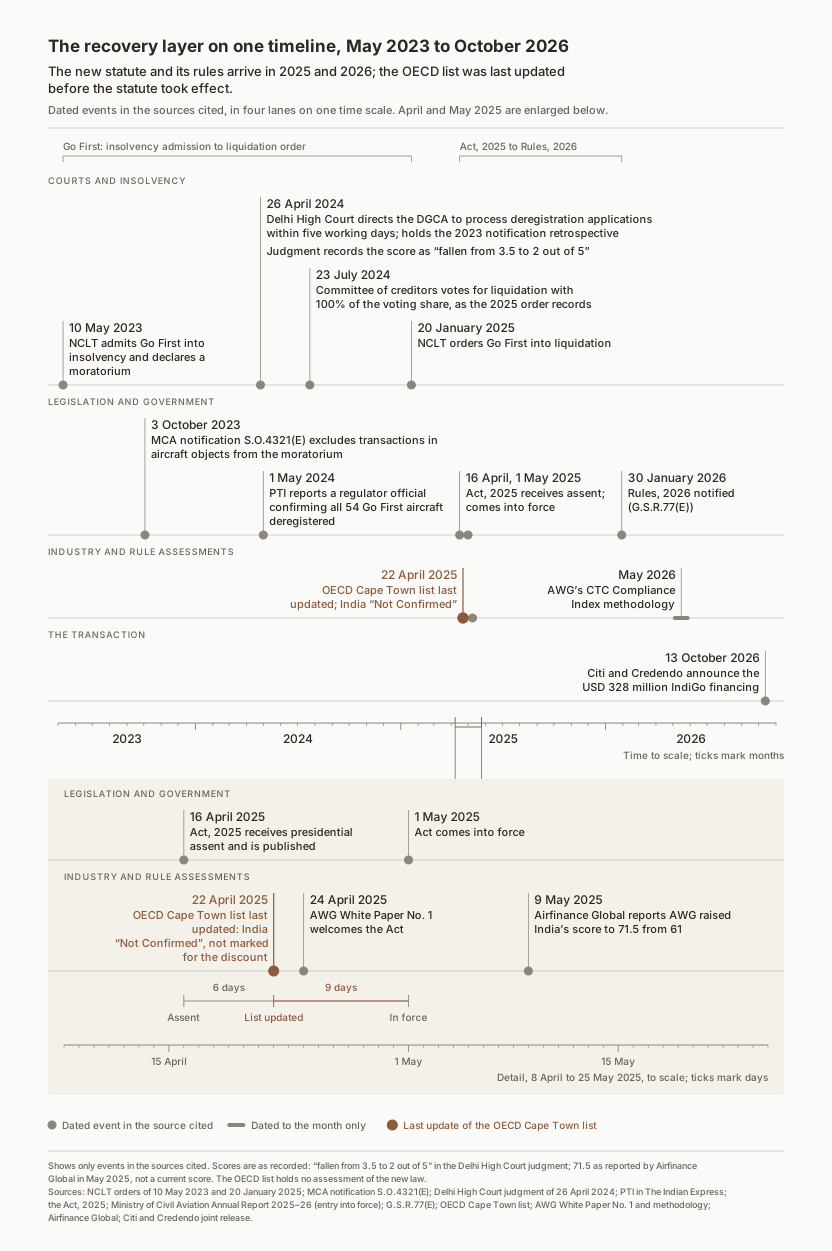
Figure 1. India’s new statute and its rules arrive in 2025 and 2026, while the OECD Cape Town list was last updated on 22 April 2025, six days after the Act received assent and nine days before it came into force. Only events in the sources cited are shown.
The case for GIFT as the engine
The strongest objection to this reading holds that GIFT is the engine. Without GIFT’s licensing and booking arrangements, the structure could not have been built: IndiGo’s subsidiary holds an IFSCA licence, owns aircraft and leases them to the parent, and the transaction was executed through it. Two of the three parties, Citi and IndiGo, tied the deal to GIFT in their own words, Citi to India’s GIFT policy and IndiGo to GIFT IFSC’s potential to bring banks and export credit agencies together. IndiGo has committed to the venue at scale, with USD 820 million allocated in FY2025–26 for aircraft purchases through its GIFT entity. On this view, export credit arrived because GIFT made Indian airline risk bookable in a form an export credit agency could accept, and more of it will follow by the same route.
GIFT made the structure possible; the record does not establish it as Credendo’s reason for insuring. GIFT’s regime was the common precondition of every GIFT deal in Table 1, and four of the five disclosed no export credit support. A precondition common to all five cannot explain why export credit appears in only one of them. GIFT explains where the deal could be booked. Why an export credit agency would insure it is a separate question, and the record answers it once, in Credendo’s words, pointing to Belgium. Evidence that GIFT is the engine would look different: an export credit agency naming GIFT as a reason to underwrite, or similar cover on a deal with no link to an export interest. Neither is in the record.
What passes to the next borrower
Only the venue passes. A lender, an export credit insurer and an airline’s IFSC subsidiary have shown once that an export-credit-insured aircraft financing can be booked through a GIFT IFSC leasing structure, and the next bank to try will not have to prove that again. The export credit layer itself stays with the deal. Its reason was Credendo’s own, its cover and price were never published, and the credit beneath it was IndiGo’s, so the next borrower negotiates the reason, the cover and the price afresh. Export credit is a minority source to begin with: Boeing’s outlook estimates its share of delivery financing for Boeing, Airbus and Embraer deliveries, by value, at between 3% and 6% in each year from 2022 to 2025.
Table 1 can now record an export-credit-backed aircraft financing through GIFT. It cannot record the terms that would let a lender price the next one by comparison. That is the limit of this precedent, and the point at which the public story becomes a question for the next credit committee. Read across its GIFT rows, the table also shows what a financial centre’s track record is made of. Each row records lenders, lessors and insurers agreeing to carry their part of a risk on a deal booked there; it shows where each decision was booked, not why it was taken. For the one GIFT row with export credit, the only reason on record lies in Belgium. GIFT City was where the coverage placed this story. The reason that made it an export credit story came from somewhere else.
The next attempt to bring export credit into an Indian airline’s aircraft-delivery financing through GIFT will test that limit at a bank’s credit committee and an export credit agency’s underwriting review. The October deal can be cited there for the booking route it established. The next airline’s credit, and the reason and terms on which an agency would insure it, will have to be weighed on their own evidence.
The account that committee is likely to start from is already circulating. Indian financial media and trade briefs hold a reading shaped by the joint release and the words of Citi and IndiGo, in which GIFT has brought export-credit-backed liquidity to Indian aviation finance. In the sources reviewed through 16 October 2026, there is no rating action, transaction law-firm note or independent lessor commentary specific to the deal, and its insurance price was not disclosed. The likeliest mistake is to let the venue stand in for the underwriting reason, as if another airline using GIFT could obtain export credit insurance on the same footing as IndiGo. The release’s carefully limited first can also grow in the retelling, losing one of its three conditions, export credit backing, aircraft financing and a GIFT IFSC leasing structure, until it sounds like a first for India or for GIFT generally.
If a mandate were built on that reading, the difference would emerge when the agency specified its own cover, risk categories and premium, under OECD rules whose prevailing Cape Town list does not mark India for the discount. The bank’s credit team and the agency’s underwriter would see it first, and rework, delay and repricing would follow for a mandate that had assumed terms the October announcement never disclosed. A lessor assessing recovery would still be working from Go First, the 2025 Act and the 2026 Rules, since this deal added no new public evidence on that layer. October put one mark in GIFT City’s export-credit column. The next mark, if there is one, will depend on an agency’s decision to insure another airline’s risk, on terms that can pass a bank’s credit committee and the agency’s underwriting review.
Sources
- Citi and Credendo, joint press release announcing the USD 328 million financing for eight IndiGo Airbus aircraft, 13 October 2026. https://credendo.com/sites/default/files/media/files/2026-10/Citi%20and%20Credendo%20Announce%20Landmark%20USD%20328%20Million%20-%20Press%20Release%20(003).pdf (accessed 17 October 2026)
- Credendo, article on its support for the Belgian aeronautics sector, 13 October 2026. https://credendo.com/en/knowledge-hub/credendo-increases-support-belgian-aeronautics-sector (accessed 17 October 2026)
- Business Standard, Subrata Panda, report on the Citi and Credendo financing for eight IndiGo jets through GIFT City, 13 October 2026. https://www.business-standard.com/amp/industry/aviation/citi-credendo-close-328-mn-deal-for-eight-indigo-jets-through-gift-city-126101301169_1.html?isa=yes (accessed 17 October 2026)
- The Economic Times, PTI report on IndiGo’s USD 328 million finance deal with Citi for eight Airbus aircraft, 13 October 2026. https://economictimes.indiatimes.com/industry/transportation/airlines-/-aviation/indigo-signs-328-million-finance-deal-with-citi-for-8-airbus-aircraft-buys/articleshow/134913722.cms (accessed 17 October 2026)
- Mint, Subhana Shaikh, report on the Citi and Credendo financing of eight IndiGo Airbus jets, 13 October 2026. https://www.livemint.com/companies/news/citi-and-credendo-close-328-million-deal-to-finance-indigo-s-8-airbus-jets-11791883975762.html (accessed 17 October 2026)
- BCR Publishing, report on IndiGo’s Citi and Credendo export credit financing, 13 October 2026. https://bcrpub.com/news/indigo-closes-us328m-citi-and-credendo-export-credit-financing/ (accessed 17 October 2026)
- AviTrader, report on the Citi and Credendo financing of eight IndiGo Airbus aircraft, 14 October 2026. https://avitrader.com/2026/10/14/citi-and-credendo-to-finance-eight-indigo-airbus-aircraft/ (accessed 17 October 2026)
- Air India, press release on the acquisition of its first A350-900 through GIFT IFSC, 29 September 2023. https://www.airindia.com/in/en/newsroom/press-release/a350-acquisition-gift-ifsc.html (accessed 17 October 2026)
- Airfinance Global, Olivier Bonnassies, “Exclusive: Indigo closes inaugural GIFT City financing”, 23 August 2024. https://platform.airfinanceglobal.com/Widget/SaveAsPDF/3594667 (accessed 17 October 2026)
- Boeing, Commercial Aircraft Finance Market Outlook 2026. https://www.boeing.com/content/dam/boeing/v2/products/current-aircraft-financing-market/pdf/commercial-aircraft-finance-market-outlook-2026.pdf (accessed 17 October 2026)
- Standard Chartered and Bank of India, announcement of the USD 215 million aircraft financing for AI Fleet Services, 15 October 2025. https://www.sc.bank.in/news-media/sc-and-bank-of-india-announce-landmark-aircraft-financing/ (accessed 17 October 2026)
- Clifford Chance, announcement on advising SMBC on a JOLCO transaction for IndiGo through GIFT City, 6 March 2026. https://www.cliffordchance.com/news/news/2026/03/clifford-chance-advises-smbc-on-first-of-its-kind-jolco-transaction-for-indigo-in-india.html (accessed 17 October 2026)
- CALC, press release on its first export-credit-supported financing, for an A320 leased to Air India, 31 March 2015. https://calc.aero/?id=119&route=press_detail (accessed 17 October 2026)
- IndiGo (InterGlobe Aviation), Annual Report 2025–26, filed with the National Stock Exchange of India on 28 July 2026. https://nsearchives.nseindia.com/annual_reports/AR_30032_INDIGO_2025_2026_A_16514151_28072026132713.pdf (accessed 17 October 2026)
- IndiGo (InterGlobe Aviation), Annual Report 2024–25, filed with the National Stock Exchange of India on 26 July 2025. https://nsearchives.nseindia.com/annual_reports/AR_27116_INDIGO_2024_2025_A_26072025103933.pdf (accessed 17 October 2026)
- IndiGo, disclosure to the National Stock Exchange of India attaching Moody’s periodic review of 30 April 2026, filed 1 May 2026. https://nsearchives.nseindia.com/corporate/Indigo1_01052026153930_StxDisclosureCreditRatingMoodys-010526.pdf (accessed 17 October 2026)
- ICRA, rating rationale for InterGlobe Aviation Limited (change in limits), 23 September 2026. https://www.icra.in/Rating/GetRationalReportFilePdf?Id=145809 (accessed 17 October 2026)
- Crisil Ratings, rating rationale for InterGlobe Aviation Limited, 25 September 2026. https://www.crisilratings.com/mnt/winshare/Ratings/RatingList/RatingDocs/InterGlobeAviationLimited_September%2025_%202026_RR_405451.html (accessed 17 October 2026)
- OECD, Arrangement on Officially Supported Export Credits, TAD/PG(2026)1, including Annex III, the Sector Understanding on Export Credits for Civil Aircraft, version dated 26 January 2026. https://one.oecd.org/document/TAD/PG(2026)1/en/pdf (accessed 17 October 2026)
- OECD, aircraft-specific rules page, linking the prevailing Cape Town list. https://www.oecd.org/en/topics/sub-issues/aircraft-specific-rules.html (accessed 17 October 2026)
- OECD, “Prevailing List of States qualifying for the Cape Town Discount”, last updated 22 April 2025. https://www.oecd.org/content/dam/oecd/en/topics/policy-sub-issues/aircraft-specific-rules/025-ctc-22april2025.pdf (accessed 17 October 2026)
- National Company Law Tribunal, order admitting Go Airlines (India) Limited into insolvency, CP(IB)-264(PB)/2023, 10 May 2023. https://technicul-s3-live.s3.ap-south-1.amazonaws.com/GoAir/Storage/file/goJgeMSzM2VMl2CKSeoKXIZD55axxjvYVeJVGUSv.pdf (accessed 17 October 2026)
- Ministry of Corporate Affairs, notification S.O.4321(E) on aircraft transactions and the insolvency moratorium, 3 October 2023. https://ibbi.gov.in/uploads/legalframwork/8273e42bb4de11d39f37ab81f96f93ec.pdf (accessed 17 October 2026)
- Delhi High Court, judgment in Accipiter Investments Aircraft 2 Limited and others v Union of India and others, 26 April 2024. https://ibbi.gov.in/uploads/order/0cef8d314164c186f140ff4b32c64e70.pdf (accessed 17 October 2026)
- The Indian Express, PTI report that the DGCA deregistered all 54 Go First aircraft, 1 May 2024. https://indianexpress.com/article/business/aviation/dgca-deregisters-bankrupt-go-first-54-planes-9302025/ (accessed 17 October 2026)
- National Company Law Tribunal, liquidation order for Go Airlines (India) Limited, 20 January 2025. https://nclt.gov.in/gen_pdf.php?filepath=/Efile_Document/ncltdoc/casedoc/0710102057052023/04/Order-Challenge/04_order-Challange_004_17373754971966884142678e3f090333e.pdf (accessed 17 October 2026)
- The Protection of Interests in Aircraft Objects Act, 2025, Gazette of India, 16 April 2025 (PRS Legislative Research copy). https://prsindia.org/files/bills_acts/bills_parliament/2025/Protection_of_Interests_in_Aircraft_Objects_Act,2025.pdf (accessed 17 October 2026)
- Ministry of Civil Aviation, Annual Report 2025–26. https://www.civilaviation.gov.in/sites/default/files/2026-04/annual-report-english-2025-moca.pdf (accessed 17 October 2026)
- Ministry of Civil Aviation, notification G.S.R.77(E), the Protection of Interests in Aircraft Objects Rules, 2026, 30 January 2026. https://www.civilaviation.gov.in/sites/default/files/2026-02/gazette-notification-of-the-protection-of-interests-in-aircraft-objects-rules-2026.pdf (accessed 17 October 2026)
- Aviation Working Group, White Paper No. 1 on the interpretation of the Protection of Interests in Aircraft Objects Act, 2025, 24 April 2025. https://awg.aero/wp-content/uploads/2025/04/AWG-White-Paper-limited-version-interpretation-only.pdf (accessed 17 October 2026)
- Airfinance Global, Dominic Lalk, “AWG upgrades India’s CTC compliance score”, 9 May 2025. https://platform.ishkaairfinance.com/Widget/SaveAsPDF/3596828 (accessed 17 October 2026)
- Aviation Working Group, CTC Compliance Index methodology, May 2026. https://ctc-compliance-index.awg.aero/CTC%20Compliance%20Index%20-%20Methodology.pdf (accessed 17 October 2026)