Four Families of Narrative Intervention
Interventions differ by what they change, not by how they look. Four kinds of work behind familiar moves, and why one move can read differently across audiences.
When an institutional outcome refuses to move, communication is often the first remedy.
The instinct is understandable. A communications plan converts an ambiguous problem into work that can be assigned, measured, and reported. The company can sharpen its explanation, assemble stronger materials, brief its executives, and reach a wider set of audiences. Progress becomes visible.
Yet the consequential judgment may remain almost exactly where it was. The financing committee applies the same discount. A licensing authority returns with the same conditions. A market-entry process continues to stall for reasons the commercial plan does not explain. The materials improve, but the constraint governing the outcome does not.
This does not make the communications work misguided. It may have solved a real problem. The harder possibility is that the company improved its expression while the judgment rested on something else: whether the company was entitled to shape the discussion, whether its presence was considered dangerous, whether its claims carried weight beyond management assertion, or whose interpretation organized the decision.
Those are different problems. They require different kinds of work.
The question before the remedy
Public advice tends to begin after a situation has already been named. A crisis calls for a response. A reputation gap calls for correction. An unclear business calls for a stronger corporate story. Once the category has been selected, each discipline offers a developed set of practices.
Any of those diagnoses may fit. A company may need to answer a specific charge, replace stale information, or explain a business that important audiences have never properly understood. Crisis response, reputation work, and corporate storytelling solve such problems every day.
The difficulty arises when the initial label is too broad. A “perception problem” may describe the management team’s discomfort without identifying the judgment that matters, the institution forming it, or the reason the judgment persists. More communication then becomes a general treatment for conditions that only look similar from inside the company.
Consider a regulatory submission that is received and read, but answered only in form. The company’s evidence enters the file, yet its questions do not structure the review and its reasoning attracts no substantive response. Elsewhere, an authority may accept the company’s technical account while continuing to regard the proposed arrangement as dangerous. A lender may find management’s explanation plausible but give it little evidentiary weight. In another case, the company’s account may be taken seriously throughout the process, while the final decision is organized around a classification supplied by someone else.
The outward response in each case can look much the same: clearer language, more evidence, broader circulation, new messengers. The object that needs to change is different.
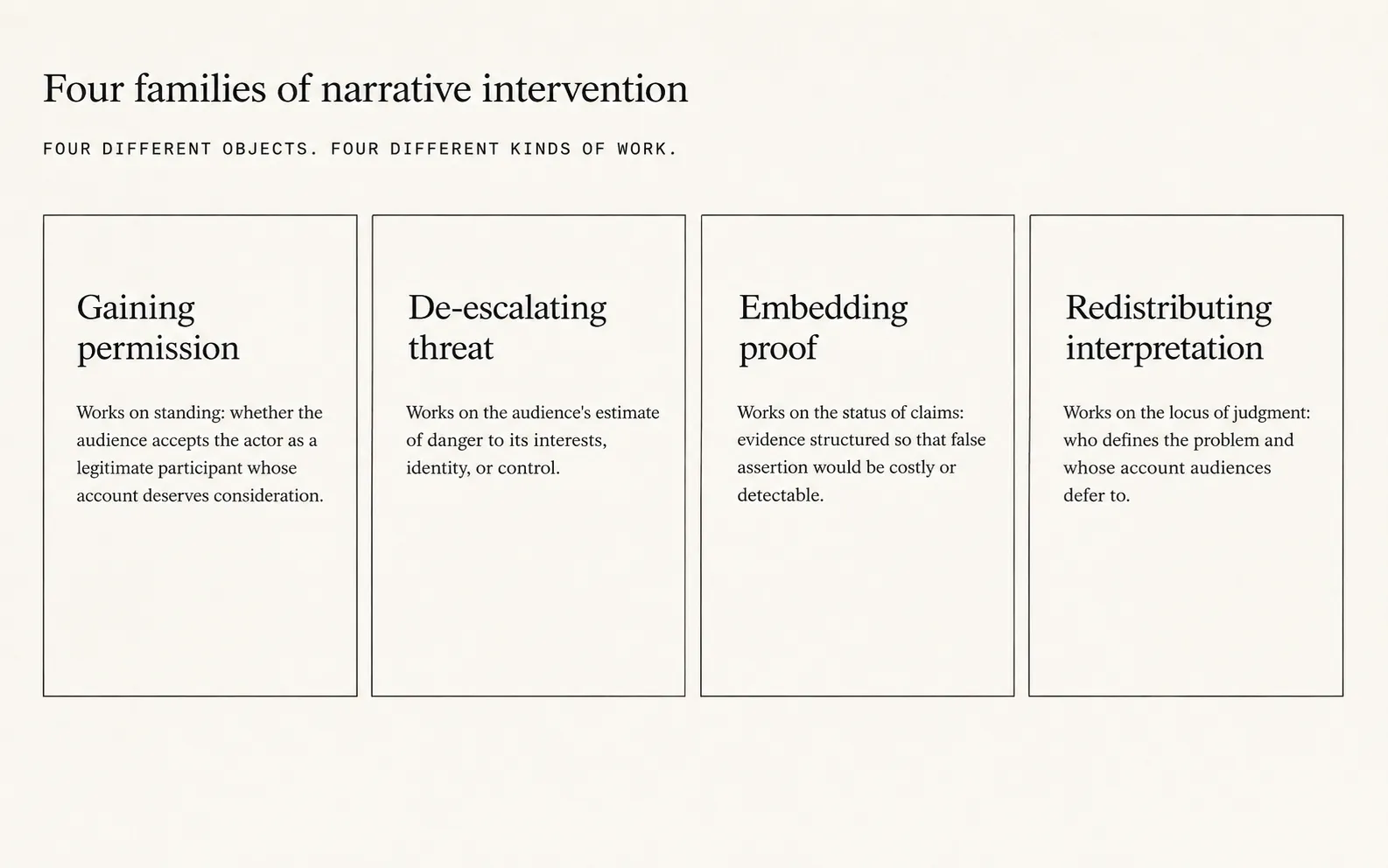
Interventions fall into four families: gaining permission, de-escalating threat, embedding proof, and redistributing interpretation. Which family fits depends on the power scenario at hand. The grouping is an analytical synthesis rather than a taxonomy drawn intact from a single literature. Its mechanisms are informed by research on legitimacy, threat and reassurance, signaling and credible commitment, and framing authority.
Gaining permission
Participation does not guarantee standing.
A company may be invited to a consultation, permitted to submit evidence, or given time before a committee. These procedural openings establish that it can speak. They reveal less about whether the institution treats it as a participant whose account deserves serious consideration.
Standing becomes visible in the response. Questions receive substantive answers. Evidence is examined on its merits rather than discounted because of its source. Other participants must address the company’s reasoning instead of merely acknowledging that it was submitted. The company may still lose the argument, but it has entered the argument as a recognized party.
This judgment attaches to roles as much as organizations. A manufacturer may be accepted as a commercial operator while carrying little authority on public risk. A technology company may be treated as a useful technical contributor but excluded from defining the policy problem. A foreign investor may be welcome as a source of capital and viewed with suspicion as a participant in strategic infrastructure.
Standing also changes across institutional environments. Recognition in one market does not travel automatically to another, because each setting has its own account of who may speak credibly, in what capacity, and on which questions. In cross-border situations, a position that strengthens legitimacy with one audience can complicate it with another.
Gaining permission therefore reaches beyond the quality of the message. It may depend on conduct, authorization, local relationships, institutional role, or a record of participation that changes how the speaker is classified. Communication can make those changes legible. It rarely creates them by itself.
Permission should also be kept separate from interpretive control. An institution may take a company’s submissions seriously and still reject the company’s account of what the issue fundamentally is. Standing determines whether the contribution must be engaged. It does not determine which account will govern the conclusion.
De-escalating threat
An audience can accept the facts and remain deeply uneasy about what they imply.
A regulator may agree that sensitive data is stored locally and still worry about future access. A commercial partner may accept the projected economics of an arrangement while fearing dependence on a supplier it cannot replace. A community may accept an environmental assessment and still see the project as a loss of control over decisions that shape its future.
In such cases, further explanation often has diminishing value. The concern is attached to anticipated harm: to interests, identity, autonomy, control, or the unpredictability of future conduct. The audience may understand the company perfectly well.
De-escalating threat changes that estimate of harm. Sometimes the estimate rests on incorrect information. A clear account, supported by credible evidence, may be enough to revise it. In other cases, the concern is substantially grounded. The intervention then has to reach the source of exposure: governance, ownership, access, operating practice, concentration, dependency, or the discretion the company retains.
A change in governance can reduce the company’s capacity to act in ways the audience fears. A contractual right can give a counterparty recourse. A more diversified arrangement can reduce dependence. These are narrative interventions only in the broader sense that they change the relationship from which the narrative is formed. Their effect comes from altering what the audience expects could happen.
Not every conflict can be designed away. Interests may remain opposed. Even then, escalation is not inevitable. Anxiety can fall, motives can become more predictable, and disagreement can be contained within a narrower institutional question rather than expanding into a general judgment about the company.
This is where de-escalating threat differs from embedding proof. A safeguard may perform both kinds of work, but the mechanisms are distinct. It reduces threat when it lowers the probability, scale, or reach of the feared harm. It embeds proof when it gives the audience a stronger basis for believing the company’s commitments. One changes the exposure. The other changes the grounds of belief.
Embedding proof
Many corporate claims are perfectly intelligible. Their weakness is that the company remains the principal reason to believe them.
A lender may understand management’s account of supply-chain resilience. An approval authority may find a compliance commitment plausible. A partner may accept that the company intends to preserve local operations after an acquisition. Each claim can be coherent, detailed, and supported by internal records. It may still remain a management representation.
The vulnerability lies less in the content of the claim than in what the claim asks the audience to take on trust.
Embedding proof changes the status of that claim. Evidence is generated, verified, monitored, or enforced through a structure the company cannot freely rewrite. This may involve an independent review, contractual consequences, governance rights, external monitoring, public reporting against a defined standard, or a commitment whose breach becomes visible to parties with the ability to act.
Cost sometimes matters, but expense is not proof. A large investment may demonstrate capacity or seriousness without establishing the truth of the underlying claim. The more useful question is whether the arrangement separates a company that means what it says from one that can merely say it well.
That separation can come from several sources. The verifier may operate independently. The commitment may constrain future conduct. Performance may be observable on someone else’s timetable. Failure may trigger consequences beyond reputational embarrassment. What matters is that the company no longer controls both the assertion and the test.
Proof remains specific to the receiver. An audit carries weight only to the extent that the audience accepts the auditor’s independence, the scope of the work, and the standards applied. A certification may satisfy a customer and leave a regulator unmoved. A contractual commitment may look strong until the audience examines the jurisdiction, enforcement process, or counterparty incentives behind it.
For this reason, adding evidence is not the same as increasing evidentiary weight. A company can disclose thousands of pages and still leave the audience dependent on the company’s own account of what those pages establish. Transparency makes information available. Proof changes the basis on which a claim can be judged.
Redistributing interpretation
Even a credible participant with strong evidence may have limited control over what the evidence comes to mean.
Institutional decisions require more than facts. Someone defines the problem, connects events to causes, selects the relevant comparison, and decides which risks deserve weight. Those choices may appear in committee papers, approval conditions, standards, guidance, or the language of a formal decision. By the time the outcome is announced, much of the interpretive work has already been done.
A company can contribute extensively to the record while another actor supplies its organizing logic. Its facts are cited, but under a classification it did not shape. Its proposed remedy is evaluated against an account of the problem supplied by a regulator, local institution, industry body, adviser, or recognized expert. The company has standing. Its claims may even be believed. The operative interpretation still comes from elsewhere.
Redistributing interpretation changes the source from which that judgment is drawn.
This is not achieved by multiplying spokespeople. A group of outside voices can repeat company language without acquiring any independent authority. The number of speakers rises; the location of judgment stays where it was.
A genuine interpreter develops an account that is visibly its own. Independence includes the capacity to qualify the company’s claims, use different language, narrow the argument, or disagree. That friction is part of what makes the interpretation usable. An audience that can see the limits of the relationship has more reason to treat the resulting judgment as something other than coordinated advocacy.
Interpretive authority can move through people, institutions, or procedures. An expert’s reasoning may enter a regulator’s analysis. A local institution may recast a company’s role in terms that carry standing within the market. A standards process may establish categories that allow the company’s evidence to be evaluated differently. A committee may adopt a new definition of the relevant risk.
The company does not need to become the dominant interpreter for movement to occur. Often the more credible outcome is that another institution develops an account the company could not have authored persuasively for itself.
The visible action is only the surface
The four families describe the work an intervention performs. They are not lists of tactics.
An independent audit may embed proof by changing the evidentiary status of a claim. It may also redistribute interpretation if the auditor becomes a source the relevant institution relies upon. A local partnership may improve standing, reduce fears of exclusion or dependence, and introduce an interpreter with authority the company lacks. A governance concession may reduce actual exposure while making a commitment more credible.
The action alone does not reveal the mechanism. Its significance depends on what changes in the relationship after it occurs.
This also means the families overlap. A single intervention can affect several objects, and the same visible move can operate differently across audiences. Evidence that reassures a lender may prompt a regulator to ask why exceptional verification was required. A partnership that strengthens legitimacy in one market may be read elsewhere as evidence of political alignment. An independent review can carry authority with one institution and look commissioned or ceremonial to another.
There is therefore no universal matching rule. Selecting an intervention requires a reading of the particular audience, the decision it controls, the powers available to it, the sources it treats as credible, and the reactions the intervention may create among other observers.
The depth of the work matters as well. Some problems sit primarily in expression. Wording, sequence, emphasis, or choice of messenger may genuinely be the constraint. Other problems rest on commitments, evidence, relationships, governance, or institutional authority. A clearer account can explain a structural change. It cannot create one.
Many failed interventions are substitutions across these levels. More communication is offered where standing is weak. Disclosure is presented where the audience is looking for independent verification. A technical answer is refined for an objection rooted in dependence or control. A respected messenger repeats a company-authored account where the institution is waiting for an interpretation formed outside the company.
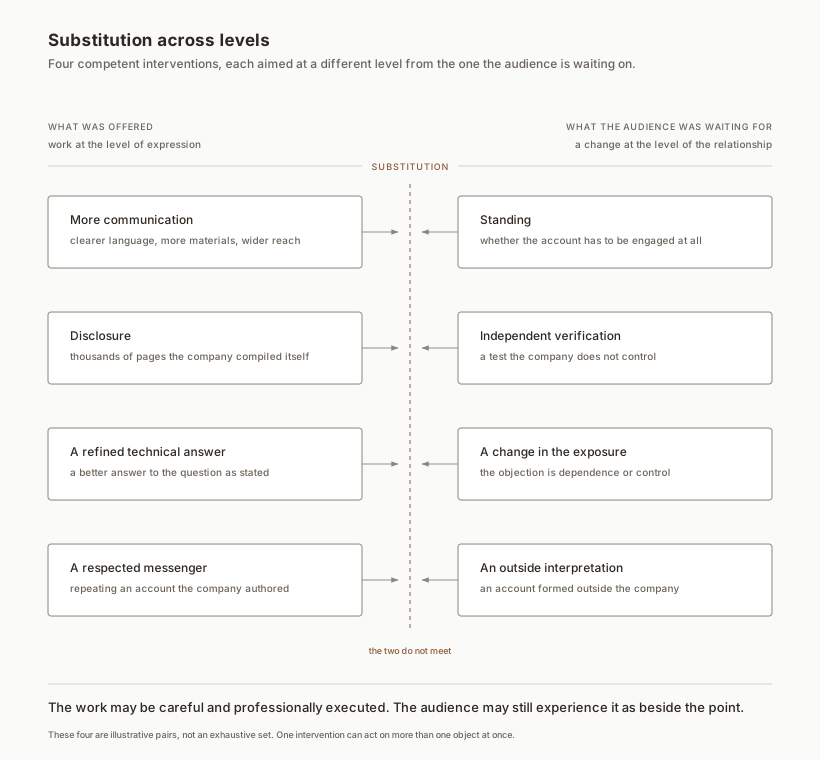
The work may be careful and professionally executed. The audience may still experience it as beside the point.
Before any of this applies
The four-family distinction becomes useful only after the problem has been established as a material narrative obstacle.
Some adverse judgments are substantially accurate. A product may be unsafe, a governance arrangement may create genuine exposure, or a business model may depend on conduct an audience reasonably rejects. The primary intervention is then to change what is true. Communication can document the change, clarify its limits, and make progress visible. It cannot substitute for the underlying work.
Other difficulties are narrower. Stale records, poor discoverability, missing information, or factual inaccuracies may require communications, legal, technical, or administrative correction without changing the power relationship around the decision. Fabricated claims may call for legal, regulatory, or security action depending on their source and effect.
Where immediate safety, operational continuity, or physical harm is at issue, the operational response takes priority.
A company may also dislike an account that does not materially constrain it. The description may carry little stigma, reveal no meaningful legitimacy gap, or matter chiefly to audiences with limited authority over the outcome. Engaging it can consume attention and sometimes increase its reach. Narrative intervention is not justified by discomfort alone.
Whether a real obstacle exists is examined in what makes a real narrative obstacle. The five narrative power scenarios considers which audience relationship governs the outcome. The scope and output of an engagement are described in what an NPA engagement examines.
A difficult label often sends a company searching for a message, a messenger, or a campaign. Those choices become useful only after the preceding judgment has been made: what in this relationship would have to become different before the consequential reading could move?
Only then does communication become part of an intervention rather than a substitute for one.
Understand the method: Narrative Problems Are Power Problems | See it applied: Passing the Wrong Examination | Evaluate fit: What an NPA Engagement Examines and Produces
Reading list
The four families are this method’s grouping; each mechanism rests on an established literature. These eight works anchor them.
-
Mark C. Suchman (1995), “Managing Legitimacy: Strategic and Institutional Approaches,” Academy of Management Review, 20(3), 571-610.
-
Tatiana Kostova and Srilata Zaheer (1999), “Organizational Legitimacy Under Conditions of Complexity: The Case of the Multinational Enterprise,” Academy of Management Review, 24(1), 64-81.
-
Thomas F. Pettigrew and Linda R. Tropp (2006), “A Meta-Analytic Test of Intergroup Contact Theory,” Journal of Personality and Social Psychology, 90(5), 751-783.
-
Andrew Kydd (2000), “Trust, Reassurance, and Cooperation,” International Organization, 54(2), 325-357.
-
Michael Spence (1973), “Job Market Signaling,” The Quarterly Journal of Economics, 87(3), 355-374.
-
Oliver E. Williamson (1983), “Credible Commitments: Using Hostages to Support Exchange,” American Economic Review, 73(4), 519-540.
-
Robert M. Entman (1993), “Framing: Toward Clarification of a Fractured Paradigm,” Journal of Communication, 43(4), 51-58.
-
James N. Druckman (2001), “On the Limits of Framing Effects: Who Can Frame?” The Journal of Politics, 63(4), 1041-1066.